

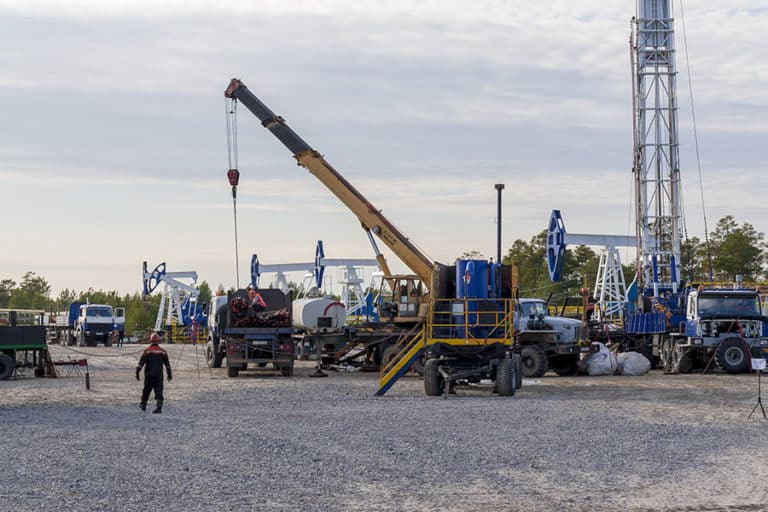
Every construction site manager has watched it happen: a 200-ton crane settles into soft ground, operations halt, and the project timeline extends by days while crews scramble to remediate a failed equipment pad. The engineering challenge is straightforward but expensive to solve with conventional methods—how do you create stable working platforms for heavy equipment on sites with variable or weak subgrades without pouring concrete that you’ll demolish when the project ends?
Heavy equipment pads require ground stabilization systems that distribute concentrated point loads across weak subgrades while resisting the cyclic loading and outrigger pressures that cause bearing capacity failures. BaseCore HD™ Geocell achieves this through three-dimensional cellular confinement, delivering H-20+ load capacity at 4–6 inches of cell depth—reducing aggregate requirements by 40–60% compared to unreinforced granular bases while providing a removable, reusable foundation system that eliminates demolition costs on temporary installations.
This article covers the geotechnical engineering principles behind equipment pad failures, how cellular confinement technology addresses these failure modes, and practical specification guidance for engineers and contractors designing heavy equipment pads for construction sites, staging areas, and temporary crane platforms.
The Geotechnical Challenge: Why Conventional Equipment Pads Fail
Heavy equipment pads present a specific geotechnical problem that differs fundamentally from road or pavement design. While roads distribute loads across relatively wide contact areas through tire footprints, equipment pads must handle concentrated point loads from outriggers, crane mats, and stabilizer feet—often exceeding 100 PSI at the pad surface.
The physics follow Boussinesq stress distribution: vertical stress applied at the surface propagates downward through the soil mass in a bulb-shaped pattern, with stress intensity decreasing as depth increases. In unreinforced granular bases, this stress spreads at approximately a 1:1 angle (45 degrees from vertical), meaning a 100 PSI surface load still delivers roughly 25 PSI to a subgrade 12 inches below the surface.
For construction sites with weak native soils—classified by USDA as having CBR values below 3—this stress concentration exceeds the subgrade’s bearing capacity, triggering the failure modes that halt equipment operations:
- Punching shear failure — Outrigger pads penetrate through the base course into soft subgrade, creating localized depressions that destabilize equipment
- General shear failure — The entire loaded area settles as subgrade soil displaces laterally, causing equipment tilting and safety concerns
- Rutting under cyclic loading — Repeated equipment movement progressively densifies loose areas while displacing material from loaded zones, creating an uneven working surface
- Aggregate migration — Unreinforced granular bases allow lateral aggregate displacement under concentrated loads, reducing effective base thickness over time
The conventional engineering response is to increase base course thickness—sometimes to 18–24 inches of compacted aggregate on weak subgrades—or to pour reinforced concrete pads. Both approaches work mechanically but carry significant project costs: concrete requires curing time that delays equipment mobilization, demolition costs on temporary sites, and disposal of construction debris. Thick aggregate lifts require extensive trucking, extended compaction time, and often prove impractical on sites with limited staging area or access constraints.
The U.S. Army Corps of Engineers recognized this problem in the 1970s when they began researching cellular confinement systems for rapid deployment of temporary roads and equipment platforms on weak soils—the research that eventually led to modern geocell technology.
How Geocell Technology Delivers Equipment Pad Stability
Cellular confinement fundamentally changes the load distribution mechanics that govern equipment pad performance. Rather than relying solely on aggregate particle interlock—which fails under concentrated loads—geocell systems create a three-dimensional structural matrix that distributes loads through three distinct engineering mechanisms.
Mechanism 1: Cellular Confinement
The HDPE cell walls physically prevent lateral displacement of infill aggregate under load. When an outrigger applies vertical pressure to a geocell-reinforced base, the aggregate particles attempt to move horizontally—but the cell walls resist this movement, dramatically increasing the confined stiffness of the aggregate mass.
This confinement effect increases the apparent cohesion of cohesionless fill materials. Granular aggregate that would behave as a loose, easily displaced material in an unreinforced configuration instead acts as a semi-rigid structural layer when confined within geocell walls.
Mechanism 2: Beam Action
Interconnected geocell panels function as a flexible structural slab, distributing point loads laterally across adjacent cells rather than transmitting them directly to the subgrade below the loaded area. This beam action spreads concentrated outrigger loads across a much wider subgrade area than the contact footprint alone.
The practical effect: a 12-inch diameter outrigger pad applying 50,000 pounds becomes distributed across several square feet of subgrade rather than the 113 square inches of direct contact area—reducing peak subgrade stress by 60–80% compared to unreinforced configurations.
Mechanism 3: Membrane Effect
Under load, the tensioned HDPE cell walls redistribute vertical forces as tensile stresses through the geocell panel. This membrane effect adds structural capacity beyond what the infill aggregate alone provides, creating a composite system where the geocell and aggregate work together to resist deformation.
BaseCore HD™ Geocell leverages these three mechanisms to deliver a published structural layer coefficient of 0.35—meaning 1 inch of geocell-reinforced base provides equivalent structural capacity to approximately 2 inches of unreinforced aggregate base course according to AASHTO pavement design methodology.
For equipment pad applications, this translates to H-20+ load capacity at 4–6 inches of geocell depth on subgrades with CBR values as low as 1–3. Conventional unreinforced aggregate sections would require 12–18 inches or more to achieve equivalent performance on the same weak subgrades.
The load distribution improvement is measurable: geocell confinement increases the effective load dispersion angle from the typical 1:1 ratio in unreinforced bases to approximately 1.5:1 or greater, spreading surface loads across a wider subgrade area and keeping peak stresses within the native soil’s bearing capacity.
BaseCore’s engineering team provides free project evaluations for equipment pad design, including geocell depth recommendations based on your site’s CBR data and expected loading. Request a quote at basecore.co/quick-basecore-quote or call 888-511-1553.
Specifying Geocell for Heavy Equipment Pad Applications
Proper specification of geocell-stabilized equipment pads requires matching system depth to the combination of expected loading, subgrade conditions, and performance requirements. Engineers and contractors should consider these design parameters when developing equipment pad specifications.
Load Classification and Geocell Depth Selection
Equipment pad loading varies dramatically across applications. A construction site crane pad supporting a 300-ton crawler crane imposes fundamentally different demands than a staging area for skid-steer operations. BaseCore HD™ Geocell depth recommendations follow this relationship between load intensity and subgrade strength:
- Light equipment (under 20,000 lb gross weight) — 3–4 inch geocell depth typically sufficient on subgrades with CBR ≥3
- Medium equipment (20,000–60,000 lb) — 4–6 inch geocell depth on moderate subgrades (CBR 2–5)
- Heavy equipment and outrigger loads (60,000+ lb) — 6–8 inch geocell depth, often combined with BaseGrid™ geogrid subgrade reinforcement on very weak soils (CBR <2)
- Crane outriggers with concentrated point loads — 6+ inch geocell depth with engineered outrigger pads to distribute load across multiple cells
These recommendations assume proper infill compaction and adequate drainage. Site-specific factors—including cyclic loading frequency, dynamic impact loads, and environmental conditions—may require engineering adjustment.
Subgrade Preparation Requirements
Geocell performance depends on proper subgrade preparation. The native soil surface must be proof-rolled to identify soft spots, graded to provide positive drainage, and prepared to receive the geocell system:
A separation geotextile should be installed between the subgrade and geocell layer on fine-grained soils (silts and clays) to prevent subgrade intrusion into the aggregate infill. This geotextile maintains the structural integrity of the base course over time by preventing pumping of fines into the aggregate matrix under cyclic loading.
On extremely weak subgrades (CBR <1), consider a two-layer system: geogrid placed directly on the subgrade to provide tensile reinforcement, followed by geotextile separation fabric, then geocell with aggregate infill. This stacked approach addresses both tensile weakness in the subgrade and the need for three-dimensional load distribution at the surface.
Infill Material Selection
The aggregate infill material significantly affects equipment pad performance. For heavy equipment applications, specify well-graded crushed aggregate meeting these general parameters:
- Particle size — 3/4-inch minus to 1.5-inch minus crushed stone, depending on geocell depth and loading
- Gradation — Well-graded aggregate with adequate fines content (8–15% passing #200 sieve) to facilitate compaction while maintaining drainage
- Hardness — Crusite or similar hard, angular aggregate for maximum interlock and resistance to degradation under cyclic loading
- Compaction — Target 95% Standard Proctor density minimum for heavy equipment pad applications
Rounded river gravel should generally be avoided for equipment pads—the smooth particle surfaces provide less interlock and more susceptibility to lateral displacement under concentrated loads than angular crushed material.
Installation Methodology
The geocell installation process for equipment pads follows a systematic sequence designed to maximize system performance:
- Site preparation — Clear vegetation, proof-roll subgrade, identify and remediate soft areas, grade to provide minimum 2% cross-slope for drainage
- Geotextile placement — Roll out separation fabric with 12-inch minimum overlaps at seams, secure temporarily with pins or aggregate
- Geocell deployment — Expand panels to full dimension, connect adjacent panels using manufacturer-specified connectors (J-pins, spiral binders, or polymer clips depending on product)
- Anchoring — Stake perimeter cells and periodically throughout the panel on slopes or areas subject to lateral loading
- Fill and compact — Place aggregate infill in lifts, overfilling cells by 1–2 inches, compact with vibratory plate or smooth drum roller
- Surface treatment — Apply additional 1–2 inch cover layer of aggregate for equipment tire/track protection of cell walls if needed
Installation time for a typical 5,000 square foot equipment pad runs 4–8 hours with a three-person crew and basic equipment—compared to 2–3 days for equivalent-performance concrete (excluding curing time) or multiple days for thick aggregate placement and compaction.
Temporary vs. Permanent Equipment Pad Considerations
One of geocell technology’s significant advantages for construction sites is the removability factor. Unlike concrete pads that require demolition and disposal at project completion, geocell-stabilized equipment pads can be recovered and reused on subsequent projects.
For temporary equipment staging applications, this changes the total cost of ownership calculation substantially. A concrete equipment pad might cost $8–15 per square foot installed, plus $3–6 per square foot for demolition and disposal at project end. A geocell system installed at $4–8 per square foot (material plus labor, depending on project scale and site conditions) can be recovered, relocated, and reinstalled—amortizing the material cost across multiple projects.
The documented project case studies demonstrate this advantage across multiple industries. Energy sector projects frequently redeploy geocell crane pads from one substation or solar installation to the next. Oil and gas operators recover and reuse well pad stabilization systems as drilling programs move across lease areas.
For permanent installations, geocell provides the additional benefit of HDPE’s material longevity. BaseCore’s geocell products are manufactured from high-density polyethylene engineered for a 75+ year service life—outlasting the typical 20–30 year lifespan of concrete surfaces subject to freeze-thaw cycling, chemical exposure, and heavy loading.
Industry-Specific Applications
Heavy equipment pad stabilization requirements vary across industries. Understanding these application-specific demands helps engineers and contractors select appropriate geocell configurations.
Energy Sector: Crane Pads and Laydown Areas
Wind farm construction, solar installation, and substation projects require heavy equipment access on sites often characterized by agricultural soils or undeveloped land with weak subgrades. Energy sector applications typically involve:
- Crane pads for turbine erection (200–500 ton crane capacity)
- Transformer and equipment laydown areas
- Cable pulling and stringing equipment staging
- Temporary access roads connecting work areas
The combination of heavy concentrated loads and temporary project duration makes geocell particularly cost-effective for these applications—providing the load capacity of engineered fills without the permanence (or demolition cost) of concrete.
Oil and Gas: Well Pad and Completion Site Stabilization
Drilling and completion operations require stable working platforms for drill rigs, completion equipment, and crane operations on sites that may be abandoned or converted to production facilities after initial construction. Geocell systems allow operators to meet the ground reinforcement requirements for heavy equipment while maintaining flexibility for future land use changes.
General Construction: Temporary Equipment Staging
Commercial and infrastructure construction projects frequently require equipment staging areas on sites where permanent concrete is impractical or prohibited. Geocell-stabilized staging areas can be installed rapidly, used throughout construction, and removed during final grading without debris disposal complications.
What Load Capacity Does Geocell Provide for Heavy Equipment?
BaseCore HD™ Geocell delivers H-20+ load capacity (equivalent to 32,000 lb single-axle loading per AASHTO classification) at 4–6 inches of geocell depth on subgrades with CBR values of 3 or greater. For concentrated outrigger loads exceeding these parameters, deeper geocell sections (6–8 inches) combined with engineered load distribution pads can accommodate crane outrigger pressures exceeding 100 PSI at the pad surface. The structural layer coefficient of 0.35 means geocell provides roughly double the structural benefit per inch of thickness compared to unreinforced aggregate base.
How Does Geocell Equipment Pad Cost Compare to Concrete?
Geocell equipment pads typically cost 40–60% less than equivalent-performance concrete installations when considering total project costs including installation, curing time (or lack thereof), and end-of-project demolition. While material costs vary by project scale and location, the aggregate reduction alone (40–60% less material than unreinforced granular bases) combined with faster installation and elimination of demolition costs makes geocell financially advantageous for most temporary and many permanent equipment pad applications. Request a project-specific quote for accurate cost comparison.
Can Geocell Equipment Pads Be Reused on Multiple Projects?
Yes—geocell panels can be recovered and reinstalled multiple times without significant degradation in structural performance. The HDPE material is resistant to UV exposure, chemical attack, and mechanical fatigue within normal operating parameters. Many construction contractors and energy developers treat geocell equipment pads as reusable capital equipment, amortizing the initial material investment across multiple project deployments. Proper recovery technique (removing infill aggregate before lifting panels) minimizes cell wall stress and maximizes panel service life.
Engineering Heavy Equipment Pads That Perform
The geotechnical challenge of heavy equipment pad stabilization comes down to matching the stabilization system’s load distribution capacity to the site’s subgrade strength and the equipment’s loading demands. Geocell technology provides a mechanically sound solution that addresses the three failure modes that disable unreinforced equipment pads—punching shear, bearing capacity failure, and aggregate migration—while offering the practical advantages of rapid installation, removability, and reusability that concrete cannot match.
For engineers specifying equipment pads and contractors installing them, the design process starts with understanding the site conditions and loading requirements, then selecting the appropriate geocell depth and system configuration to deliver reliable performance throughout the project duration.
Contact BaseCore’s engineering team at 888-511-1553 or request a free project evaluation to discuss your equipment pad stabilization requirements and receive site-specific design recommendations.
Frequently Asked Questions
What geocell depth is required for crane outrigger loads?
Crane outrigger applications typically require 6–8 inch geocell depth combined with engineered load distribution pads that spread the concentrated point load across multiple geocell cells. The specific depth depends on outrigger pressure (often 50–150 PSI), subgrade CBR, and crane lift capacity requirements. On very weak subgrades (CBR <2), a geogrid subgrade reinforcement layer beneath the geocell system may be recommended.
How long does it take to install a geocell equipment pad?
A typical 5,000 square foot geocell equipment pad can be installed in 4–8 hours with a three-person crew and basic equipment (skid steer or small excavator for aggregate placement, vibratory plate compactor). This compares to 2–3 days for equivalent-area concrete installation plus 7+ days of curing time before the pad can accept equipment loads. The rapid installation timeline makes geocell particularly valuable when project schedules require immediate equipment mobilization.
Does geocell meet DOT specifications for construction equipment staging?
Yes—geocell technology meets structural requirements for heavy equipment applications when properly designed for the expected loading. BaseCore HD’s structural layer coefficient of 0.35 aligns with AASHTO pavement design methodology, and the H-20+ load capacity satisfies requirements for heavy construction equipment. Project-specific DOT approval may require submittal of product specifications and design calculations demonstrating adequate structural capacity for the intended application.
Can geocell be installed on slopes for equipment access?
Geocell can stabilize sloped equipment access at grades up to 30–40 degrees depending on soil conditions and anchoring configuration. The cellular confinement prevents aggregate migration on slopes that would rapidly fail with unreinforced gravel surfaces. Proper perimeter anchoring and potentially internal anchoring patterns are required for sloped installations to resist the lateral forces that develop under equipment loading on grades.
What is the total cost of ownership for geocell vs. concrete equipment pads?
Geocell equipment pads typically deliver 30–50% lower total cost of ownership than concrete when accounting for installation, curing time delays, and end-of-project demolition and disposal costs. For temporary applications where the geocell system can be recovered and reused on subsequent projects, the cost advantage compounds across multiple deployments. The specific ROI depends on project scale, labor costs, aggregate availability, and whether the installation is temporary or permanent.
This article is for informational purposes only and does not constitute engineering advice. The technical information provided reflects published geotechnical principles, industry standards, and BaseCore’s product documentation. Site conditions, loading requirements, environmental factors, and regulatory requirements vary by project—consult BaseCore’s engineering team or a licensed professional engineer for project-specific design recommendations. For current product specifications, project evaluations, and pricing, visit basecore.co or call 888-511-1553.