

Every industrial project—whether it’s a wind farm in West Texas, a drilling operation in the Permian Basin, or a commercial development on marginal ground—faces the same foundational question: how do you build access roads that support heavy equipment without excessive cost, construction time, or environmental impact?
Access road construction for industrial applications requires balancing load capacity (typically H-20 or greater for equipment transport), subgrade conditions (often CBR values below 3), project timeline constraints, and total installed cost. Traditional methods using thick aggregate lifts or full-depth asphalt solve the engineering problem but often double or triple the budget and timeline. Geocell-reinforced road construction achieves equivalent load capacity with 40–60% less aggregate depth, faster installation, and the option for removal when temporary access is required. BaseCore HD™ Geocell delivers H-20 performance at 4–6 inches of cell depth, making it the engineered alternative for project teams under budget and schedule pressure.
This guide covers the complete engineering framework for access road construction: geotechnical principles governing road performance, design methodologies for different load classifications, construction methods compared head-to-head, and implementation guidance for specifying engineers and contractors.
The Engineering Challenge: Why Access Roads Fail
Access road failures trace back to a single geotechnical principle: inadequate load distribution through the road structure to the subgrade. When wheel loads exceed the subgrade’s bearing capacity, the result is rutting, pumping, and progressive structural failure.
Boussinesq Stress Distribution and Road Design
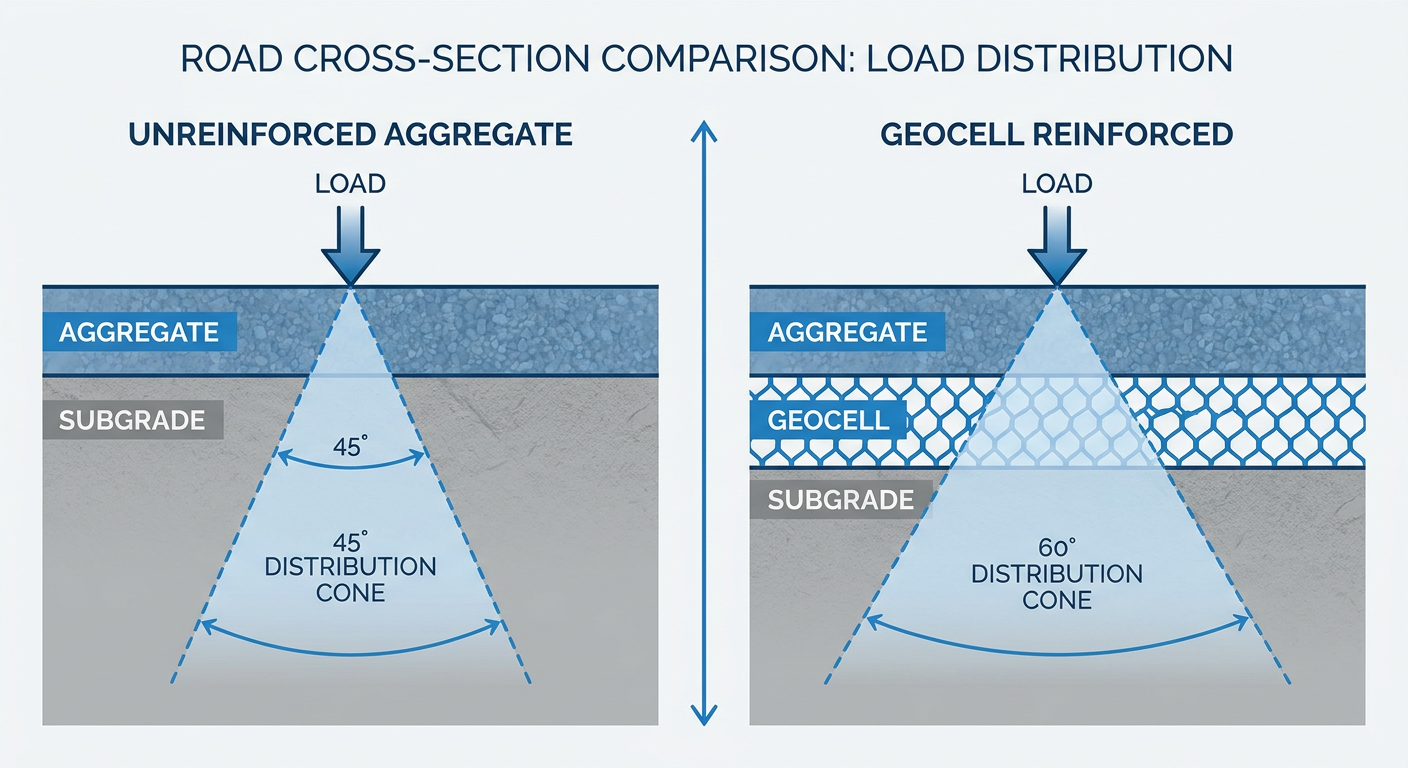
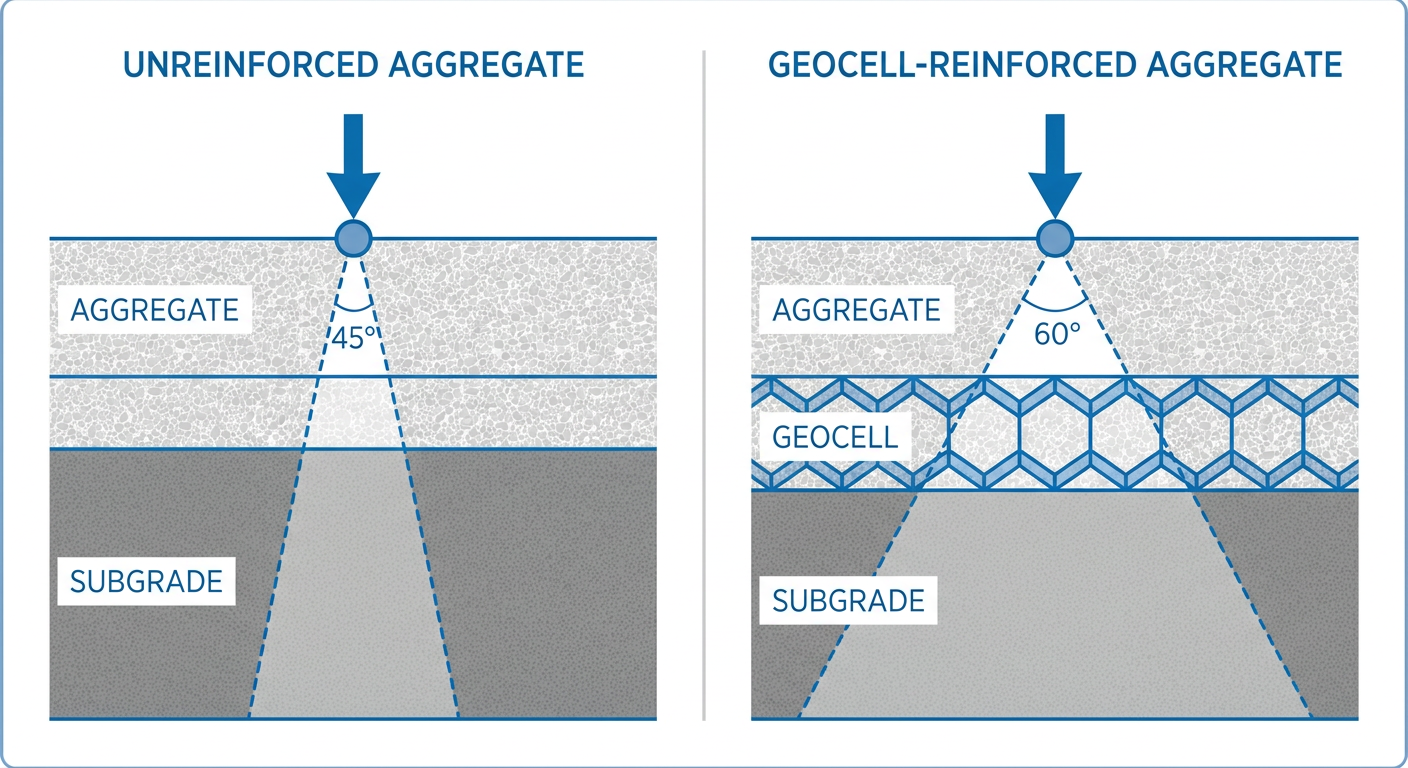
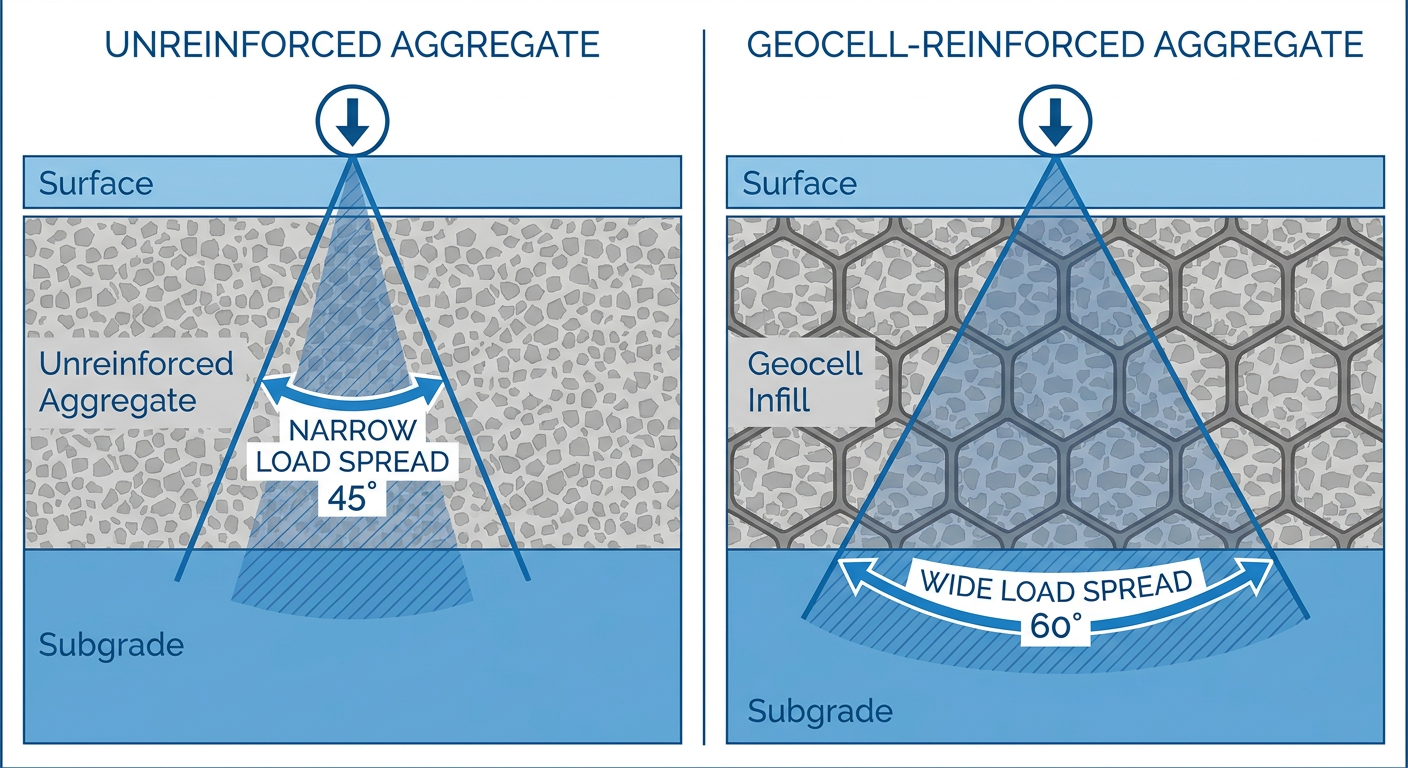
The Boussinesq equation, developed in 1885 and still foundational to pavement design, describes how point loads disperse through granular materials. In unreinforced aggregate, stress disperses at approximately a 1:1 angle (45 degrees from vertical). A 20,000-pound wheel load applied to a 12-inch contact patch spreads to roughly 48 inches diameter at a depth of 18 inches—but the pressure at the subgrade interface may still exceed what soft soils can support.
This is why conventional access road design in weak subgrade conditions requires thick aggregate sections. FHWA guidelines for unpaved roads on subgrades with CBR values below 3 often specify 18–24 inches of aggregate to achieve adequate load distribution. That’s 1,200–1,600 tons of material per lane-mile—a significant cost driver before you account for trucking, placement, and compaction.
The Three Failure Modes
Access roads under heavy equipment loading fail through three primary mechanisms:
- Bearing capacity failure — subgrade shear failure under concentrated loads, creating deep ruts and heaving
- Rutting from plastic deformation — aggregate displacement under repeated loading without adequate confinement
- Pumping and fines migration — wet subgrade soil migrating upward into the aggregate base, contaminating the structural layer
Each failure mode requires a different engineering response. Traditional design addresses all three through aggregate depth alone—more material equals more load distribution and more separation from the subgrade. Geocell technology addresses all three through cellular confinement, achieving equivalent performance with dramatically less material.
How Geocell Technology Solves Access Road Engineering Problems
Geocell-reinforced road construction works through three complementary load-carrying mechanisms that fundamentally change the stress distribution through the road structure.
Mechanism 1: Cellular Confinement
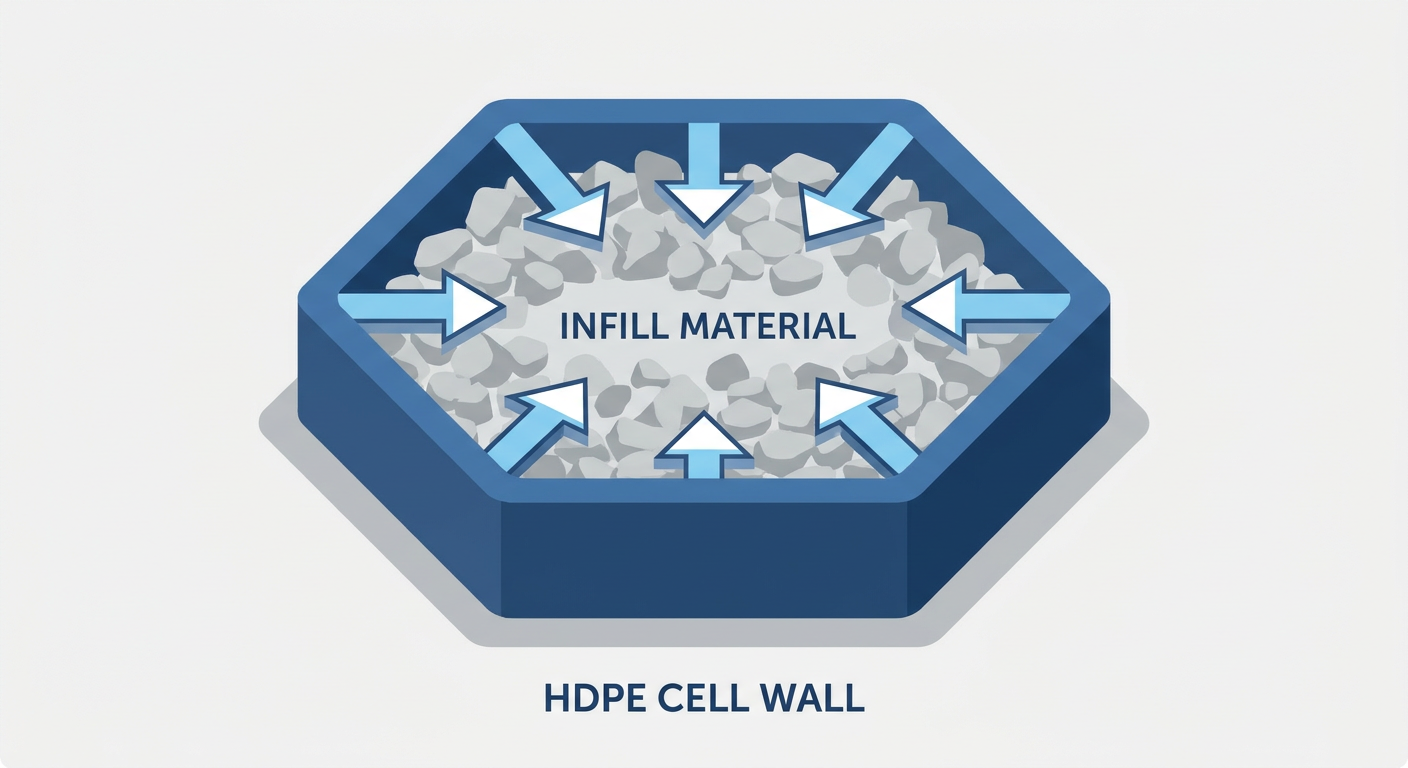
High-density polyethylene (HDPE) cell walls prevent lateral displacement of infill aggregate under load. When a wheel load compresses the fill material, the cell walls resist outward movement, dramatically increasing the apparent stiffness of the confined layer. Laboratory testing shows confined aggregate exhibits 3–5 times the modulus of the same material unconfined.
This confinement effect is why BaseCore™ Geocell achieves a structural layer coefficient of 0.35—comparable to hot-mix asphalt and significantly higher than the 0.10–0.14 typical of unreinforced aggregate base. The practical result: equivalent structural capacity with less than half the material depth.
Mechanism 2: Beam Action
Interconnected geocell panels don’t just confine aggregate locally—they distribute loads laterally across adjacent cells. When a wheel load compresses one cell, the rigid cell walls transfer force to neighboring cells, spreading the load across a wider footprint before it reaches the subgrade. This beam effect improves the load dispersion angle from approximately 45 degrees in unreinforced aggregate to 55–60 degrees in geocell-reinforced sections.
The load distribution through geocell-reinforced soil follows a fundamentally different stress pattern than conventional aggregate bases, reducing subgrade pressure by 30–50% for equivalent surface loads.
Mechanism 3: Membrane Effect
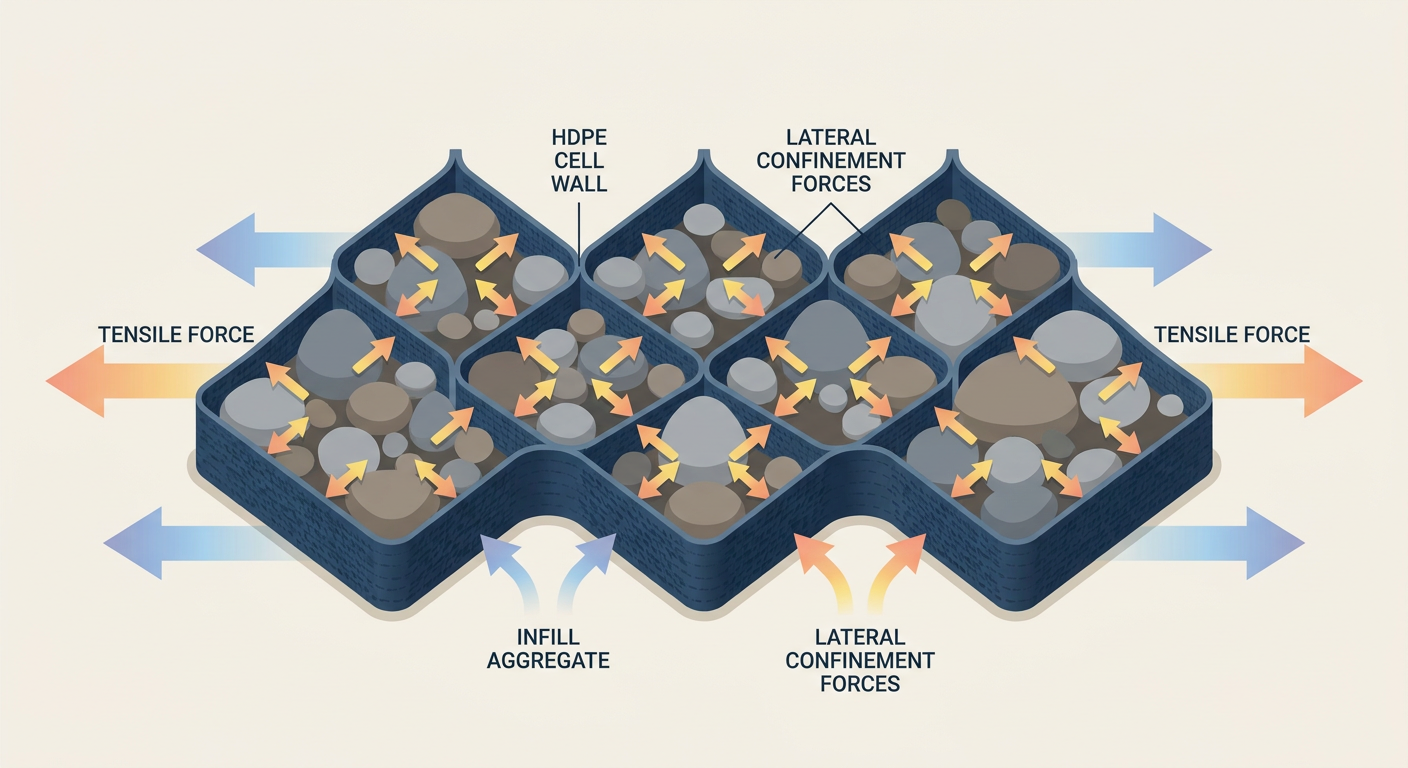
Under load, the tensioned HDPE cell walls redistribute vertical forces as tensile stresses through the geocell panel. This membrane action adds structural capacity beyond what the confined aggregate alone provides, particularly valuable for spanning localized weak zones in the subgrade.
The combined effect of these three mechanisms is why BaseCore HD™ Geocell delivers H-20 load capacity at 4–6 inches of cell depth—a performance level that would require 12–18 inches of conventional aggregate base on equivalent subgrade conditions.
BaseCore’s engineering team provides free project evaluations with geocell depth recommendations based on your site’s CBR data and expected loading. Request a quote at basecore.co/quick-basecore-quote or call 888-511-1553.
Access Road Construction Methods: Engineering Comparison
Project teams evaluating access road construction have four primary methodologies to consider. Each has distinct engineering characteristics, cost profiles, and application fit.
Method 1: Conventional Aggregate Construction
The traditional approach uses thick lifts of graded aggregate—typically AASHTO Class II or equivalent—placed in 6-inch lifts and compacted to 95% Standard Proctor density. Design depth follows CBR-based methodology, with required thickness increasing as subgrade strength decreases.
Typical specifications for H-20 loading:
- CBR 3 subgrade: 18–24 inches aggregate depth
- CBR 6 subgrade: 12–16 inches aggregate depth
- CBR 10+ subgrade: 8–12 inches aggregate depth
Advantages: Familiar to every contractor, no specialized materials, well-documented design methodology.
Limitations: High material volume (1,200–1,600 tons per lane-mile for weak subgrades), significant trucking costs, extended construction timeline, aggregate displacement under repeated loading, not removable for temporary applications.
Method 2: Geogrid-Reinforced Aggregate
Geogrids provide tensile reinforcement at the aggregate-subgrade interface, improving load distribution and reducing required aggregate depth by 20–30% compared to unreinforced sections. Biaxial geogrids work well for static loads; triaxial designs better accommodate multi-directional traffic.
Advantages: Proven technology, moderate aggregate reduction, compatible with standard construction equipment.
Limitations: Requires minimum aggregate cover (typically 6 inches) over the grid, less effective than geocell for very weak subgrades, no cellular confinement effect.
For many projects, the optimal solution combines both technologies: geogrid at the subgrade interface for tensile reinforcement with geocell above for cellular confinement and beam action.
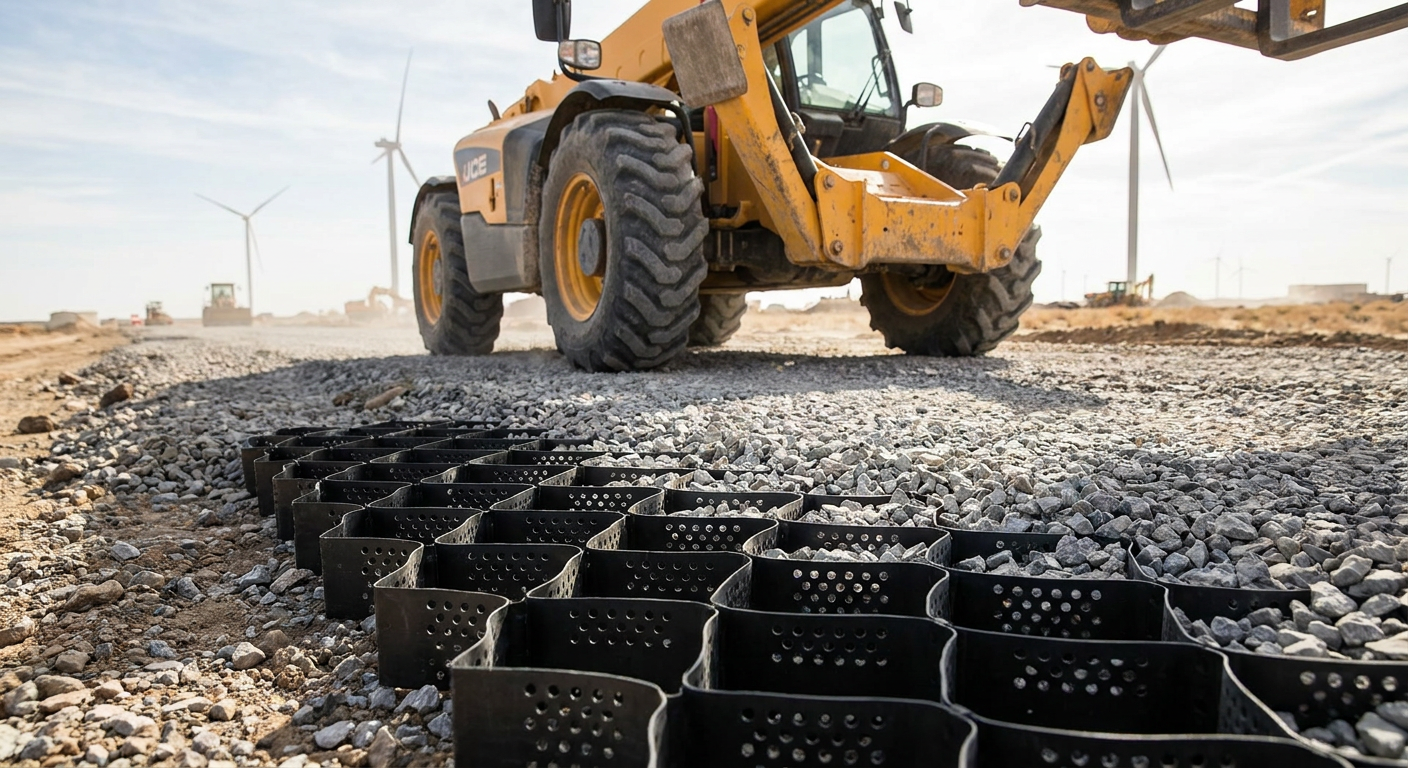
Method 3: Geocell-Reinforced Construction
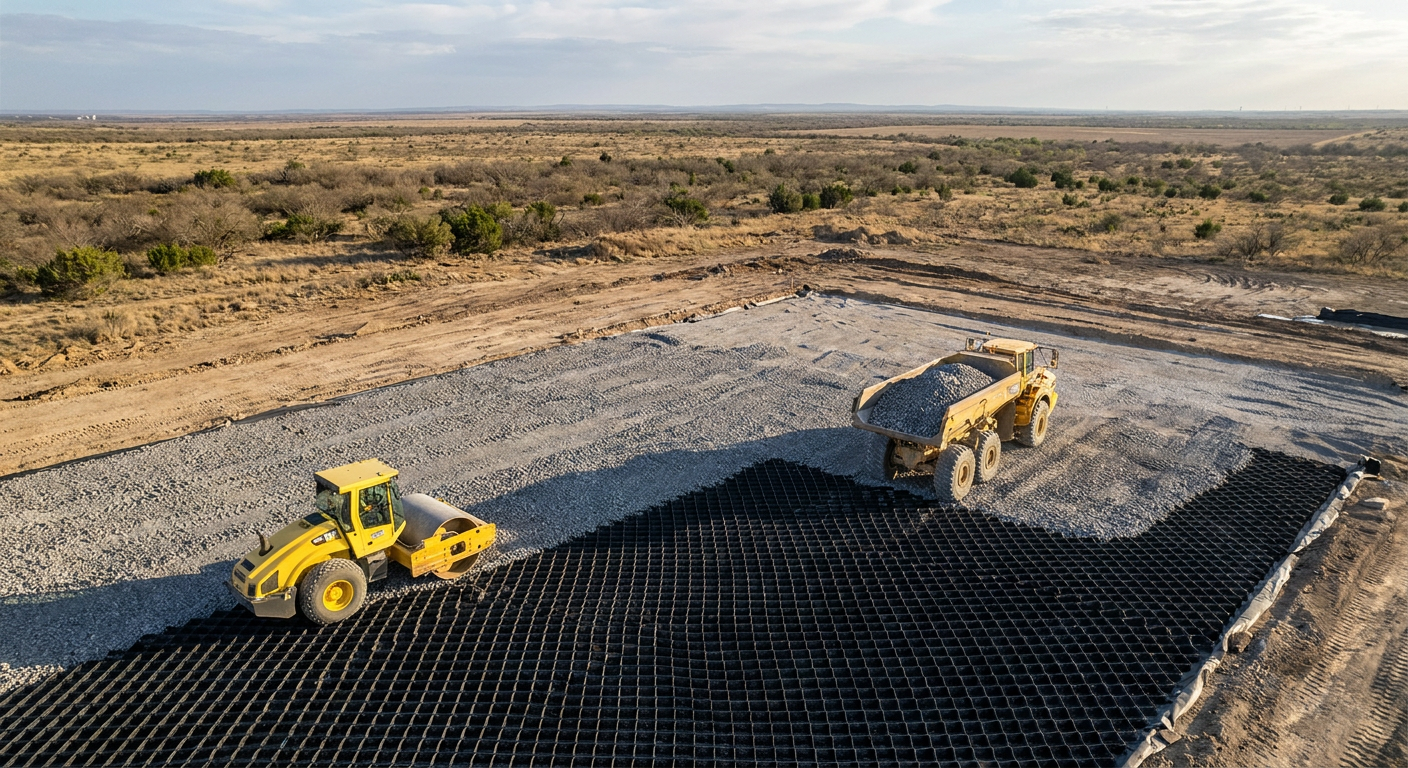
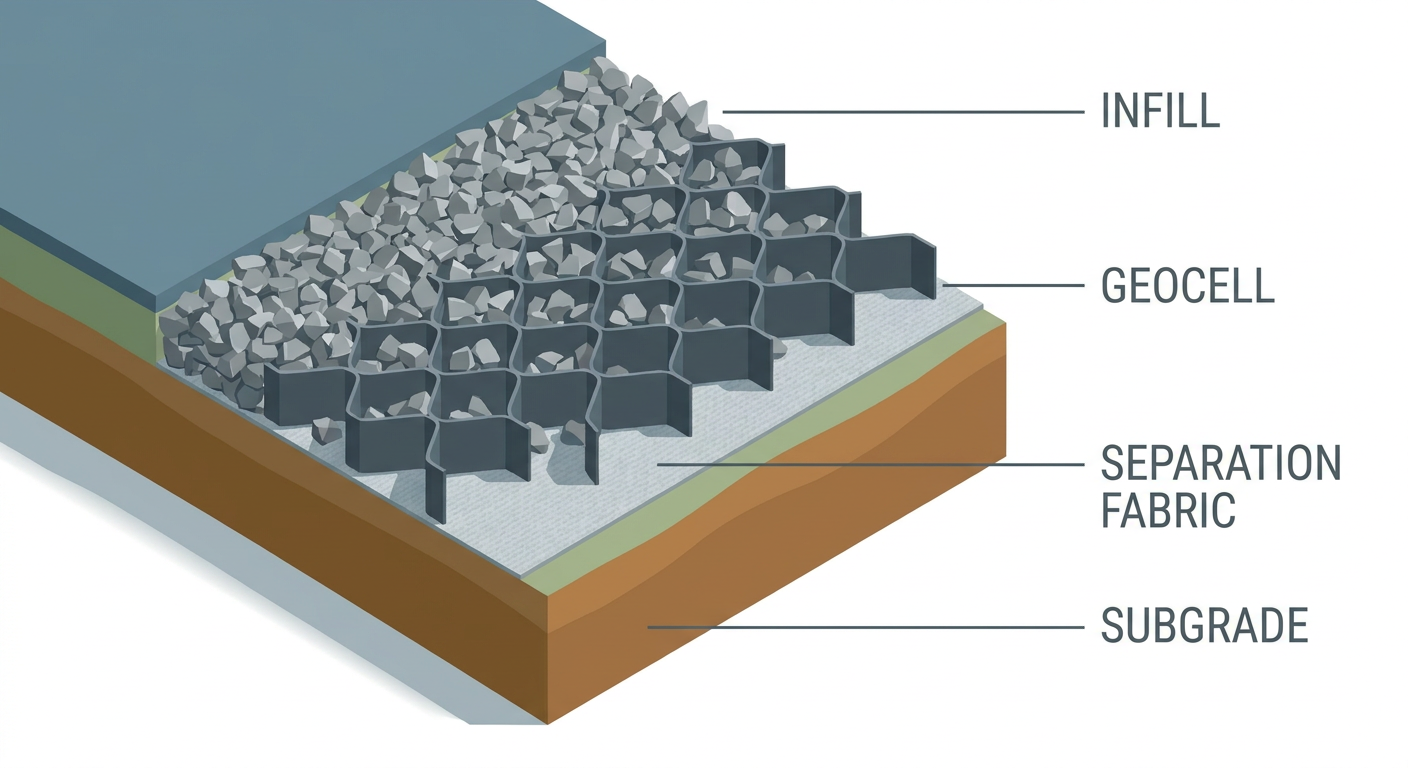
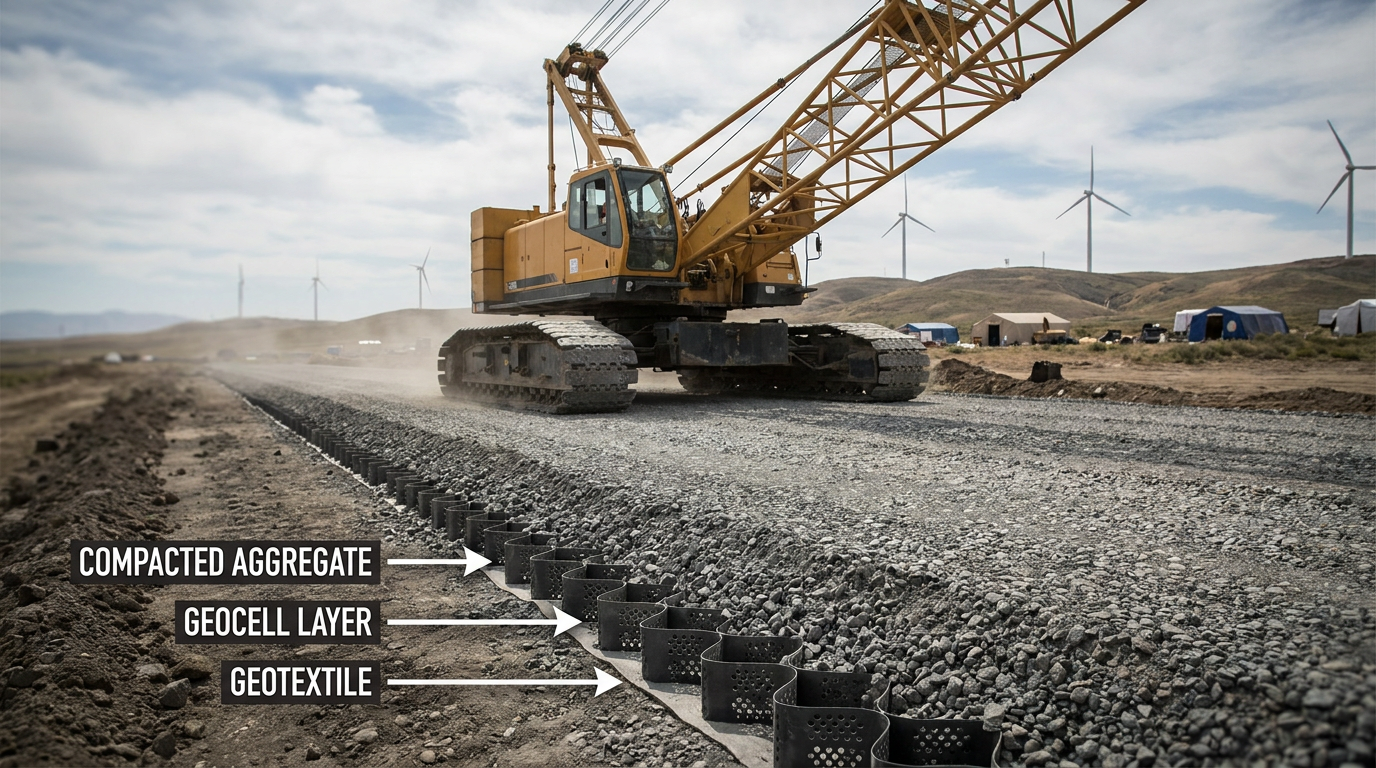
Geocell construction places three-dimensional HDPE cellular panels directly on prepared subgrade (or over a geotextile separation layer when fines migration is a concern), then fills and compacts with aggregate. The cellular confinement, beam action, and membrane effects achieve H-20 load capacity with 4–6 inch cell depth plus 2–3 inches of aggregate cover.
Typical specifications for H-20 loading with BaseCore HD:
- CBR 3 subgrade: 6-inch geocell depth + geotextile separation
- CBR 6 subgrade: 4-inch geocell depth
- CBR 10+ subgrade: 4-inch geocell depth (structural redundancy)
Advantages: 40–60% aggregate reduction, faster installation (one crew can install 5,000+ square feet per day), removable for temporary access roads, 75+ year HDPE lifespan for permanent installations, permeable design meets stormwater requirements.
Limitations: Requires geocell material cost, infill must be properly compacted, less familiar to some contractors (though installation is straightforward).
Method 4: Full-Depth Asphalt or Concrete
Paved access roads provide the highest load capacity and longest service life but at premium cost and extended construction timelines. Full-depth asphalt typically requires 6–8 inches of HMA plus 8–12 inches of aggregate base; concrete requires 6–8 inches of reinforced slab plus subbase.
Advantages: Highest durability, lowest maintenance for permanent high-traffic roads, familiar construction methodology.
Limitations: 3–5x cost of geocell construction, extended timeline (curing, weather delays), impermeable surface requires separate stormwater management, not removable, significant environmental footprint.
For detailed engineering comparison, see the BaseCore geocell versus asphalt analysis.
Project Implementation: Specification and Installation
Successful access road construction with geocell technology requires proper specification, site preparation, and installation methodology. This section provides the engineering guidance specifiers and contractors need.
Design Specification Process
Specifying geocell depth for access road construction follows a systematic methodology based on design load, subgrade strength, and infill material:
Step 1: Determine design load classification. Most industrial access roads require H-20 capacity (32,000-pound axle load) for equipment transport. Some applications—mining haul roads, crane pads, drilling operations—may require H-25 or custom load analysis.
Step 2: Characterize subgrade conditions. CBR testing (ASTM D1883) provides the subgrade strength data needed for geocell depth selection. For preliminary design, standard penetration test (SPT) or dynamic cone penetrometer (DCP) results can be correlated to approximate CBR values.
Step 3: Select geocell system. BaseCore HD™ is engineered for heavy-duty applications requiring H-20+ capacity. Standard BaseCore™ Geocell suits moderate-load applications including construction yard access and light equipment roads.
Step 4: Determine geocell depth and infill. BaseCore’s engineering team provides project-specific recommendations based on your CBR data, load requirements, and project conditions. General guidance for H-20 loading: 4-inch depth for CBR 6+ subgrades, 6-inch depth for CBR 3–6 subgrades, 6-inch depth plus geogrid reinforcement for CBR below 3.
The geocell selection guide provides detailed specification criteria for different applications.
Installation Methodology
Geocell installation follows a straightforward sequence that experienced crews can complete at 5,000+ square feet per day:
1. Site preparation. Strip topsoil and organic material. Grade subgrade to design elevation with 2–4% cross-slope for drainage. Compact subgrade to 95% Standard Proctor density where soil conditions allow.
2. Separation layer (when required). On subgrades with significant fines content or high water table, install geotextile fabric as a separation layer to prevent fines migration into the aggregate infill.
3. Geocell deployment. Expand geocell panels and stake at corners and edges. Connect adjacent panels with manufacturer-specified connectors to maintain cellular continuity across the roadway width.
4. Infill placement. Fill cells with specified aggregate—typically 3/4-inch angular crushed stone or recycled concrete aggregate. Overfill cells by 1–2 inches to account for compaction.
5. Compaction. Compact infill with vibratory roller or plate compactor to 95% Standard Proctor density. Multiple passes may be required to achieve full compaction.
6. Wearing surface. Apply 2–3 inches of surface aggregate (3/8-inch or finer) for a smooth driving surface.
Complete installation procedures are detailed in the BaseCore geocell installation guide.
Infill Material Selection
Infill material significantly affects road performance. The best geocell infill materials for access road applications include:
- Angular crushed stone (3/4-inch minus) — optimal interlock and load transfer, highest structural capacity
- Recycled concrete aggregate — comparable performance to virgin aggregate at lower cost, supports sustainability goals
- Crusite or manufactured aggregate — engineered gradation for maximum density and stability
Rounded gravels and river rock perform poorly as geocell infill due to limited particle interlock—avoid these materials in structural applications.
Industry Applications for Access Road Construction
Access road requirements vary significantly by industry. This section addresses the specific engineering considerations for major industrial sectors.
What Are the Access Road Requirements for Oil and Gas Operations?
Oil and gas access roads—including lease roads, pad access, and pipeline ROW—must support the heaviest equipment in industrial construction: drilling rigs, frac spreads, and crane assemblies with axle loads exceeding 40,000 pounds. Subgrade conditions in producing basins (Permian, Bakken, Marcellus) often feature expansive clays, high plasticity soils, and seasonal moisture variations that challenge conventional road construction.
Geocell road construction has become the preferred method for oil and gas operators because it addresses both the engineering challenge (extreme loads on weak subgrades) and the operational reality (roads may be temporary, must be installed quickly, and should minimize lease disturbance). BaseCore HD achieves the required load capacity while allowing road removal at lease termination—a significant advantage for operators managing reclamation obligations.
How Do You Build Access Roads for Renewable Energy Projects?
Wind farms, solar installations, and battery energy storage (BESS) facilities require access roads that support component delivery (turbine blades, transformers, battery containers) while meeting increasingly stringent environmental permitting requirements. Many renewable energy sites are located on agricultural land, wetland buffers, or other sensitive areas where conventional road construction triggers environmental review or mitigation requirements.
Geocell-reinforced access roads offer renewable energy developers a permeable, lower-impact alternative that often qualifies for reduced permitting requirements. The reduced aggregate volume also translates to lower carbon footprint—a meaningful consideration for projects where sustainability metrics affect financing and offtake agreements.
What Load Capacity Do Mining Haul Roads Require?
Mining operations present the most demanding access road requirements: haul trucks with gross vehicle weights exceeding 400 tons, continuous heavy traffic, and often challenging site conditions including steep grades and variable subgrade strength. While primary haul roads typically require engineered pavement sections, secondary access roads, exploration roads, and temporary pit access are well-suited to geocell construction.
The key engineering advantage for mining applications is speed of construction. Exploration programs and mine development operate on compressed schedules where road construction delays directly impact production timelines. Geocell roads can be constructed in days rather than weeks, with immediate trafficability—no curing time required.
How Do You Stabilize Construction Site Access Roads?
Commercial construction sites face a recurring challenge: heavy equipment and delivery trucks must access the site throughout construction, but permanent roads aren’t installed until project completion. Temporary access roads using conventional aggregate often fail under construction traffic, requiring repeated maintenance and eventual reconstruction.
Geocell-reinforced builder site access roads provide a stable platform throughout construction, then can be removed and the geocell panels reused on the next project. This approach eliminates the maintenance cycle and reduces aggregate waste—a meaningful cost savings for contractors managing multiple concurrent projects.
For permanent construction yard access, geocell construction provides the durability of paved surfaces at a fraction of the cost, with the added benefit of permeability for stormwater compliance.
What Is the Cost Comparison Between Geocell and Conventional Access Roads?
Total installed cost for access road construction varies significantly based on site conditions, material availability, and project scale. However, geocell-reinforced construction consistently delivers 30–50% cost savings compared to conventional aggregate construction and 60–75% savings compared to asphalt or concrete.
The cost advantage comes from three factors:
Reduced aggregate volume. A geocell road requiring 6 inches total depth (4-inch cells plus 2-inch cover) versus 18 inches of conventional aggregate reduces material requirements by 67%. At typical aggregate costs of $15–25 per ton delivered, this translates to $8–15 per square foot in material savings alone.
Reduced trucking and placement. Fewer aggregate tons means fewer truck trips, less fuel, and faster construction. For remote sites—common in energy and resource extraction—trucking costs often exceed material costs, amplifying the geocell advantage.
Faster construction. Geocell installation rates of 5,000+ square feet per day with a small crew compare favorably to 1,500–2,500 square feet per day for conventional aggregate construction. Reduced construction time means earlier project access and lower general conditions costs.
For detailed cost analysis specific to your project, BaseCore’s engineering team provides free project evaluations including material quantity estimates and installed cost comparisons. The geocell cost breakdown provides additional pricing guidance.
How Long Do Geocell Access Roads Last?
BaseCore geocell products are manufactured from high-density polyethylene (HDPE) engineered for 75+ year service life in ground-contact applications. The HDPE resists UV degradation (when covered with aggregate), chemical attack from petroleum products and road salts, and biological degradation from soil microorganisms.
In practice, the service life of a geocell access road is typically limited by aggregate wear rather than geocell degradation. Properly constructed geocell roads maintain structural integrity for decades with periodic aggregate surface replenishment. Several BaseCore case studies document installations operating successfully after 10+ years of heavy traffic.
For temporary applications, geocell roads can be deconstructed and the panels recovered for reuse—a significant advantage for project-based operations in oil and gas, construction, and event staging.
Does Geocell Road Construction Meet DOT Specifications?
Geocell technology has a proven track record in transportation infrastructure applications. The U.S. Army Corps of Engineers has used geocell for military road construction since the 1970s, and multiple state DOTs have approved geocell for specific applications including temporary roads, unpaved shoulders, and low-volume rural routes.
Specification acceptance varies by jurisdiction and application. BaseCore’s engineering team can provide documentation supporting geocell specification for DOT and municipal projects, including reference to USACE technical reports, ASTM test data, and project case studies demonstrating successful deployments under similar conditions.
For projects requiring formal DOT approval, early engagement with the specifying agency is recommended. BaseCore provides engineering support for the approval process, including load capacity documentation, material specifications, and installation methodology.
What Maintenance Do Geocell Access Roads Require?
Geocell access roads require significantly less maintenance than conventional unpaved roads. The cellular confinement prevents the rutting and aggregate displacement that drive maintenance cycles on traditional gravel roads.
Typical maintenance requirements include:
- Surface aggregate replenishment — every 2–5 years depending on traffic intensity, add 1–2 inches of surface material to replace wear loss
- Drainage maintenance — keep roadside ditches clear, repair any erosion at road edges
- Spot repairs — address any localized damage from unusual events (excavation, impact damage)
For dust control on gravel roads, standard dust suppressants (water, chloride solutions, synthetic binders) are compatible with geocell construction and applied using conventional equipment.
The road maintenance guide provides comprehensive guidance for maintaining geocell and conventional access roads.
Conclusion: Engineering Better Access Roads
Access road construction doesn’t have to mean choosing between adequate load capacity and reasonable cost. Geocell-reinforced construction achieves H-20+ performance with 40–60% less aggregate than conventional methods, faster installation timelines, and the flexibility for temporary or permanent applications.
For project teams evaluating access road solutions—whether for oil and gas lease roads, renewable energy sites, mining operations, or commercial construction—BaseCore HD Geocell offers the engineered alternative to thick aggregate sections and expensive paved surfaces.
Request a free project evaluation at basecore.co/quick-basecore-quote or call 888-511-1553 to discuss your access road requirements with BaseCore’s engineering team.
Frequently Asked Questions
What is the minimum CBR required for geocell road construction?
Geocell road construction is effective on subgrades with CBR values as low as 1–2, though very weak subgrades (CBR below 3) typically require a geotextile separation layer and may benefit from geogrid reinforcement beneath the geocell. BaseCore’s engineering team provides project-specific recommendations based on your site’s CBR data.
How quickly can geocell access roads be installed?
Experienced crews can install geocell access roads at rates of 5,000+ square feet per day, with immediate trafficability after compaction—no curing time required. A typical 12-foot-wide, quarter-mile access road (approximately 15,000 square feet) can be completed in 2–3 days with a small crew and standard construction equipment.
Can geocell roads be removed and the materials reused?
Yes—geocell roads can be deconstructed by removing the aggregate infill and recovering the geocell panels for reuse. This makes geocell ideal for temporary access roads in oil and gas, construction, and event staging applications. The HDPE panels maintain structural integrity through multiple installation cycles.
What aggregate depth is required for H-20 loading with geocell?
BaseCore HD Geocell achieves H-20 load capacity (32,000-pound axle load) with 4–6 inches of cell depth plus 2–3 inches of aggregate cover, depending on subgrade CBR. This compares to 12–18 inches of aggregate typically required for conventional unreinforced construction on equivalent subgrades.
How does geocell road construction affect project ROI?
Geocell construction typically reduces total installed cost by 30–50% compared to conventional aggregate roads through reduced material volume, lower trucking costs, and faster installation. For temporary applications, the ability to recover and reuse geocell panels provides additional ROI. BaseCore’s engineering team provides free cost comparisons for project evaluation.
This article is for informational purposes only and does not constitute engineering advice. The technical information provided reflects published geotechnical principles, industry standards, and BaseCore’s product documentation. Site conditions, loading requirements, environmental factors, and regulatory requirements vary by project—consult BaseCore’s engineering team or a licensed professional engineer for project-specific design recommendations. For current product specifications, project evaluations, and pricing, visit basecore.co or call 888-511-1553.