


Every mining operation and oil & gas site faces the same infrastructure question: how do you build haul roads that survive 200-ton trucks, 24/7 operations, and extreme weather without consuming your maintenance budget?
Cellular confinement systems (geocells) provide the most effective soil stabilization for heavy haul roads carrying 100+ ton loads. By confining aggregate infill within HDPE cell walls, geocell technology increases effective bearing capacity by 3–5x over unreinforced aggregate, reduces required base course thickness by 40–60%, and extends maintenance intervals from weeks to years. The technology distributes concentrated wheel loads across wider subgrade areas through beam action and membrane effect mechanisms.
BaseCore HD™ Geocell delivers this performance with a documented structural coefficient of 0.35—matching asphalt in AASHTO pavement design calculations while eliminating the brittleness, curing time, and thermal cracking that limit conventional pavement in heavy industrial applications.
This engineering guide covers the geotechnical principles behind haul road failure, the load distribution mechanics that make geocell stabilization effective, design specifications for 100+ ton applications, and implementation methodology for mining and O&G projects.
The Engineering Problem: Why Heavy Haul Roads Fail
Heavy haul roads in mining and O&G operations experience loading conditions that exceed the design assumptions behind conventional pavement engineering. Understanding why these roads fail requires examining the soil mechanics at work beneath the surface.
Load Magnitude and Repetition
A fully loaded CAT 797 haul truck applies approximately 1.2 million pounds of gross vehicle weight through just six tire contact patches. Each patch delivers contact pressures exceeding 90 PSI—far beyond the 80 PSI assumption in standard FHWA pavement design methodology.
These loads repeat continuously. A single pit mine may see 50–100 loaded truck passes per hour, accumulating thousands of Equivalent Single Axle Loads (ESALs) daily. Traditional pavement design assumes 18-kip (18,000-pound) standard axles; haul trucks deliver 80,000+ pounds per axle.
Boussinesq Stress Distribution and Subgrade Failure
When concentrated loads apply to a pavement surface, stress propagates downward through the structural layers according to Boussinesq’s equations. In unreinforced aggregate base, this stress cone spreads at approximately 26.5° from vertical—meaning stress concentrations remain high at relatively shallow depths.
The practical consequence: weak subgrades (CBR values below 3–5) experience stress levels exceeding their bearing capacity even under thick aggregate lifts. The subgrade deforms plastically, creating the characteristic rutting, potholing, and washboarding that plague mining haul roads.
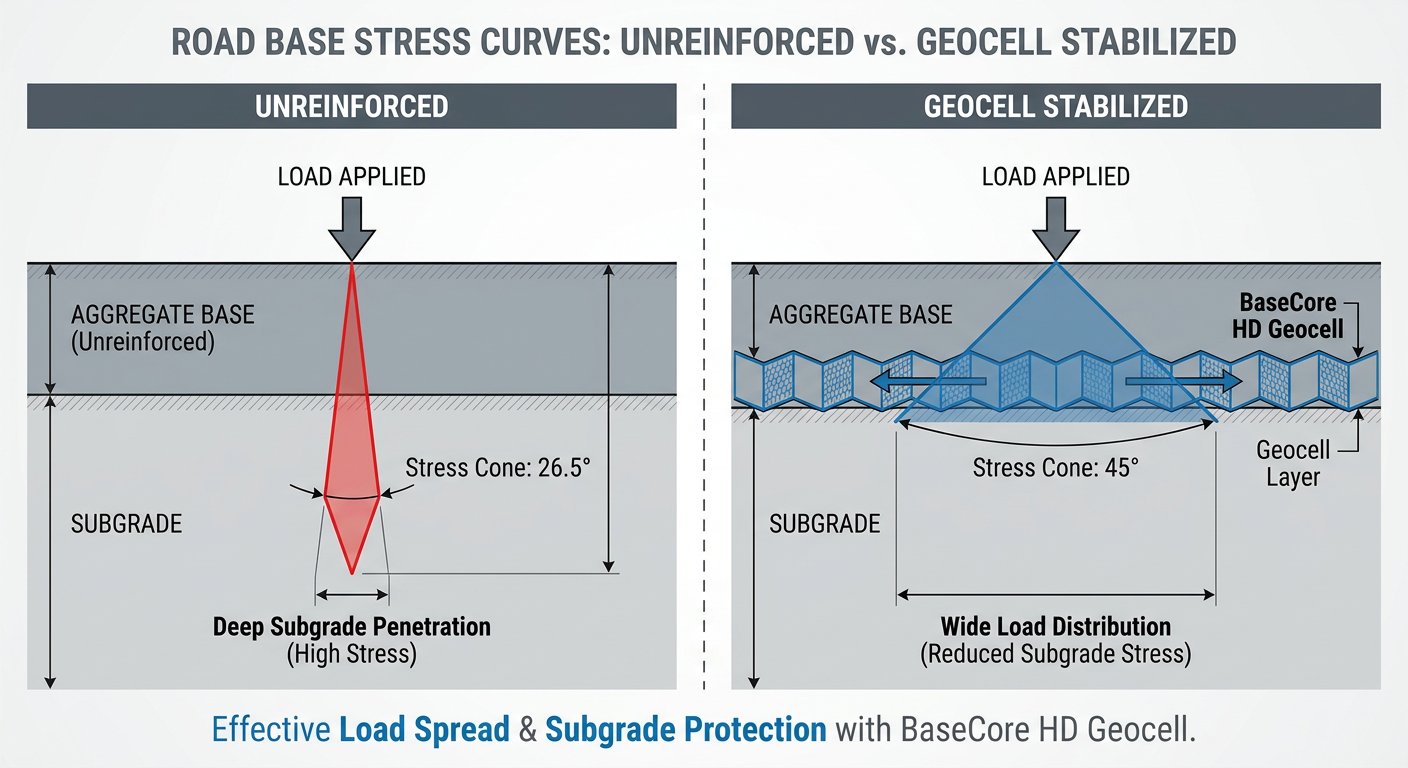
Geocell reinforcement improves the stress distribution angle from 26.5° to 45°, significantly reducing pressure on the subgrade.
The Maintenance Spiral
Conventional response to haul road deterioration follows a predictable and expensive pattern:
- Grade and compact the surface (temporary fix, hours to days of relief)
- Add more aggregate (increases load on already-failed subgrade)
- Repeat every 1–4 weeks during heavy production
This cycle consumes aggregate, equipment hours, fuel, and—critically—production time. Industry data suggests maintenance costs for conventional unpaved haul roads range from $15,000 to $40,000+ per lane-mile per year, with production losses during grading operations adding indirect costs that often exceed direct maintenance spending.
Climate and Drainage Complications
Water infiltration accelerates every failure mode. Saturated subgrades lose bearing capacity rapidly—a subgrade with CBR 8 when dry may drop to CBR 2–3 when saturated. Freeze-thaw cycling in northern climates creates additional heave and settlement damage.
Traditional responses (crowning, side ditches, culverts) manage surface water but do nothing to address the fundamental structural deficiency: insufficient load distribution through the base course.
How Geocell Technology Solves Heavy Haul Road Failure
Cellular confinement fundamentally changes the load distribution mechanics of aggregate base courses. Rather than relying solely on aggregate interlock and friction, BaseCore HD™ Geocell adds three distinct structural mechanisms that combine to create a stiffened composite layer.
Mechanism 1: Cellular Confinement
HDPE cell walls (200mm nominal height for heavy-duty applications) prevent lateral displacement of aggregate infill under load. This confinement dramatically increases the apparent stiffness of the aggregate layer.
Unconfined aggregate under wheel loads tends to displace laterally—particles roll and slide away from the load point, creating the depression pattern visible in rutted roads. Confined aggregate cannot displace laterally; the energy that would drive lateral movement instead increases the material’s resistance to vertical deformation.
Laboratory testing demonstrates confined aggregate exhibits 2.5–4x higher modulus values than identical unconfined material. This stiffening effect is immediate and permanent—it does not degrade with load repetition like cement-treated bases can.
Mechanism 2: Beam Action
Individual geocell panels (typically 256 cells per panel for BaseCore HD) are connected to form continuous sections. Under point loading, the interconnected cell structure distributes force laterally to adjacent cells.
This beam action spreads the load concentration across a much wider effective area before stress reaches the subgrade. The practical effect: the stress cone angle improves from approximately 26.5° (unreinforced) to 45° or greater (geocell-reinforced), dramatically reducing peak subgrade stress.
For a 90 PSI tire contact pressure, improving the distribution angle from 26.5° to 45° can reduce subgrade stress by 50–60% at equivalent depth—or achieve the same subgrade protection with 40–50% less structural section thickness.
Mechanism 3: Membrane Effect
Under deflection, the tensioned HDPE cell walls redistribute vertical loads as tensile forces through the panel. The membrane carries a portion of the applied load directly, adding structural capacity beyond what the aggregate infill alone provides.
This mechanism becomes more pronounced under heavy loading—exactly when additional capacity is most needed. The high-density polyethylene material maintains its tensile properties across a wide temperature range (-40°F to +160°F), ensuring consistent performance in both arctic oil fields and desert mining operations.
Quantified Performance: BaseCore HD Specifications
BaseCore HD™ Geocell delivers documented performance metrics relevant to heavy haul applications:
- Structural coefficient: 0.35 (matching asphalt in AASHTO flexible pavement design)
- Cell height options: 100mm, 150mm, 200mm (4″, 6″, 8″)
- Material: High-density polyethylene with UV stabilization
- Lifespan: 75+ years based on accelerated aging testing
- Load capacity: H-20 and above depending on cell height and infill selection
For comparison, unreinforced crushed stone base typically carries a structural coefficient of 0.10–0.14. Cement-treated base ranges 0.20–0.25 but is subject to fatigue cracking under heavy repetitive loads.
BaseCore’s engineering team provides free project evaluations for heavy haul road applications, including geocell depth recommendations based on your site’s CBR data and expected loading. Request a quote or call 888-511-1553.
Project Implementation: Specifying and Installing Geocell for Heavy Haul Roads
Effective geocell stabilization requires proper design specification, subgrade preparation, and installation methodology. This section provides the engineering framework for specifying geocell road construction on heavy industrial projects.
Design Specification Framework
Step 1: Characterize Subgrade Conditions
Obtain CBR values for the in-situ subgrade at representative locations along the proposed alignment. For mining and O&G applications, assume worst-case (saturated) conditions unless drainage improvements will guarantee dry subgrade.
CBR values guide geocell height selection:
- CBR 1–3 (very weak): 200mm (8″) geocell + geotextile separation layer
- CBR 3–6 (weak): 150mm–200mm (6″–8″) geocell
- CBR 6–10 (moderate): 100mm–150mm (4″–6″) geocell
- CBR 10+ (good): 100mm (4″) geocell may suffice; evaluate traffic loads
Step 2: Define Traffic Loading
Document the expected vehicle weights, tire pressures, and daily/annual traffic volumes. For mining haul trucks:
- CAT 793: ~240 tons GVW loaded
- CAT 797: ~350 tons GVW loaded
- Komatsu 930E: ~320 tons GVW loaded
Convert to expected ESALs using heavy vehicle equivalency factors—a single loaded 300-ton haul truck can equal 10,000+ standard 18-kip ESALs.
Step 3: Select Geocell Configuration
For heavy haul applications (100+ ton vehicles), specify BaseCore HD™ Geocell at 150mm–200mm cell height with well-graded crushed stone infill (typically 3/4″ minus to 1.5″ clean angular aggregate).
Include a geotextile separation layer beneath the geocell when subgrade fines risk migrating into the aggregate base. Specify nonwoven geotextile with minimum 230 lb grab tensile strength and appropriate filtration characteristics for site soils.
Installation Methodology
Subgrade Preparation
- Clear vegetation, topsoil, and organic materials from the roadway alignment
- Grade subgrade to design profile with appropriate crown (typically 2–4% cross-slope for drainage)
- Compact subgrade to 95% Standard Proctor density minimum
- Install geotextile separation layer if specified, overlapping seams 12″ minimum
Geocell Deployment
- Expand BaseCore HD panels across prepared subgrade
- Connect adjacent panels using provided connectors (J-clips or ATRA keys depending on product variant)
- Anchor perimeter cells with steel stakes at 3–4 cell intervals
- Verify uniform cell expansion—cells should form consistent honeycomb geometry
Fill and Compaction
- Fill cells with specified aggregate using front-end loader or conveyor
- Overfill cells by 1–2 inches to account for compaction
- Compact with vibratory roller (minimum 10-ton) in 2–3 passes
- Final surface should be flush with or slightly above cell walls
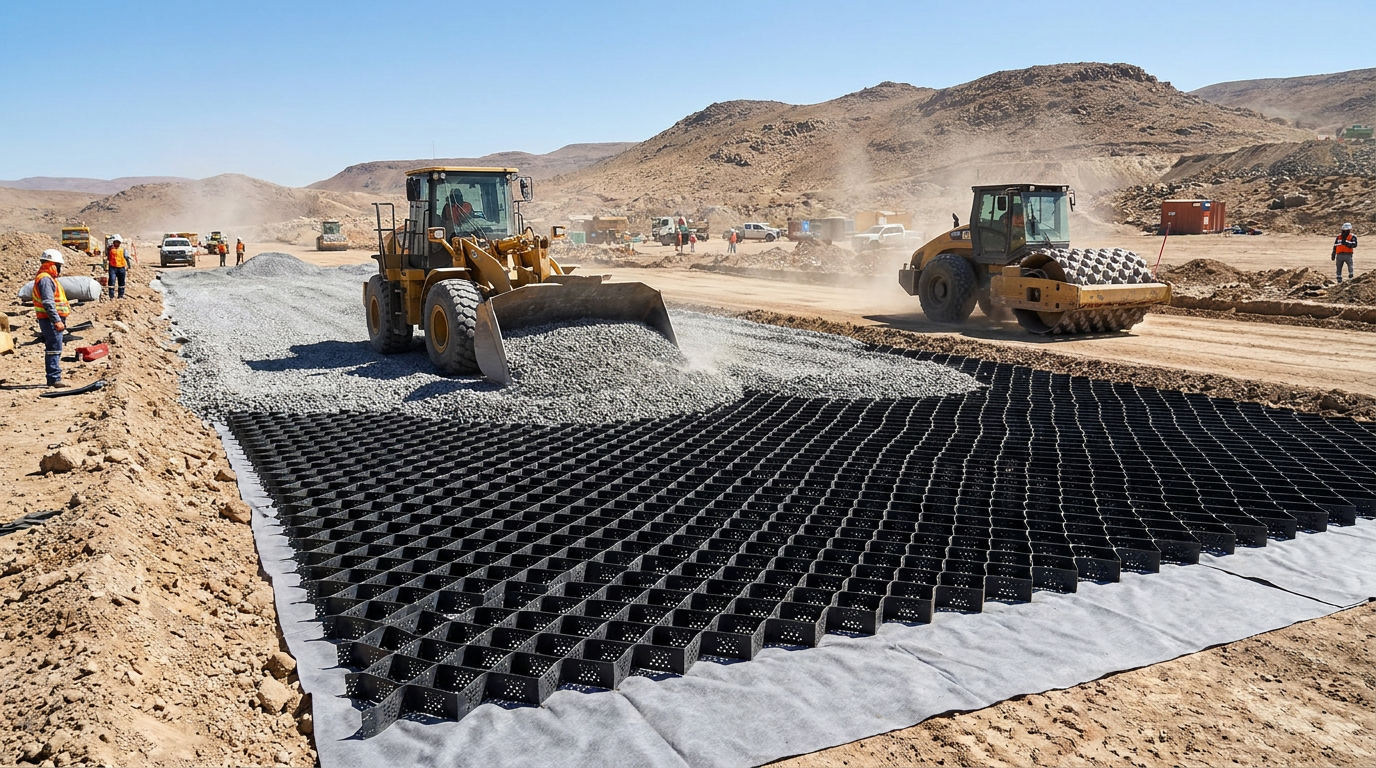
BaseCore HD installation on an industrial site showing the transition from expanded panels to compacted aggregate infill.
Installation rates for experienced crews: 2,000–5,000 square feet per hour per crew, depending on equipment and site conditions. A 1-mile, 30-foot-wide haul road section can be stabilized in 2–3 days versus 2–3 weeks for conventional thick-lift aggregate construction.
When to Combine Products
Some sites benefit from combining multiple geosynthetic products:
- Geocell + Geotextile: Standard combination for soft subgrades; geotextile prevents fines migration and provides filtration
- Geocell + Geogrid: For extremely weak subgrades (CBR <2), a BaseGrid™ geogrid layer beneath the geocell provides additional subgrade reinforcement
- Dual-layer geocell: For the heaviest applications (400+ ton trucks), some designs specify two geocell layers with aggregate between them
BaseCore’s engineering support team can evaluate site-specific conditions and recommend optimal product combinations. Contact us at 888-511-1553 or request a free project evaluation.
How Thick Should a Stabilized Base Be for Haul Trucks Over 100 Tons?
For haul trucks exceeding 100 tons gross vehicle weight, geocell-stabilized bases typically require 6–8 inches (150mm–200mm) of cell height plus 2–4 inches of surface aggregate above the cells, for a total structural section of 8–12 inches. This compares to 18–36 inches of unreinforced aggregate that would be required to achieve equivalent load distribution.
The exact depth depends on three factors: subgrade CBR, expected traffic volume, and tire contact pressure. Lower CBR values, higher traffic counts, and higher tire pressures all push the design toward the thicker end of the range. BaseCore’s ground reinforcement solutions include engineering support to optimize depth specifications for your specific loading conditions.
What Causes Rutting Failure in Mining Haul Roads?
Rutting in mining haul roads results from plastic deformation of the subgrade when applied stress exceeds bearing capacity. Under massive wheel loads, unreinforced aggregate bases distribute stress through a narrow cone—approximately 26.5° from vertical per Boussinesq theory—concentrating pressure on a small subgrade footprint.
When this concentrated stress exceeds the subgrade’s shear strength, the soil deforms permanently. Each subsequent load cycle adds incremental deformation, creating progressively deeper ruts. Water infiltration accelerates the process by reducing subgrade strength—saturated clays may lose 70–80% of their dry bearing capacity.
Geocell stabilization addresses the root cause by widening the stress distribution cone to 45° or greater, reducing peak subgrade stress by 50–60%. Review BaseCore case studies for documented rutting reduction in heavy industrial applications.
How Does Geocell Technology Compare to Lime or Cement Stabilization for Haul Roads?
Geocell stabilization offers several advantages over chemical stabilization (lime or cement treatment) for heavy haul applications. Lime and cement stabilization chemically modify subgrade soils to increase bearing capacity, but they introduce limitations that make them problematic for mining and oil & gas operations.
Chemical stabilization requires specific soil chemistry—highly organic soils, soils with excessive sulfates, or soils with unusual mineralogy may not respond to treatment. Curing time (7–28 days for cement, longer for lime) delays construction. And critically, chemically stabilized layers are subject to fatigue cracking under heavy repetitive loads—once cracked, they lose structural integrity rapidly.
Geocell stabilization works mechanically regardless of soil chemistry, requires zero curing time (traffic-ready immediately after compaction), and cannot crack or fatigue. The HDPE material maintains its properties indefinitely under cyclic loading. For lease road construction and mining haul roads where downtime costs exceed material costs, the immediate traffic-readiness and fatigue resistance of geocell often determine the technology choice.
Conclusion
Heavy haul roads in mining and O&G operations demand stabilization technology that matches the severity of the loading environment. Conventional approaches—thick aggregate lifts, chemical stabilization, or frequent grading—either consume excessive material, require impractical curing periods, or lock operations into perpetual maintenance cycles.
Geocell stabilization addresses the fundamental engineering problem: insufficient load distribution through the structural section. By combining cellular confinement, beam action, and membrane effect, BaseCore HD™ Geocell creates a stiffened composite layer that reduces required base thickness by 40–60% while extending maintenance intervals from weeks to years.
For project-specific design recommendations including geocell depth selection based on your subgrade conditions and vehicle fleet, request a free project evaluation or contact BaseCore’s engineering team at 888-511-1553.
Frequently Asked Questions
What is the cost difference between geocell stabilization and conventional aggregate base for haul roads?
Geocell stabilization typically reduces total installed cost by 20–40% compared to conventional thick-lift aggregate construction. The savings come from reduced aggregate volume (40–60% less material), fewer truck trips, and faster installation. Maintenance cost reductions of 50–70% over the road’s service life amplify the initial savings. Contact BaseCore at 888-511-1553 for project-specific cost analysis.
How long does geocell installation take for a mining haul road?
Experienced crews install 2,000–5,000 square feet of geocell per hour. A 1-mile, 30-foot-wide haul road section can be stabilized in 2–3 days versus 2–3 weeks for conventional thick-lift construction. The road is traffic-ready immediately after final compaction—no curing time required. See geocell road construction for installation details.
Can geocell handle freeze-thaw conditions in northern mining operations?
Yes. BaseCore HD Geocell’s HDPE material maintains its mechanical properties from -40°F to +160°F. The cellular structure actually helps manage freeze-thaw by confining aggregate and preventing the lateral displacement that creates frost heave damage. Proper drainage design remains essential in freeze-thaw environments.
What aggregate infill works best for heavy haul geocell roads?
Well-graded angular crushed stone (typically 3/4″ minus to 1.5″ nominal size) provides optimal performance. Angular particles interlock within the cells, maximizing confinement benefit. Avoid rounded gravels or single-size aggregates—they lack the particle interlock that converts lateral confinement into increased bearing capacity.
Is geocell stabilization approved for oil and gas lease roads on federal land?
Geocell technology has been used on federal lands and BLM-managed areas for decades, originating with U.S. Army Corps of Engineers research. Specific approval requirements vary by land management agency and project type. BaseCore’s engineering team can provide documentation supporting permit applications for oil and gas lease road projects.