


Why do most gravel driveways fail within 3–5 years while concrete alternatives last decades? The answer lies in aggregate confinement—or the lack of it. Unconfined gravel migrates laterally under wheel loads, creating ruts, potholes, and drainage channels that accelerate surface deterioration.
A durable gravel driveway requires three components: proper subgrade preparation, cellular confinement to prevent aggregate migration, and correct infill selection. Geocell reinforcement increases the effective bearing capacity of gravel by 3–5 times compared to unconfined aggregate, eliminating rutting and displacement under heavy loads while maintaining full permeability.
BaseCore™ Geocell technology applies the same cellular confinement principles the U.S. Army Corps of Engineers has used since the 1970s for temporary road construction over weak subgrades. This guide covers the geotechnical engineering behind durable gravel driveway installation, product selection criteria, and step-by-step construction methodology for commercial and industrial applications.
The Engineering Problem: Why Gravel Driveways Fail
Gravel driveways fail because loose aggregate cannot resist lateral displacement under vertical loading. When a vehicle tire applies pressure to an unconfined gravel surface, the load disperses at approximately 26° from vertical through the aggregate layer—the angle predicted by Boussinesq stress distribution theory for granular materials.
This shallow load dispersion means vertical pressure concentrates on a small subgrade area directly beneath the wheel path. If the subgrade’s California Bearing Ratio (CBR) is insufficient to support that concentrated load, the subgrade deforms. The gravel above follows, creating the characteristic ruts and potholes that plague conventional gravel driveways.
The Three Failure Mechanisms
Mechanism 1: Lateral aggregate migration. Without confinement, individual aggregate particles shift outward under each wheel pass. Over hundreds or thousands of load cycles, gravel migrates from the wheel path toward the driveway edges, leaving thin spots that expose the subgrade.
Mechanism 2: Subgrade pumping. On fine-grained or high-moisture subgrades, repeated loading pumps fines upward into the aggregate layer. This contamination reduces the gravel’s internal friction angle and accelerates rutting. A geotextile separation layer prevents this mechanism but doesn’t address lateral migration.
Mechanism 3: Differential settlement. Localized subgrade weakness causes uneven surface settlement. Water pools in low spots, softening the subgrade further and creating a progressive failure cycle.
Why Conventional Solutions Fall Short
The traditional engineering response to these failure mechanisms is straightforward: add more aggregate. AASHTO pavement design methodology calculates required base course thickness based on subgrade CBR, traffic loading, and target service life. For a weak subgrade (CBR 3–5) supporting light commercial traffic, this calculation often specifies 12–18 inches of compacted aggregate.
This approach works—but at significant cost. A 16-inch aggregate base requires substantial excavation, imported fill, trucking, and compaction labor. Environmental impact scales with aggregate volume: more quarrying, more truck trips, more fuel consumption, more site disturbance.
Concrete and asphalt driveways solve the confinement problem by binding aggregate with cement or bitumen. However, they introduce different challenges: impervious surfaces that require stormwater management infrastructure, thermal expansion and contraction cycling that causes cracking, and high installation costs. Asphalt requires periodic seal coating; concrete requires control joints and is vulnerable to freeze-thaw damage.
For many commercial and industrial applications—facility access roads, employee parking, equipment yards, temporary construction access—the optimal solution provides aggregate stability without impermeability, complex drainage infrastructure, or the installed cost of rigid pavement.
How BaseCore Solves This: Cellular Confinement Engineering
BaseCore™ Geocell eliminates the fundamental failure mechanism of gravel driveways by confining aggregate within a three-dimensional HDPE cell matrix. This cellular confinement transforms loose gravel into a semi-rigid composite structure that resists lateral displacement and dramatically improves load distribution.
The Three Load-Carrying Mechanisms
Cellular confinement. HDPE cell walls prevent individual aggregate particles from migrating laterally under load. Each cell acts as an independent structural unit, maintaining aggregate density and position regardless of loading cycles. This confinement increases the aggregate’s apparent cohesion—even cohesionless gravel behaves like a bound material when cellular walls prevent particle movement.
Beam action. Adjacent cells interconnect through the welded HDPE panel structure. When a concentrated load (wheel load) applies pressure to one cell, the interconnected panel distributes that force laterally across adjacent cells. This beam action spreads point loads across a much wider subgrade area than unconfined aggregate, reducing peak stress on weak subgrades.
Membrane effect. Vertical loading tensions the HDPE cell walls. This tension redistributes vertical pressure as tensile forces through the geocell panel, adding structural capacity beyond what the aggregate infill alone provides. The membrane effect becomes more pronounced under higher loads, which is why geocell performance improves relative to unconfined aggregate as traffic loading increases.
Quantified Performance Advantages
BaseCore™ Geocell carries a structural coefficient of 0.35 in AASHTO-equivalent pavement design calculations—meaning 1 inch of geocell-confined aggregate provides the same structural contribution as 1 inch of Portland cement concrete. This coefficient allows significant base course thickness reduction compared to unconfined aggregate (structural coefficient 0.11–0.14).
Practical translation: a gravel driveway that would require 14–16 inches of unconfined aggregate over a CBR 4 subgrade can achieve equivalent performance with 4–6 inches of BaseCore-confined aggregate. This reduction delivers multiple project benefits:
- 40–60% less aggregate volume, reducing material and trucking costs
- Shallower excavation, reducing earthwork and disposal costs
- Faster installation—geocell panels deploy in minutes, not hours
- Reduced site disturbance and environmental impact
- Full permeability maintained for stormwater compliance
For heavy-duty applications—delivery truck access, equipment staging, or facilities expecting H-20 loading—BaseCore HD™ Geocell provides enhanced wall thickness and weld strength to handle concentrated loads exceeding 16,000 lbs per single axle.
75+ Year Design Life
BaseCore geocells are manufactured from high-density polyethylene (HDPE) engineered for long-term UV exposure and chemical resistance. Published lifespan data indicates 75+ years of structural performance under normal loading conditions—far exceeding the 15–20 year typical lifespan of asphalt surfaces and approaching concrete durability without the cracking and joint maintenance concrete requires.
BaseCore’s engineering team provides free project evaluations for commercial driveway installations, including geocell depth recommendations based on your site’s subgrade conditions and expected traffic loading. Request a quote or call 888-511-1553.
Project Implementation: Step-by-Step Installation
Geocell-reinforced gravel driveway construction follows a systematic process that any experienced earthwork contractor can execute. The methodology prioritizes proper subgrade preparation—the foundation that determines long-term performance.
Step 1: Site Assessment and Design
Before excavation, characterize the existing subgrade. At minimum, determine:
- Subgrade CBR. Field CBR testing or Dynamic Cone Penetrometer (DCP) correlation establishes the subgrade’s bearing capacity. Lower CBR values require greater geocell depth or subgrade improvement.
- Drainage conditions. Identify high water table, poor drainage, or areas prone to saturation. Geocell maintains permeability, but saturated subgrades require drainage solutions (French drains, underdrain systems) regardless of surface treatment.
- Traffic loading. Define expected vehicle types and frequency. Light passenger vehicles require less geocell depth than delivery trucks or heavy equipment.
- Regulatory requirements. Many jurisdictions require permeable surfaces for stormwater compliance. Geocell-reinforced gravel satisfies these requirements without additional infiltration infrastructure.
BaseCore’s engineering support team provides free design assistance for commercial projects. Submit your site CBR data and traffic requirements at basecore.co/contact-us for project-specific geocell depth and infill recommendations.
Step 2: Excavation and Subgrade Preparation
Excavate to design depth. Total excavation depth equals geocell height plus any sub-base material and geotextile separation layer. For most commercial gravel driveways, this ranges from 6–10 inches depending on subgrade strength and loading requirements.
Compact the subgrade to 95% Standard Proctor density. Remove soft spots, organic material, and debris. Grade the subgrade to match finished driveway slope—geocell panels follow subgrade contours.
Step 3: Install Geotextile Separation Layer
Place geotextile fabric over the prepared subgrade. The geotextile serves three functions:
- Separation. Prevents fine-grained subgrade particles from migrating upward into the aggregate infill (subgrade pumping)
- Filtration. Allows water to drain from aggregate to subgrade while retaining fines
- Stabilization. Provides additional tensile reinforcement at the subgrade interface
Overlap geotextile seams 12–18 inches. For weak subgrades (CBR below 3), consider BaseGrid™ Geogrids beneath the geotextile for additional subgrade reinforcement.
Step 4: Deploy Geocell Panels
Expand BaseCore™ Geocell panels across the geotextile surface. Panels ship compressed and expand accordion-style to full dimensions. Secure expanded panels with J-hooks or pins driven through the geotextile into the subgrade.
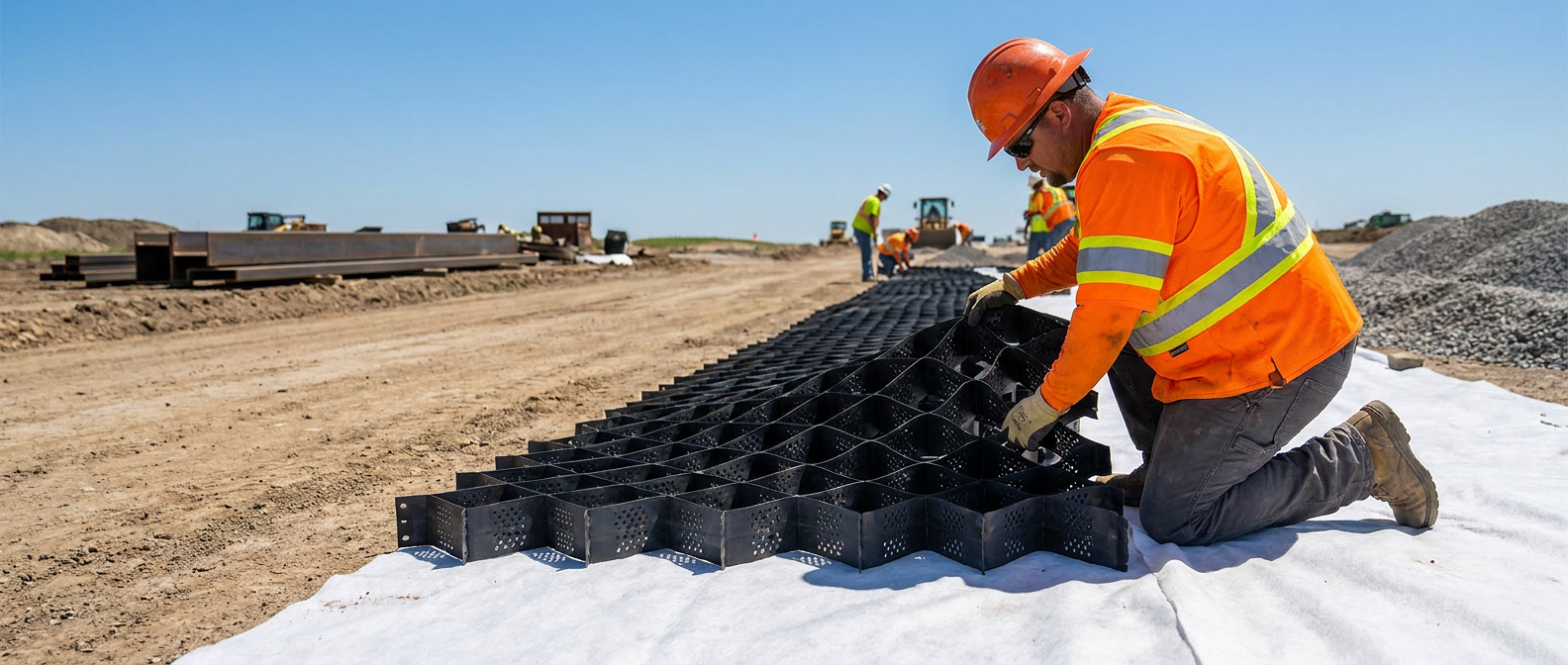
Geocell panels expand easily over a geotextile separation layer.
Connect adjacent panels using the integrated connection system—cell-to-cell alignment ensures continuous load transfer across the entire driveway surface. For driveways with curves or irregular shapes, cut panels to fit using standard hand tools.
Step 5: Select and Place Infill Material
Infill selection depends on application requirements:
- Angular crushed stone (3/4″ minus). Standard choice for vehicle traffic. Angular particles interlock within cells, maximizing confinement benefit. ASTM D448 Size No. 57 or No. 67 aggregate works well.
- Recycled concrete aggregate. Cost-effective alternative where available. Screen to remove oversized particles and fines.
- Native soil/aggregate blend. Acceptable for light-duty applications where native material meets minimum strength requirements.
Fill cells slightly above the cell wall height (overfill 1/2–1 inch). Compaction will settle infill to cell wall level.
Step 6: Compact and Finish
Compact infill with a vibratory plate compactor or roller. Make 3–4 passes minimum, adding infill as needed to maintain surface grade. Final compaction should achieve 95%+ Standard Proctor density within the cells.
For a finished appearance, top-dress with 1/2–1 inch of pea gravel or decorative aggregate. This cosmetic layer conceals the geocell structure while the confined aggregate below carries all structural load.
Installation Timeline
A two-person crew can typically install 2,000–3,000 square feet of geocell-reinforced gravel driveway per day, including subgrade prep, geotextile, geocell deployment, fill, and compaction. This timeline compares favorably to concrete (which requires forming, pouring, and 7+ days of curing) or asphalt (which requires hot-mix coordination, specialized paving equipment, and 24–48 hour cure time before traffic).
Industry Questions Answered
What depth of gravel is needed for a commercial driveway?
Commercial driveways supporting delivery trucks and heavy vehicles typically require 4–6 inches of geocell-confined aggregate over a prepared subgrade. Without geocell confinement, equivalent performance requires 12–18 inches of compacted aggregate—a 40–60% reduction in material volume. Exact depth depends on subgrade CBR and maximum expected axle loads; BaseCore’s engineering team provides project-specific recommendations through the free project evaluation.
How long does a geocell-reinforced gravel driveway last?
BaseCore™ Geocell delivers 75+ year structural lifespan based on HDPE material properties and accelerated aging testing. The aggregate infill may require periodic top-dressing (every 5–10 years depending on traffic) to replace surface wear, but the cellular confinement structure remains intact throughout the design life. This lifespan significantly exceeds asphalt (15–20 years with maintenance) and approaches concrete durability without expansion joints, cracking, or freeze-thaw vulnerability.
Is a gravel driveway cheaper than asphalt or concrete?
Geocell-reinforced gravel typically costs 30–50% less than asphalt and 50–70% less than concrete on a total installed basis. Cost advantages compound for projects with weak subgrades—where concrete and asphalt require extensive subgrade improvement, geocell’s load distribution mechanisms often allow installation directly on marginal soils. Additionally, permeable gravel surfaces may eliminate stormwater infrastructure costs required for impervious alternatives in regulated jurisdictions.
Conclusion
Durable gravel driveway installation isn’t about adding more aggregate—it’s about engineering proper confinement. BaseCore™ Geocell applies proven cellular confinement technology to transform loose gravel into a load-bearing structural system that eliminates rutting, migration, and the progressive failures that plague conventional gravel driveways.
For commercial and industrial facilities, geocell-reinforced gravel delivers the durability of rigid pavement at a fraction of the cost, with full permeability for stormwater compliance and 75+ year structural lifespan. Contact BaseCore’s engineering team for a free project evaluation at basecore.co/quick-basecore-quote or call 888-511-1553.
Comparison of vertical stress distribution between loose aggregate and geocell-reinforced gravel.
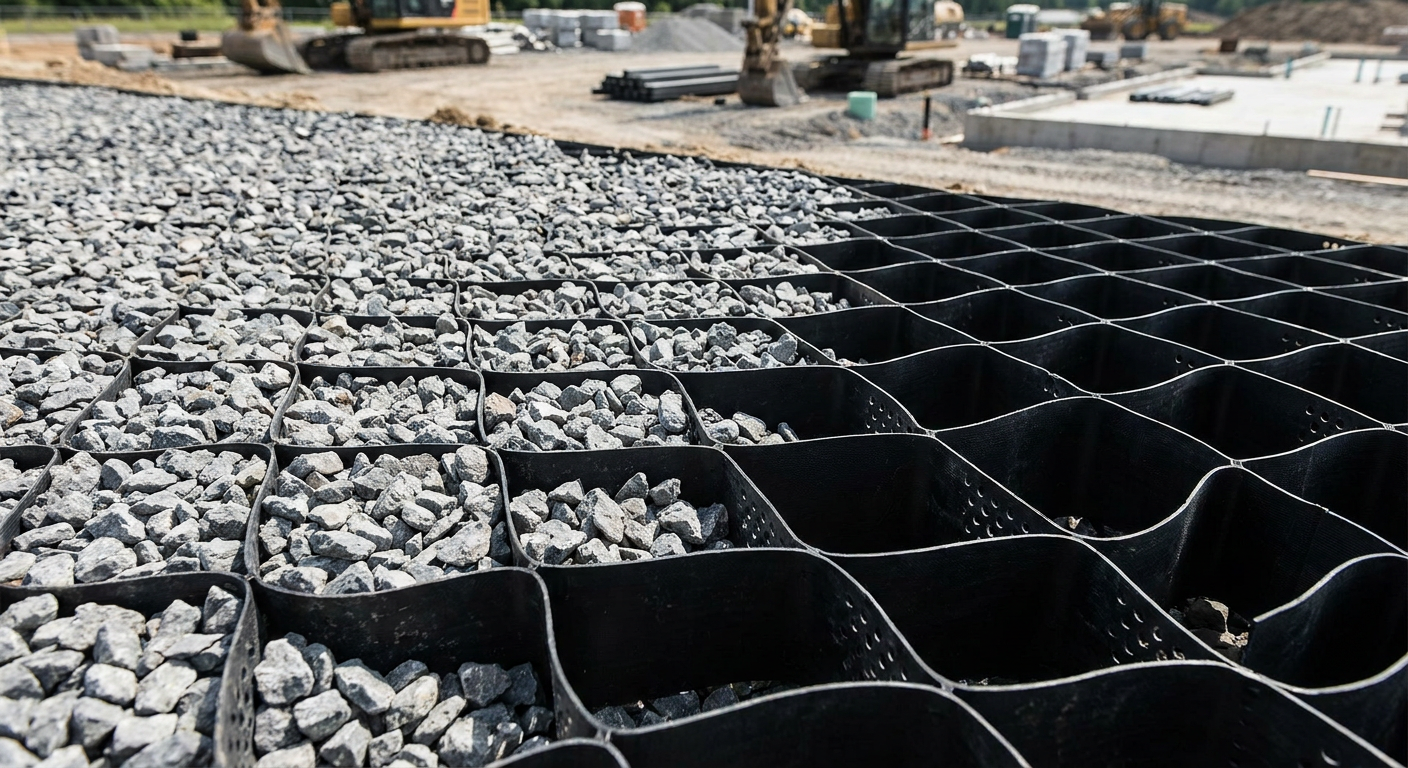
The three-dimensional HDPE matrix creates a semi-rigid composite layer.
Frequently Asked Questions
What type of gravel works best with geocell reinforcement?
Angular crushed stone in the 3/4-inch minus range (ASTM D448 Size No. 57 or No. 67) provides optimal performance with geocell. Angular particles interlock within cells more effectively than rounded river rock, maximizing the confinement benefit. The aggregate should be well-graded with minimal fines to maintain drainage while achieving high compaction density.
Can geocell-reinforced gravel handle heavy truck traffic?
Yes. BaseCore HD™ Geocell is engineered for H-20 and higher load classifications, supporting single-axle loads exceeding 16,000 lbs. Delivery trucks, garbage trucks, fire apparatus, and heavy equipment can operate on properly designed geocell-reinforced gravel surfaces without causing rutting or aggregate displacement.
Does geocell gravel driveway installation require specialized equipment?
No specialized equipment is required. Standard earthwork tools—excavator or skid steer for site prep, vibratory plate compactor for compaction—handle all installation steps. Geocell panels expand by hand and cut with standard hand tools. A two-person crew can install 2,000–3,000 square feet per day without paving equipment, concrete trucks, or hot-mix coordination.
How does a geocell gravel driveway handle stormwater?
Geocell-reinforced gravel is fully permeable—stormwater infiltrates directly through the aggregate surface into the subgrade below. This permeability satisfies EPA and local stormwater regulations that require permeable surfaces or Low Impact Development (LID) approaches. Unlike concrete or asphalt, geocell gravel typically eliminates the need for retention ponds, detention basins, or piped drainage infrastructure.
What is the ROI of geocell versus traditional driveway construction?
Geocell-reinforced gravel delivers 30–70% lower installed cost compared to asphalt or concrete, plus reduced long-term maintenance. The 75+ year geocell lifespan eliminates multiple asphalt overlay cycles or concrete panel replacements over the project lifetime. For commercial facilities, BaseCore’s free project evaluation includes cost comparison analysis for your specific site conditions.