

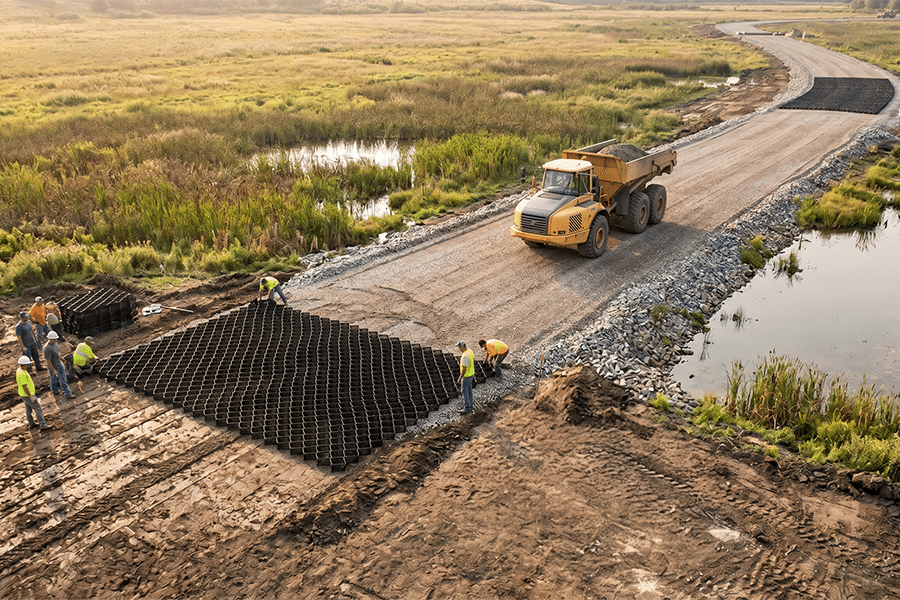
Every construction project, utility installation, film production, festival, and emergency response involves the same overlooked challenge: getting people and equipment across ground that was never meant to carry them. The traditional options have been expensive or environmentally damaging — crushed rock dumped and abandoned, timber mats that trap moisture and kill vegetation, or graded haul roads that leave lasting scars. An eco-friendly temporary road solutions provides the access your project needs without the lasting site impact, the regulatory complications, or the one-project-one-use waste. This guide walks through what makes a temporary road “eco-friendly,” where the approach applies, how the permitting and sustainability case works, and how to specify a BaseCore system for temporary use.
What Is an Eco-Friendly Temporary Road Solution?

An eco-friendly temporary road solution is a load-bearing ground access system designed to minimize environmental impact during installation, perform with minimal ecological disruption during use, and be fully removable at project close with the site capable of natural recovery. Core criteria include permeability (allowing water infiltration rather than creating runoff), reusability (the system can be lifted and redeployed), minimal site preparation (limited excavation or fill), and no chemical contamination of soil or groundwater.
The contrast is with traditional temporary access — dumped crushed rock, timber corduroy, chemically stabilized earth roads, or poured asphalt — each of which leaves meaningful residual site impact and typically cannot be reused.
BaseCore geocell meets every eco-friendly criterion: the HDPE panels are inert, they install over minimal base preparation, they maintain permeability under traffic, they lift cleanly at project close, and they redeploy on the next site. A single set of BaseCore panels routinely serves multiple temporary projects over its 60+ year service life.
Why Does Eco-Friendly Temporary Road Access Matter?
Eco-friendly temporary road access matters because construction access is one of the largest sources of site disturbance on any project, and regulatory frameworks increasingly require contractors to minimize and mitigate that disturbance. Stormwater Pollution Prevention Plans (SWPPPs) under the Clean Water Act, Section 404 permits for wetland crossings, LEED Sustainable Sites credits, and state environmental review processes all drive specification toward low-impact solutions.
Beyond regulatory compliance, eco-friendly temporary roads protect the contractor’s own interests. Site scarring triggers restoration costs, environmental violations trigger fines, and lasting damage to adjacent vegetation or hydrology can trigger liability. Permeable, removable, reusable road solutions reduce all three exposures simultaneously.
The economic case aligns with the environmental case: a reusable system amortizes across multiple projects, making the per-project cost substantially lower than single-use rock, timber, or asphalt alternatives.
What Makes BaseCore Geocell Eco-Friendly for Temporary Roads?

BaseCore geocell meets eco-friendly temporary road criteria through six distinct mechanisms: 90%+ permeability maintained under load, infill flexibility that accepts recycled and local materials, removability without site scarring, reusability across multiple projects, 60+ year service life that maximizes reuse cycles, and HDPE material that is chemically inert and recyclable at end-of-life.
Mechanism 1: Permeability
BaseCore maintains 90%+ permeability even under sustained heavy traffic because the cellular structure prevents the infill from compacting the way loose gravel does. Rainfall infiltrates directly through the road surface rather than running off to ditches or storm sewers. This is a qualified practice under EPA stormwater best management practices and is often the specific feature that lets a temporary road qualify as a permeable Best Management Practice (BMP) on a construction SWPPP.
Mechanism 2: Recycled and Local Infill Options
The infill inside BaseCore cells can be sourced locally or from recycled streams. Options include crushed stone from regional quarries (reducing transport emissions), asphalt screenings (diverting asphalt production byproduct), milled reclaimed asphalt pavement (RAP) from demolished road surfaces (diverting landfill waste), vegetated soil (maintaining green aesthetic and biological function), and on-site native aggregate where geology permits. Every one of these choices reduces the carbon footprint compared to imported fresh aggregate or hot-mix asphalt.
Mechanism 3: Clean Removability
At project close, BaseCore panels are lifted off their base course without breaking or damaging them. The underlying geotextile fabric can be pulled and reused or properly disposed of. The base aggregate can be collected for reuse elsewhere or left to be re-covered by native vegetation. No jackhammering, no asphalt disposal, no chemical residue in the soil.
Mechanism 4: Reusability Across Projects
The same BaseCore panels install, perform, remove, and redeploy on subsequent projects. Contractors who standardize on BaseCore for temporary access frequently amortize a single set of panels across five, ten, or more individual job sites. This reuse model is fundamentally different from single-use rock dumping or timber mats that degrade with each deployment.
Mechanism 5: 60+ Year Service Life
The HDPE material is UV-stabilized (70% strength retained at 1,500 hours per ASTM D4355), chemically resistant, and rated for service from -50°C to 80°C. This long service life is what makes the reusability mechanism economically viable. A product rated for 60+ years can realistically serve a contractor’s fleet for decades of temporary projects.
Mechanism 6: Recyclable HDPE
HDPE is the most widely recycled plastic polymer in the waste stream. At true end-of-service (well beyond the typical reuse cycle), BaseCore panels can be recycled through standard HDPE recycling infrastructure rather than landfilled.
Which Applications Benefit Most from Eco-Friendly Temporary Roads?
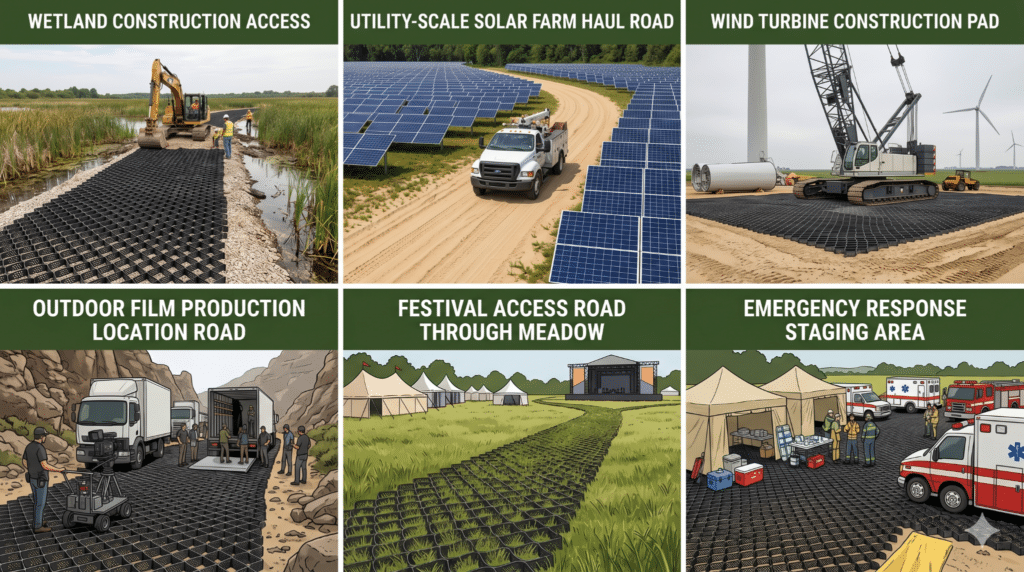
The approach adapts to a wide range of temporary-access scenarios.
Wetland and Floodplain Construction Access
Wetland crossings and floodplain access roads face the strictest environmental requirements in construction. Section 404 permits under the Clean Water Act often require temporary access methods that minimize wetland disturbance and allow full site restoration at project close. BaseCore geocell with appropriate high-strength BaseGrid woven fabric and local aggregate meets these requirements, lifts cleanly at project end, and leaves the wetland capable of natural recovery.
Utility-Scale Solar Farm Construction
Solar farm construction requires long access roads across rural and agricultural land that the project owner generally wants to return to its original condition (or a restored grassland state) after construction. Reusable BaseCore roads carry loaded panel transport trucks during construction, then lift out for redeployment on the next solar project.
Wind Farm Access and Turbine Crane Paths
Wind turbine installation requires extraordinary access — mobile crane paths capable of supporting the heaviest lift equipment in construction. BaseCore HD supports up to 60,000 kg gross vehicle weight at 8-inch cell depth, making it viable for wind construction. The permeable surface also supports stormwater compliance across the long linear paths typical of wind farms.
Oil and Gas Wellsite and Pipeline Access
Wellsite construction, workover operations, pipeline installation, and related oilfield activity face increasing environmental compliance requirements. An eco-friendly temporary road solution satisfies SWPPP, produced-water runoff, and reclamation commitments — and the reusable panels follow the operator’s equipment to the next location rather than being abandoned as single-use rock.
Film and Television Production Location Access
Outdoor film and television productions at scenic or environmentally sensitive locations need temporary access for equipment trucks, generators, and crew transport — without leaving permanent roads behind. BaseCore panels install, support production, and lift out at wrap, leaving the location in the condition the permit required.
Outdoor Events, Festivals, and Concerts
Music festivals, outdoor weddings, sporting events, and cultural gatherings in parks, meadows, and agricultural fields require temporary parking and vehicle access that doesn’t destroy the venue. Grass-reinforced BaseCore with vegetated infill maintains green aesthetics during use and supports full recovery afterward.
Emergency Response and Disaster Staging
Emergency management agencies, FEMA operations, and disaster response contractors need rapid-deployment access and staging areas on ground that was never engineered for heavy equipment. BaseCore panels deploy quickly, support response-phase traffic, and relocate as disaster recovery progresses.
Trailhead and Park Access Construction
Conservation organizations, state and federal land management agencies, and park authorities building temporary access for trail construction, ecological restoration, or fire management benefit from a low-impact road solution that lifts cleanly once the work is done.
Ecological Restoration Project Access
Restoration projects — stream bank stabilization, dune rehabilitation, prescribed burns, invasive species removal — require access that does not itself cause new damage. The reusable, removable nature of BaseCore makes it the preferred access specification on many restoration contracts.
Military and Defense Temporary Access
Forward operating areas, training range access, temporary helipads, and rapid-deployment staging yards benefit from logistically simple, reusable access. BaseCore panels ship compact, expand on site, install without specialized paving equipment, and redeploy as the mission moves.
Agricultural Access During Wet Seasons
Farm operators needing temporary field access during wet seasons or harvest can deploy BaseCore to keep equipment moving without compacting or rutting the soil. After the season, the panels lift out and the field returns to production.
How Does an Eco-Friendly Temporary Road Compare to Traditional Options?
BaseCore geocell typically costs less over its multi-project life than single-use alternatives, maintains full permeability (unlike asphalt or concrete), removes without site scarring (unlike compacted rock), avoids moisture-trapping damage to vegetation (unlike timber mats), and redeploys indefinitely (unlike any single-use option).
| Temporary Road Option | Permeability | Removable | Reusable | Site Scarring | Permit Fit |
| Dumped crushed rock | High initially | Partially | No | Moderate–High | Limited |
| Timber mats / corduroy | Moderate | Yes | Limited (degrades) | Moderate (vegetation kill) | Limited |
| Asphalt temporary road | None | Demolition required | No | High | Poor |
| Chemically stabilized earth | None | No | No | High | Poor |
| BaseCore geocell | 90%+ | Yes, clean | Yes, many cycles | Minimal | Strong (SWPPP, 404, LEED) |
For a broader comparison of paved versus permeable surfaces, see our alternative to asphalt guide.
How Does BaseCore Support Environmental Permitting?
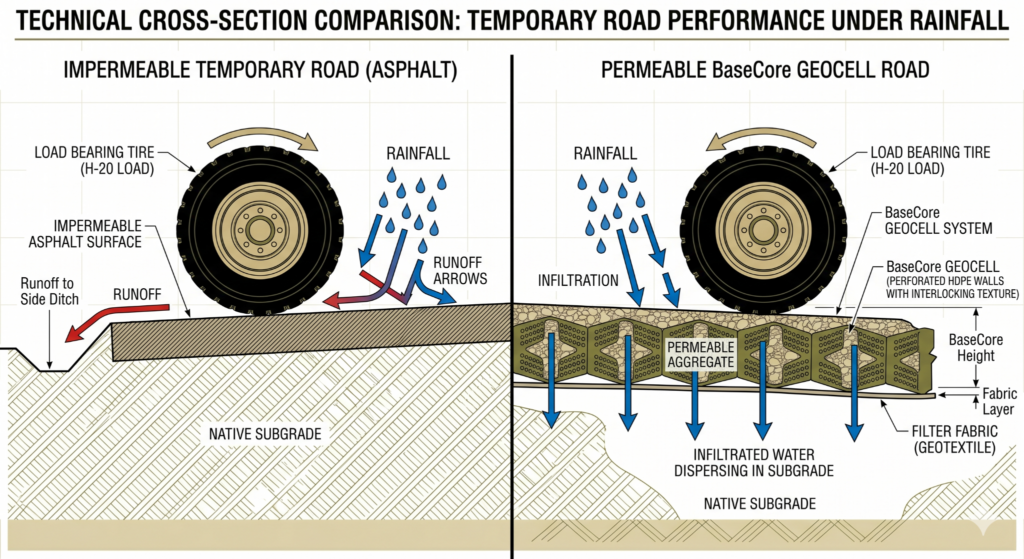
BaseCore supports three major environmental permitting frameworks directly. Under Stormwater Pollution Prevention Plans (SWPPPs) required by EPA Construction General Permits, BaseCore’s permeability qualifies it as a permeable surface BMP that reduces runoff. Under Section 404 permits for wetland crossings, its removability satisfies the “temporary impact” criterion. Under LEED v4 Sustainable Sites, its permeability supports Rainwater Management credits and its recyclable content supports Material and Resources credits.
SWPPP and Stormwater Compliance
The EPA Construction General Permit requires sites disturbing more than one acre to implement a SWPPP with BMPs for sediment and stormwater control. Permeable temporary access roads reduce the volume of runoff generated during construction and reduce the sediment loading in any runoff that does occur. BaseCore is recognized as a permeable pavement BMP under EPA stormwater guidance.
Section 404 Wetland Permits
The U.S. Army Corps of Engineers regulates work in wetlands under Section 404 of the Clean Water Act. Temporary construction access across wetlands generally requires either a Nationwide Permit or an Individual Permit, and both place heavy weight on minimizing duration and footprint of impact. A reusable, removable geocell road that can be installed and removed without significant wetland grading or fill is frequently the specified approach.
LEED and Green Building Certification
The U.S. Green Building Council LEED v4 rating system awards credits under Sustainable Sites (Rainwater Management) for projects that manage runoff volume and quality, and under Material and Resources for projects that specify recyclable and recycled-content materials. BaseCore can contribute to both categories on qualifying projects.
State Environmental Review
State-level environmental review processes (California CEQA, New York SEQRA, and similar) evaluate construction access impacts as part of broader project review. Low-impact temporary access solutions reduce mitigation requirements and streamline the review process.
How Do You Specify an Eco-Friendly Temporary Road Project?
Start by documenting the heaviest regular vehicle, the soil conditions, the expected project duration, the environmental regulatory framework, and the site restoration requirements. Request a tailored quote from BaseCore confirming cell depth, geotextile fabric, infill choice, and quantity including overage.
Step 1: Document Load Requirements
Identify the heaviest regular vehicle and any ground support equipment. Most eco-friendly temporary roads fall into the H-20 loading category (fire trucks, loaded commercial trucks, loaded service vehicles), which BaseCore HD handles at 4–6 inches of cell depth versus the 6–8 inches commonly specified across the industry.
Step 2: Evaluate Site Conditions
Document subgrade type (clay, silt, sand, organic, saturated), drainage patterns, wetland presence, and any existing vegetation that must be protected. Mention uncertainty during the BaseCore consultation — site photos and soil observations inform specification decisions.
Step 3: Identify Applicable Permits
Confirm whether your project falls under EPA Construction General Permit requirements (disturbance >1 acre), Section 404 wetland permits (any work in jurisdictional wetlands), local stormwater ordinances, or state environmental review. This shapes specification and documentation requirements.
Step 4: Select Infill Strategy
Choose infill based on the balance of structural requirements, environmental priorities, and site restoration goals. Crushed stone for structural performance, asphalt screenings for firmer surface, milled RAP for sustainability, or vegetated soil for green aesthetic and ecological recovery.
Step 5: Plan the Removal and Redeployment
Document how panels will be lifted, stored, and redeployed. Design for removability: use minimum base course thickness, choose infill that can be either collected or left to integrate with native soil, and specify edge restraint that can be removed without lasting ground disturbance.
Step 6: Request a Tailored Quote
BaseCore provides quotes at basecore.co/quick-basecore-quote or by phone at 888-511-1553. A 15-minute consultation covers recommended cell depth, material quantities, geotextile fabric specification, panel sizing (custom sizing reduces field connections and speeds installation), and total installed cost.
How Is the Road Installed and Later Removed?
Installation follows the standard BaseCore sequence — subgrade preparation, geotextile fabric, base course, expanded BaseCore panels, infill, compaction — with modifications for the temporary nature of the installation: minimum base thickness, removable edge restraint, and infill chosen for clean recovery.
For full installation detail, see professional installation standards in BaseCore’s installation guide. For removal at project close, the sequence reverses: edge restraint is removed first, infill is collected or left in place per site plan, BaseCore panels are lifted by hand or with a skid steer, and the geotextile fabric is pulled. A skilled crew removes a temporary road at roughly the same pace they installed it — up to 25,000 square feet per day.
The removed panels are inspected, cleaned if needed, stored flat or collapsed, and redeployed on the next project. Individual panels can be replaced if damaged without affecting the rest of the inventory.
Conclusion
An eco-friendly temporary road solution does three things well simultaneously: it provides the load-bearing site access your project actually needs, it minimizes environmental disturbance during that access, and it lifts cleanly at project close for redeployment on the next job. BaseCore geocell delivers all three. The HDPE panels maintain 90%+ permeability, support H-20 loading at just 4–6 inches of BaseCore HD cell depth, install at up to 25,000 square feet per day, accept recycled and local infill, and are engineered to last 60+ years across many reuse cycles. They support SWPPP compliance, Section 404 wetland permits, LEED Sustainable Sites credits, and state environmental review. Whether the project is a wetland crossing, a solar construction site, a festival, an emergency response, or a restoration access road, the eco-friendly temporary road solution is the same: a reusable, permeable, removable, engineered system. Request a tailored quote at basecore.co/quick-basecore-quote or call 888-511-1553.
Frequently Asked Questions
What makes a temporary road “eco-friendly”?
An eco-friendly temporary road is permeable (allowing water infiltration rather than runoff), removable at project close, reusable across multiple projects, installed with minimal site preparation, and free of chemicals that could contaminate soil or groundwater. BaseCore geocell meets all five criteria.
Can BaseCore really be removed and reused on another project?
Yes. BaseCore panels lift cleanly off their base course at project close, inspect for damage, and redeploy on subsequent projects. Contractors routinely amortize a single set of panels across many individual job sites over the system’s 60+ year service life.
Does an eco-friendly temporary road meet environmental permitting requirements?
Yes. BaseCore’s permeability qualifies under EPA SWPPP requirements; its removability supports Section 404 wetland permit compliance; and it can contribute toward LEED v4 Sustainable Sites credits for Rainwater Management and Material and Resources categories.
What loads can an eco-friendly temporary road support?
BaseCore HD supports H-20 loading (fire trucks, loaded commercial trucks) at 4–6 inches of cell depth and gross vehicle weights up to 60,000 kg at 8-inch cell depth, covering virtually all construction and emergency response equipment.
Can I use recycled materials as infill for a temporary road?
Yes. Milled reclaimed asphalt pavement (RAP), asphalt screenings, local crushed stone, and native aggregate all work as BaseCore infill. These options reduce transport emissions, divert waste from landfill, and lower the project’s overall environmental footprint.
This article references publicly available information from BaseCore (Scottsdale, Arizona), including the BaseCore Submittal Sheet, BaseCore Installation Guide, BaseCore Geocell Selection Guide, BaseCore Weights chart, and BaseCore vs. Asphalt vs. Concrete comparison sheet. Technical specifications reference ASTM D5199, D6392, D6818, D6454, D1693, D4355, and AASHTO T-180 standards. Environmental permitting references include U.S. EPA National Pollutant Discharge Elimination System (NPDES) Construction General Permit and stormwater best management practices, U.S. Army Corps of Engineers Section 404 of the Clean Water Act, and U.S. Green Building Council LEED v4 Sustainable Sites and Material and Resources credits. Results described are specific to the applications referenced and may vary based on site conditions, applicable permits, and installation technique. For current specifications, pricing, and warranty details, consult basecore.co or call 888-511-1553.