

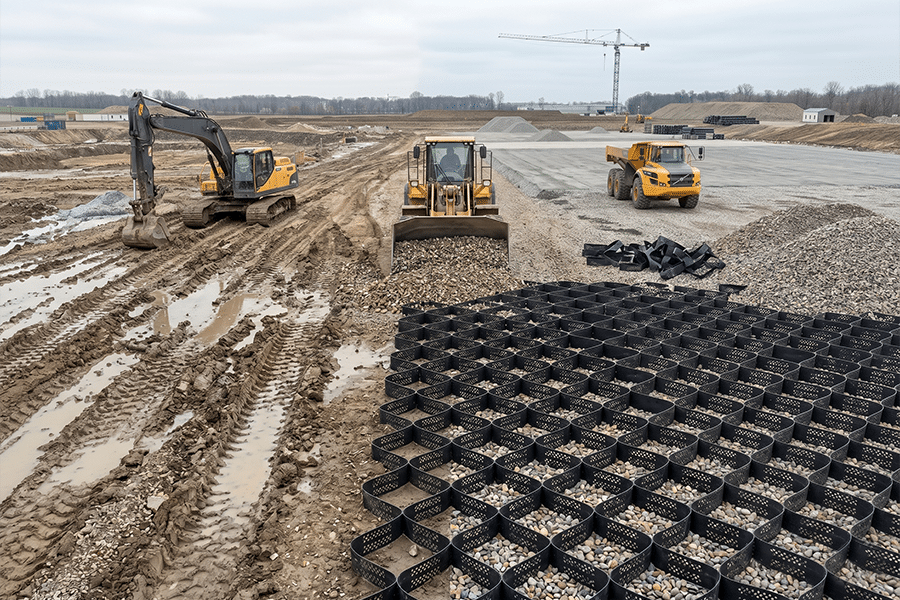
Soft soil is a universal construction problem. Low California Bearing Ratio (CBR) clays, saturated organic soils, recently disturbed fill, expansive soils, peat, muck, and high-water-table sites all deliver the same outcome without intervention: rutted access roads, stuck equipment, damaged underground utilities, construction delays, and blown budgets. The traditional remediation options — full excavation and replacement, lime or cement stabilization, thick aggregate mats — are expensive, slow, and often environmentally constrained. Geocell reinforce soft soil construction projects offers a faster, cheaper, permeable, and reusable alternative that transforms soft soil into usable construction ground without wholesale replacement.
This guide walks through the engineering principle behind soft-soil reinforcement, the specification logic, the installation procedure, and the construction applications where this approach delivers the most value.
What Counts as “Soft Soil” in a Construction Context?
Soft soil in construction refers to any subgrade with insufficient bearing capacity to support planned construction loads without unacceptable deformation. Common soft-soil categories include low-CBR clays (CBR below 3), saturated silts and organic soils, freshly placed or uncompacted fill, peat and muck, expansive clays that lose strength when wet, and high-water-table sites where groundwater proximity reduces bearing capacity.
In engineering terms, soft soil is typically characterized by California Bearing Ratio (CBR) below 5, subgrade modulus values below approximately 50 pci, or undrained shear strength below roughly 25 kPa. These soils rut quickly under construction traffic, pump fines upward into base courses, lose additional strength when saturated, and often cannot be stabilized cost-effectively by compaction alone.
Why Is Soft Soil a Problem for Construction Projects?
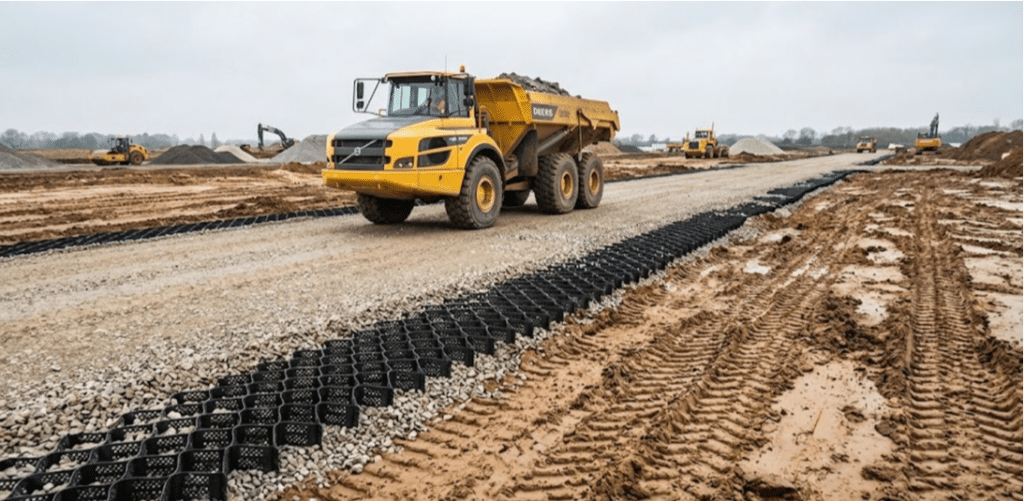
Soft soil causes five predictable construction problems: rutting under equipment traffic, subgrade pumping that contaminates aggregate bases, progressive bearing failure during rain events, accelerated wear on tires and tracks, and schedule delays when equipment becomes stuck. Each problem compounds the next.
Concentrated loads from loaded dump trucks, trackhoes, loaded trailers, and pickups contact soft soil across small footprints — often one to two square feet per tire. The resulting bearing pressure regularly exceeds the soft soil’s capacity, creating deep ruts within a few passes. Water collects in those ruts, softens the soil further, and propagates failure outward. A haul road that performed adequately for three days of dry weather can fail entirely after one heavy rain.
The traditional fix has been to excavate the soft zone, replace it with imported aggregate, and compact to specification. On a large construction site that can mean thousands of cubic yards of excavation and replacement — expensive, slow, and environmentally significant.
What Is the Engineering Principle Behind Geocell Soft-Soil Reinforcement?
Geocell reinforces soft soil through three mechanisms: cellular confinement (the HDPE cell walls prevent lateral spreading of the infill under load), load distribution (the interconnected honeycomb structure spreads concentrated contact loads across multiple cells), and structural coefficient improvement (confined infill behaves like a higher-grade pavement layer than unconfined material of the same composition).

The BaseCore Installation Guide documents this structural coefficient improvement with published equivalent-layer thickness data. BaseCore filled with sandy soil produces:
- Structural coefficient: 0.35
- Comparable raw materials: asphaltic concrete (0.41–0.44), crushed stone (0.14), sandy gravel (0.08–0.15), lime-stabilized soil (0.08–0.15), sandy soil (0.05–0.10)
Practically, a 4-inch BaseCore layer filled with sandy soil delivers structural performance equivalent to approximately 3.4 inches of asphaltic concrete, 10 inches of crushed stone, 12.7 inches of sandy gravel, or 20 inches of unconfined sandy soil. At a 6-inch cell depth, the equivalents scale to 5.1 inches of asphaltic concrete, 15 inches of crushed stone, or 30 inches of unconfined sandy soil.
This is why geocell soft-soil reinforcement often eliminates the need for thick aggregate replacement layers: the confined infill does more structural work per inch of thickness than the unconfined material it replaces.
Which Soft-Soil Construction Applications Benefit Most?

Any construction project dealing with low-bearing-capacity ground is a candidate for geocell reinforcement. Here are the most common scenarios.
Construction Haul Roads Over Clay and Silty Subgrade
Temporary and semi-permanent haul roads are the highest-volume application. Over low-CBR clay or silt, a haul road without reinforce soft soil construction projects rutts within days under loaded dump trucks and articulated haulers. A geocell-reinforced haul road maintains its profile for the duration of the project — and can be lifted and relocated to the next project when construction ends.
Wetland and Floodplain Temporary Access Roads
Wetland crossings and floodplain access roads face saturated subgrades with very low bearing capacity, plus strict environmental constraints that may prohibit fill import or lime treatment. A geocell-reinforced temporary access road using locally available infill minimizes environmental impact, requires no chemical stabilization, and can be removed at project close to restore the site.
Recently Placed Fill and Imported Soil Zones
Fresh engineered fill that has not fully consolidated can still be used for construction access by placing a geocell mattress on top. The cellular confinement bridges the still-consolidating fill and prevents differential settlement from compromising the access surface.
Post-Demolition and Brownfield Redevelopment Sites
Sites after building demolition often have loose, heterogeneous subgrade containing broken concrete, rubble, and disturbed fill. Installing a geocell over a separation fabric creates a stable construction platform without the cost of excavating and replacing the entire demolished footprint.
Expansive Clay Sites (Shrink-Swell Soils)
Expansive clays change volume dramatically between wet and dry seasons, cracking rigid pavements and heaving conventional aggregate bases. Geocell reinforcement accommodates modest movement without losing structural integrity, making it a practical choice for construction surfaces in expansive-soil regions.
Organic Soil and Peat Road Crossings
Organic soils and peat have extremely low bearing capacity — often CBR below 1. Traditional remediation requires deep excavation and replacement. A geocell mattress with appropriate base thickness and high-strength BaseGrid woven fabric can bridge organic zones and create usable construction access without the excavation cost.
Laydown Yards and Material Staging on Marginal Soil
Material storage yards, pipe laydown, equipment staging, and rebar storage all produce concentrated point loads over long durations on whatever ground is available. Reinforcing marginal soil with geocell creates usable staging without importing base aggregate for the entire yard footprint.
Mobile Crane and Piling Rig Pads on Soft Ground
Mobile crane outrigger pads and piling rig pads on soft ground require stable load transfer to prevent equipment overturn. The BaseCore Weights chart rates 200 mm (8-inch) cell depth for gross vehicle weights up to 60,000 kg, covering HGV, crane, and piling rig applications.
Solar Construction Access and Wind Farm Roads
Utility-scale solar and wind construction creates long access roads across undeveloped rural terrain with variable soil conditions. Geocell reinforcement lets the contractor build access once, use it through construction, and either leave it in place for maintenance access or lift and reuse it on the next project.
Erosion-Prone Slope Construction Access
Slope construction — embankments, levees, retaining walls — requires access roads on grades where soft soil compounds with gravity-driven movement. BaseCore’s Selection Guide specifies cell depth by slope steepness from 6:1 through 1:1 or steeper, pairing slope stability with soft-soil load distribution in a single system.
How Do You Diagnose Whether Your Soil Needs Reinforcement?
A soil needs reinforcement if (1) its bearing capacity is insufficient for planned construction loads, (2) it contains organic material, peat, or muck, (3) it is saturated or has a high water table, (4) it is expansive clay prone to shrink-swell, or (5) visual site inspection shows existing rutting, pumping, or deformation from prior traffic. Soil testing — including CBR, Proctor density, and moisture content — confirms the diagnosis and informs specification.
Visual Inspection Indicators
Walk the site after rain. Persistent standing water, soft or spongy areas underfoot, pre-existing ruts from prior traffic, visible organic material, and subgrade pumping (fines rising through aggregate during traffic) all signal soft-soil conditions that benefit from reinforcement.
Basic Field Testing
A dynamic cone penetrometer (DCP) test provides quick CBR estimates without laboratory work. Hand-auger samples reveal organic content and moisture. A simple walking test — heavy equipment driving short test passes on the native ground — quickly confirms whether the soil will support construction traffic without reinforcement.
Laboratory Testing When Warranted
For larger projects, standard laboratory CBR per ASTM D1883, Atterberg limits per ASTM D4318 to classify expansive clays, organic content per ASTM D2974, and Proctor density per AASHTO T-99 or T-180 inform engineered specification decisions.
When to Call BaseCore
Mention uncertainty about soil conditions during your BaseCore consultation. A project manager can review site photos, discuss preliminary specifications, and recommend soil testing scope appropriate to the project size and risk profile.
How Do You Specify a Soft-Soil Reinforcement System?
Specify cell depth, base course thickness, and geotextile fabric weight based on (1) the heaviest regular construction vehicle or static load, (2) the underlying soil’s bearing capacity, and (3) the intended service life. BaseCore’s published Weights chart maps cell depths 100 mm through 200 mm to gross vehicle weight categories from passenger cars through 60,000 kg HGV and crane applications.
Cell Depth Selection
| Construction Application | Gross Vehicle Weight | Recommended Cell Depth |
| Light site vehicles, foremen trucks | <6,000 kg | 100 mm (4″) |
| Delivery vans and light trailers | <9,000 kg | 100–150 mm (4–6″) |
| Emergency access and tractors | <16,000 kg | 150 mm (6″) |
| Standard construction traffic | <30,000 kg | 150–200 mm (6–8″) |
| Heavy construction traffic | <50,000 kg | 200 mm (8″) |
| HGV, crane, and piling rig | <60,000 kg | 200 mm (8″) |
Base Course Thickness
Over soft subgrade, base course thickness increases relative to stable-subgrade specifications. Typical soft-soil base course ranges from 6 to 12 inches of #57 crushed stone, compacted in lifts. Deeper base may be required for organic soils or high-water-table sites.
Geotextile Fabric
For soft subgrade, fabric weight increases for separation and reinforcement function. BaseCore’s Selection Guide specifies 6-to-8 oz non-woven fabric for standard applications, with BaseGrid high-strength woven fabric for heavy construction, H-20 loading, and crane/piling rig applications over marginal soil.
Custom Panel Sizing for Long Haul Roads
BaseCore can manufacture panels custom-sized to the geometry of your haul road or laydown yard. Larger panels reduce field connections, speed installation (up to 25,000 square feet per day with a 4–5 person experienced crew), and minimize cutting waste on long straight runs.
What Is the Complete Installation Procedure?

The installation sequence for soft-soil reinforcement is: grade and prepare the subgrade, lay separation or reinforcement geotextile, place and compact the crushed-stone base course, expand and connect the BaseCore panels, fill the cells completely with aggregate or sandy soil, and compact with an appropriately sized vibratory roller.
Step 1: Grade the Soft Subgrade
Do not over-excavate soft soil unless full replacement is the design intent. Instead, grade to a minimum 2% drainage slope and remove only standing water and loose debris. Over-working soft clay subgrade often makes it weaker, not stronger, by destroying natural structure and releasing pore water.
Step 2: Install Geotextile Fabric
Roll the specified fabric over the prepared subgrade in long runs with minimum 12-inch seam overlaps. For organic soils, peat, or saturated sites, BaseGrid high-strength woven fabric provides both separation and reinforcement function, preventing aggregate punch-through into the soft zone.
Step 3: Place and Compact the Base Course
Install base course in 6-to-8 inch loose lifts, compacting each lift before adding the next. Over soft subgrade, target 95% Modified Proctor density per AASHTO T-180 on each lift. Avoid over-rolling saturated subgrade — excessive compaction force on weak clay pumps water to the surface and destabilizes the layer.
Step 4: Expand and Connect BaseCore Panels
Expand panels and connect with BaseClips. On slopes exceeding 3:1 or along stream crossings where water may flow across the surface, stake panels with 1/2-inch rebar (18–24 inch length) through cell walls before filling.
Step 5: Fill Cells Completely Before Any Compaction
This is the most important installation rule: BaseCore cells must be filled completely before any equipment drives on the panels. Partial fill plus equipment equals cell wall collapse and panel damage. The three-dimensional confinement structure only functions when every cell is filled to full depth.
Acceptable infill for construction soft-soil reinforcement includes #57 angular crushed stone (preferred for structural performance), sandy soil (the published structural coefficient of 0.35 is based on this infill), asphalt screenings, milled reclaimed asphalt pavement (RAP) where a paved-style finish is desired, and vegetated soil for access roads that need to blend into the landscape post-project.
Step 6: Overfill and Compact
Overfill cells by 2–3 inches above cell tops before compaction. Use a 7-to-9 ton vibratory roller for heavy construction applications. Target 96% density. Water application during compaction improves density on dry infill.
Full professional installation standards are documented in BaseCore’s installation guide.
How Does Soft-Soil Reinforcement with Geocell Compare to Traditional Methods?
Geocell reinforcement typically costs 30–50% less than full excavation and replacement, installs faster than lime or cement stabilization, works without curing time, maintains 90%+ permeability, and can be lifted and reused on subsequent projects.
| Method | Installation Speed | Cost | Permeability | Reusable |
| Full excavation and replacement | Slow | High | Varies | No |
| Lime or cement stabilization | Moderate (curing required) | Moderate | None | No |
| Thick aggregate mat (unconfined) | Moderate | Moderate | High | No (material loss) |
| Geocell reinforcement | Fast (up to 25,000 sf/day) | Low to moderate | 90%+ | Yes |
| Timber corduroy or mats | Fast | Moderate | High | Sometimes |
For a broader category comparison of permeable versus paved approaches, see our alternative to asphalt guide.
What Does a Real Soft-Soil Reinforcement Project Look Like?
A contractor yard in Texas was sited on challenging clay subgrade. The project specification called for loaded dump trucks and heavy equipment staging — a typical soft-soil construction application. The engineering team selected 8-inch BaseCore HD with heavy-duty specifications and appropriate high-strength fabric over the clay subgrade.
Initial compaction with a 3-ton roller did not achieve adequate density in the 8-inch cell depth. The contractor paused, upgraded to a 7-ton vibratory roller, and increased water application. Final density testing returned 96% throughout the 40,000 square foot installation.
Five years post-installation, the yard has handled constant heavy truck traffic with zero settlement or rutting. The clay subgrade underneath has not been excavated, replaced, or chemically stabilized — only reinforced by the overlying geocell mattress and properly compacted base course. The system is still serviceable and has been documented for BaseCore’s long-service-life records.
What ASTM and AASHTO Standards Apply to Soft-Soil Reinforcement?
BaseCore geocell meets ASTM D6818 and D6454 guidelines, with ISO 9001 certified manufacturing. Material properties reference ASTM D5199 (sheet thickness), D6392 (seam peel strength, 1,420–2,000 N), D1693 (environmental stress crack resistance, >1,500 hours), and D4355 (UV resistance, 70% retained strength at 1,500 hours). Subgrade and base course compaction follows AASHTO T-180 (Modified Proctor).
Additional standards relevant to soft-soil diagnosis and design include ASTM D1883 (CBR), ASTM D4318 (Atterberg limits for plasticity classification), ASTM D2974 (organic content), and FHWA geosynthetic design guidelines for high-strength woven separation and reinforcement fabrics.
Conclusion
Soft soil does not have to stop or delay a construction project. A properly specified geocell reinforcement system transforms low-CBR clay, saturated silt, organic soil, expansive clay, recently placed fill, and post-demolition ground into usable construction surfaces — without full excavation and replacement, without chemical stabilization and curing delays, and without sacrificing permeability. BaseCore filled with locally available sandy soil delivers a structural coefficient of 0.35, approximately 7 times higher than unconfined sandy soil and approaching asphaltic concrete. The system installs at up to 25,000 square feet per day, handles gross vehicle weights up to 60,000 kg, and is engineered to last 60+ years. Custom panel sizing speeds installation on long haul roads and laydown yards. The next step is a 15-minute consultation. Request a tailored quote at basecore.co/quick-basecore-quote or call 888-511-1553.
Frequently Asked Questions
How soft can the soil be before geocell reinforcement won’t work?
Geocell reinforcement works on soils with CBR values as low as 1–2 when paired with appropriate base course thickness and BaseGrid high-strength woven fabric. For organic peat or muck, deeper base and heavier fabric specification are standard. Consult BaseCore with site conditions for engineered recommendations.
Can I install geocell over saturated soil?
Yes. Saturated subgrade is a common BaseCore application when paired with non-woven or high-strength woven separation fabric and adequate base course. Avoid over-compacting saturated clay subgrade — excessive force pumps water upward and weakens the layer. Work with BaseCore on proper specification.
Does geocell soft-soil reinforcement eliminate the need for excavation?
Often yes, though not always. For most construction applications, geocell reinforcement bridges soft zones without full excavation. Extremely deep organic or peat layers may still require partial excavation before reinforcement. BaseCore consultations review site conditions before recommending either approach.
How much load can a geocell-reinforced soft-soil surface hold?
BaseCore supports gross vehicle weights up to 60,000 kg at 200 mm cell depth, covering HGV, crane, and piling rig applications. Lighter configurations at 100–150 mm depths support standard construction traffic, delivery vans, and site vehicles. Specify for the heaviest regular load.
Can a reinforced soft-soil surface be removed after the project?
Yes. BaseCore panels can be lifted, moved, and reused on subsequent projects — a meaningful advantage for temporary construction access, wetland crossings, and project-specific haul roads where site restoration or panel reuse is part of the plan.
This article references publicly available information from BaseCore (Scottsdale, Arizona), including the BaseCore Submittal Sheet, BaseCore Installation Guide, BaseCore Geocell Selection Guide, BaseCore Weights chart, and structural coefficient data published in the Installation Guide. Technical specifications reference ASTM D5199, D6392, D6818, D6454, D1693, D4355, D1883, D4318, D2974, and AASHTO T-99 and T-180 testing standards. External references include U.S. Federal Highway Administration geotechnical and geosynthetic design guidelines and USDA Natural Resources Conservation Service soil survey resources. All metrics and project data are drawn from documented BaseCore records. Results are specific to the projects described and may vary based on site conditions, soil type, load specification, and installation technique. For current specifications, pricing, and warranty details, consult basecore.co or call 888-511-1553.