


A Pennsylvania manufacturer needed 30,000 square feet of overflow parking in six weeks. Asphalt quotes came in 40% over budget and required a $28,000 detention basin to handle runoff. By switching to a permeable asphalt alternative — BaseCore geocell with custom-sized panels — the facility eliminated the detention basin entirely and completed the project in nine days at roughly 55% of the lowest asphalt bid. That single outcome points to something bigger: the asphalt alternative isn’t one fixed product for one fixed use. It’s a system built to flex around your application, your loads, and even your preferred surface finish. This article walks you through the full range.
What the BaseCore Asphalt Alternative Actually Is
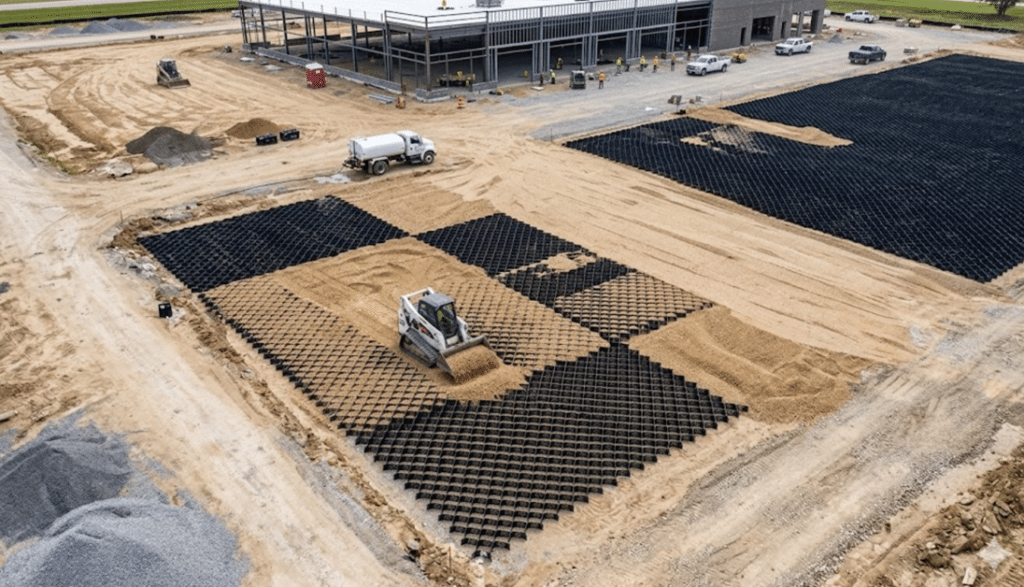
Let’s be precise about terminology, because it matters. BaseCore is not “geocell asphalt.” It’s a direct alternative to asphalt — a three-dimensional HDPE geocell structure that locks aggregate or infill material into individual honeycomb cells, creating a stable, load-bearing, permeable surface without any hot-mix paving involved.
The system is manufactured in Scottsdale, Arizona, in two primary product lines: BaseCore Standard (BC) and BaseCore HD (BCHD). Cell depths range from 2 inches up to 8 inches, sized to match the traffic load — from light foot and bike-path applications all the way to H-20 loading for fire trucks and loaded semis.
Why Custom Panel Sizing Matters
One of the most practical advantages over standardized alternatives: BaseCore can manufacture panels sized to fit your specific job. That means larger panels where the site geometry allows, fewer panel-to-panel connections, less cutting waste, and faster installation. A 4-to-5-person crew can install up to 25,000 square feet per day in part because BaseCore-sized panels reduce the number of connection points the crew has to make in the field.
For buyers comparing total installed cost against asphalt, panel customization translates into real labor savings and less leftover material at the end of the job.

The Infill Is the Surface — And You Have More Options Than You Think
This is where the asphalt alternative gets interesting, because the infill you choose inside the BaseCore cells largely determines the look, feel, and function of your finished surface. BaseCore cells are just the structural containment — what you put inside them is flexible.
Crushed Stone (The Standard Choice)
The most common infill is #57 or ¾-inch angular crushed stone. It compacts well inside the cells, stays locked in place, drains exceptionally well, and produces a clean commercial appearance. This is the default choice for most parking lots, yards, and driveways.
Asphalt Screenings (An Asphalt-Like Finish, Still Permeable)
If you want a surface that looks and feels closer to traditional asphalt but keeps all the permeability benefits of the BaseCore system, asphalt screenings are a strong infill option. Screenings are the fine dust-and-chip byproduct of asphalt production. When placed inside BaseCore cells and compacted, they create a dark, tight, asphalt-style surface that still drains through the system and still avoids the cracking, potholing, and resealing cycle of full hot-mix paving.
This is a particularly useful option for properties where aesthetic expectations lean toward a paved look — commercial frontage, mixed-use developments, HOA common areas — without committing to impervious pavement.
Milled Recycled Asphalt (Repurposing Old Pavement)
Here’s an option many buyers don’t realize exists: milled asphalt from an old lot can be repurposed as BaseCore infill. When asphalt is removed during resurfacing or replacement, it’s typically ground into reclaimed asphalt pavement (RAP). That material can be placed directly into BaseCore cells, compacted, and used as the driving surface.
The upside is significant. You get a familiar dark asphalt-like appearance, you divert material from landfill, you reduce new aggregate demand, and you often get the infill at very low or no cost from the demolition of the previous surface. For projects replacing aging asphalt with a permeable asphalt alternative, milled RAP is an obvious fit.
Vegetated Soil (The Grass-Reinforced Finish)
For properties that want to keep a green, landscaped look while still supporting vehicle loads — event overflow lots at churches and community centers, emergency access lanes, fire-truck turnaround zones behind residential developments — BaseCore accepts vegetated soil infill. Grass grows through the cells while the structural grid carries the load.
Angular Rock for Channels and Slopes
For erosion control on slopes and stormwater channels, BaseCore’s selection guide specifies angular rock infill at depths matched to slope steepness and flow velocity. This expands the system well beyond parking into civil-engineering applications.
Applications: The Many Ways BaseCore Replaces Asphalt

This is the section most worth lingering on if you’re in the research phase. The asphalt alternative isn’t locked to one application — it’s a platform. Here’s the breadth of what BaseCore is deployed for.
Commercial Parking Lots
The most common application: employee parking, customer lots, retail overflow, office parks, medical campuses. BaseCore handles passenger vehicle and light commercial traffic at 3-to-4-inch cell depths. Custom panel sizing and permeability often eliminate detention basin requirements in jurisdictions that would otherwise require them for asphalt.
Logistics Yards and Distribution Centers
Heavy-duty 6-to-8-inch BaseCore HD handles loaded semi-trucks, staging areas, and container yards. Documented installations have run five-plus years of continuous heavy-truck traffic with zero regrading — compared to traditional gravel yards that require quarterly regrading and frequent fresh-gravel replenishment.
RV Parks and Campgrounds
RV pads need to support loaded rigs (often 20,000+ lbs) without rutting, while keeping drainage clean. BaseCore with crushed stone or asphalt-screening infill provides a firm, level pad that handles repeated RV loading and unloading cycles and drains instantly after rain — a critical feature for campground operators who can’t afford to close sites after a storm.
Driveways (Residential and Commercial)
For long rural driveways, estate driveways, and commercial service drives, BaseCore ends the “fresh gravel every spring” cycle. Stones can’t migrate because they’re locked in cells. No ruts form because load distributes across multiple square feet per tire. Many owners use milled-asphalt infill for driveways to get a paved-driveway look without the paving cost.
Access Roads and Ranch Roads
Remote access roads serving farms, ranches, solar arrays, wind farms, oil and gas well pads, and construction staging areas are a strong BaseCore application. Installation doesn’t require paving crews or hot-mix plants, which is often the deciding factor when the nearest asphalt plant is an hour or more away.
Fire Lanes and Emergency Access
Fire code frequently requires vehicle access to buildings across surfaces that may otherwise be landscaped. Grass-reinforced BaseCore with vegetated soil infill keeps the green aesthetic while meeting H-20 loading for fire trucks. This is common on corporate campuses, multifamily residential developments, and institutional sites.
Event and Overflow Parking
Churches, event venues, wedding barns, sports complexes, and seasonal facilities use BaseCore with either crushed stone or grass-reinforced configurations for lots that may only see heavy use a few times per year. The economics rarely justify asphalt for intermittent-use lots; the asphalt alternative sized correctly does.
Trails, Bike Paths, and ATV/Horse Paths
2-to-3-inch BaseCore with smaller aggregate infill creates stable trail surfaces for foot, bike, ATV, and equestrian use. The cell structure prevents erosion and keeps the trail surface intact through heavy rain events.
Erosion Control Slopes
BaseCore on slopes — selected by slope steepness (6:1 through 1:1 or steeper) with appropriate cell depth — holds soil and vegetation in place, prevents washout, and supports revegetation. This is where BaseCore moves from “parking” into civil engineering.
Stormwater Channels and Spillways
Angular-rock-filled BaseCore lines drainage channels, swales, and spillways handling flow velocities up to 20 ft/s (and concrete-filled configurations for higher velocities). This is a specialty application but an important one — the same platform that replaces asphalt in your parking lot also handles the channel carrying stormwater away from it.
Solar Farm Access and Equipment Pads
Utility-scale solar developers increasingly use BaseCore for maintenance roads and equipment pads because of the speed of deployment, the permeability (which simplifies stormwater permitting), and the minimal long-term maintenance.
Boat Ramps, Beach Access, and Shoreline Applications
The HDPE material resists UV degradation and saltwater, making BaseCore viable in shoreline applications where asphalt breaks down quickly from sun, salt, and constant moisture cycling.
Measurable Outcomes — What the Numbers Actually Look Like
You don’t need a wall of case studies to see the pattern. A few documented data points are enough.
The Pennsylvania manufacturing facility mentioned in the introduction completed 30,000 square feet in nine days at 55% of the lowest asphalt bid, eliminated a $28,000 detention basin, and required zero maintenance in the three years following installation.
An Arizona distribution center replaced a traditional gravel yard that had been costing $12,000 annually in regrading. Five years post-installation with BaseCore HD, the yard has required zero regrading under continuous loaded-semi traffic.
A Georgia church replaced a muddy grass overflow lot with grass-reinforced BaseCore, completed in five days, with zero ruts after a 500+ vehicle event.
The consistent pattern across BaseCore projects: total installed cost typically lands at roughly 45–55% of comparable asphalt bids; permeability frequently eliminates stormwater infrastructure that asphalt would trigger; installation timelines run in days rather than weeks; and maintenance spend post-installation drops to near zero for the first decade-plus of service life.
Trade-offs worth naming honestly: the finish is determined by your infill choice, not by a paving contractor — so if you require the poured-and-rolled look of fresh asphalt specifically, crushed stone won’t deliver it (though asphalt screenings or milled RAP get you close). Sites with severely compromised soil may need more base preparation than asphalt would. Heavy-duty applications need thicker cells, which increases material cost relative to standard configurations.
How the Pieces Fit Together: Panels, Infill, Edges, Fabric
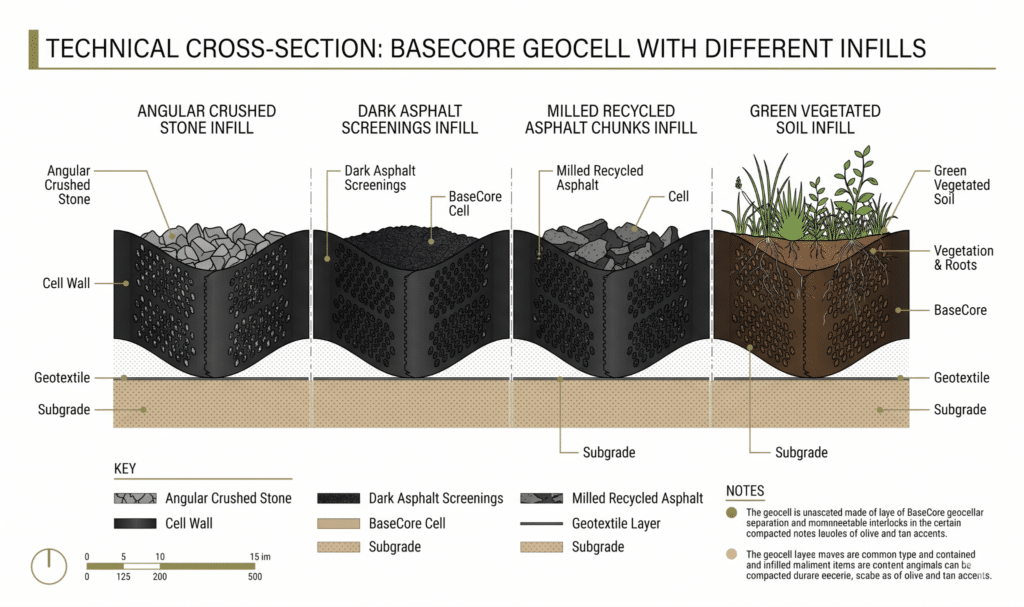
A BaseCore installation is five layers working together. Understanding them helps you plan accurately.
First, the subgrade — your native soil, graded to a 2% minimum drainage slope. Second, non-woven geotextile fabric (typically 6-to-12-ounce) separating soil from aggregate. Third, a compacted crushed-stone base course, typically 4 inches. Fourth, the BaseCore panels — custom-sized to your job for fewer connections and less waste. Fifth, your infill of choice — crushed stone, asphalt screenings, milled recycled asphalt, vegetated soil, or angular rock depending on application.
Edges are closed with your choice of concrete curbs, corten steel edging, pressure-treated wood, or flush excavation — selected by aesthetic and budget.
Full professional installation standards are documented in BaseCore’s installation guide.
Sustainability and Stormwater: Built-In Advantages
The asphalt alternative has an environmental profile asphalt simply can’t match. BaseCore maintains 90%+ permeability even under sustained heavy traffic because the cellular structure prevents the infill from compacting the way loose gravel does. This matters because permeable surfaces filter pollutants naturally, recharge groundwater, and reduce downstream flooding load — all documented benefits under EPA stormwater best management practices.
The aggregate infill also runs cooler than hot-mix asphalt, reducing urban heat island contribution. Permeable surfaces can contribute to LEED v4 Sustainable Sites credits for rainwater management.
The sustainability case strengthens when you use milled recycled asphalt as infill: you divert demolition waste from landfill, reduce demand for new aggregate, and preserve a permeable system rather than re-sealing the site with new impervious pavement.
Before finalizing any paving decision, call your local stormwater management office and ask how they treat permeable versus impermeable surfaces. The answer frequently changes the economics of the decision.
Practical Implementation Guide
Based on documented BaseCore project methodology:
Document your heaviest regular vehicle, not your average vehicle. Specify for the heaviest. Ask about detention basin elimination — this single factor often changes the economics. Choose your infill intentionally — crushed stone for most commercial, asphalt screenings for paved-look aesthetic, milled RAP if you’re replacing existing asphalt, vegetated soil for green applications, angular rock for slopes and channels. Request a tailored quote at basecore.co/quick-basecore-quote or call 888-511-1553 — panel sizes can be customized to your job. Plan on 25,000 sq ft/day installation with a 4-to-5-person crew, less for first-time crews. Review gravel parking lot design fundamentals before finalizing your layout.
Conclusion
The asphalt alternative isn’t a single product trying to imitate asphalt. It’s a platform — BaseCore geocell — that adapts to dozens of applications, accepts multiple infill types including recycled asphalt materials, ships in custom panel sizes to match your site, and installs at up to 25,000 square feet per day. Commercial buyers are choosing it because it typically lands at 45–55% of asphalt cost, eliminates stormwater infrastructure in many jurisdictions, and skips the crack-seal-patch-resurface cycle entirely.
If you’re sitting on an asphalt quote and wondering whether there’s a better path, the next step is a 15-minute call. Request a tailored quote at basecore.co/quick-basecore-quote or call 888-511-1553 — phone support is available, and specification sheets are downloadable on the website or available on request.
Frequently Asked Questions
Is BaseCore actually cheaper than asphalt?
In documented projects, total installed BaseCore cost typically runs 45–55% of comparable asphalt bids. Savings increase when permeability eliminates stormwater infrastructure — one 30,000 sq ft project saved $28,000 on detention basin costs alone.
Can I use recycled or milled asphalt as BaseCore infill?
Yes. Milled reclaimed asphalt pavement (RAP) from a demolished asphalt lot can be repurposed as BaseCore infill. It creates a dark asphalt-like surface, keeps permeability intact, and diverts demolition waste from landfill.
Does BaseCore have to look like a gravel lot?
No. Asphalt screenings produce a tighter, darker, paved-style finish. Milled RAP looks similar to weathered asphalt. Vegetated soil produces a full grass surface. Crushed stone produces the traditional gravel look. The infill determines the aesthetic.
How fast does BaseCore install?
A 4-to-5-person experienced crew installs up to 25,000 square feet per day. Custom panel sizing reduces connection points and waste, which is a major reason throughput is this high.
What applications does BaseCore cover beyond parking?
Parking lots, logistics yards, RV pads, driveways, access roads, fire lanes, event parking, trails, slopes, erosion control, stormwater channels, solar farm access, and shoreline applications — with infill and cell depth selected per use.
This article references publicly available information from BaseCore (Scottsdale, Arizona), including the BaseCore Installation Guide, BaseCore Geocell Selection Guide, BaseCore vs. Asphalt vs. Concrete comparison sheet, and documented customer project records from 2021 through 2025. External references include U.S. EPA NPDES stormwater best management practices and U.S. Green Building Council LEED v4 Sustainable Sites credits. All metrics are drawn from documented BaseCore project records. Results are specific to the organizations mentioned and may vary based on site conditions, soil, scale, and implementation approach. For current specifications, pricing, and warranty, consult basecore.co or call 888-511-1553.