

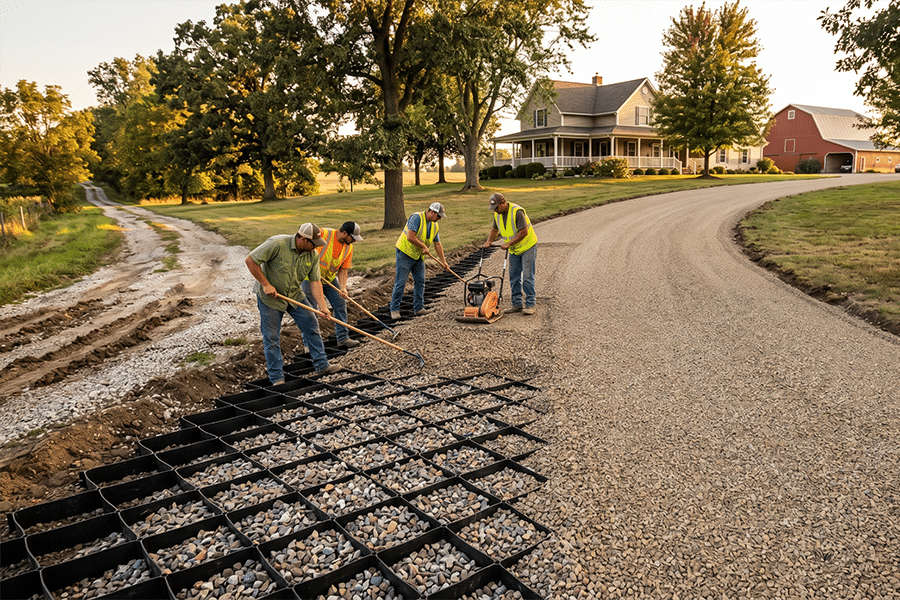
Gravel driveway owners typically spend between $500 and $8,000 a year on regrading, fresh stone, and rut repair — and that is before any major storm damage. A properly installed driveway grid ends that cycle permanently. One documented BaseCore customer in Ohio had been spending roughly $8,000 annually on gravel yard and driveway maintenance. Three years after installing BaseCore, they have done zero maintenance. This guide answers the questions buyers actually search for: what a driveway grid is, how long it lasts, which driveways it fits, what it looks like, how it installs, and whether to DIY or hire a contractor.
What Is a Driveway Grid?
A driveway grid is a three-dimensional honeycomb structure, typically made from high-density polyethylene (HDPE), that is placed on a prepared base and filled with gravel, crushed stone, asphalt screenings, milled recycled asphalt, or vegetated soil. The cell walls contain the infill so stones cannot migrate, ruts cannot form, and the driveway surface stays stable for decades.
BaseCore manufactures its driveway grid in two primary lines: BaseCore Standard (BC) and BaseCore HD (BCHD). Cell depths for driveway use range from 3 inches for light passenger vehicles to 6 inches for driveways serving loaded trucks, horse trailers, or heavy farm equipment. Panels come in stock sizes — 10×12, 10×20, and 9×18 feet — and can also be custom-manufactured to fit a specific driveway, reducing field connections and cutting waste.

How Long Does a Driveway Grid Last?
A BaseCore driveway grid is engineered to last 60+ years. The HDPE material is UV-stabilized and resistant to chemical, temperature, and moisture degradation. This lifespan significantly exceeds asphalt (15–20 years before resurfacing) and is comparable to or longer than poured concrete (typically 25–40 years before major work).
This durability is one of the reasons a driveway grid is often the lowest total-cost-of-ownership option over a multi-decade window, even when its initial installed cost is higher than loose gravel.
Why Do Traditional Gravel Driveways Fail?
Traditional gravel driveways fail because loose stone has nothing holding it in place. Vehicle weight concentrates at tire contact points and pushes stones into the softer subgrade below. Water collects in the resulting depressions, softening the subgrade further. Stones migrate into ruts, creating bare spots. Fresh gravel disappears the same way the old gravel did.
A driveway grid breaks this pattern by physically containing each stone inside a cell wall. Tire load spreads across multiple square feet of interconnected grid structure — the snowshoe effect — rather than concentrating at tire contact points. Stones stay where they were placed, and the driveway stops failing.
Which Driveway Types Work Best with a Driveway Grid?

A driveway grid adapts to almost every residential driveway configuration. Here are the most common use cases and why the grid fits each one.
Long Rural and Estate Driveways
Driveways running 500 feet to half a mile or more face constant migration and maintenance simply because of length. Asphalt is cost-prohibitive at this scale and concrete even more so. A driveway grid with crushed stone or milled asphalt infill provides a stable, permeable surface across the full length without hot-mix paving, specialized equipment, or multi-day curing.
Short Suburban Driveways
For standard residential driveways between 500 and 1,500 square feet, a driveway grid is often the quickest and cleanest path to a low-maintenance permeable surface that will not crack like aging asphalt or look industrial. Short driveways are also the zone where DIY installation is most realistic.
Sloped and Hillside Driveways
Driveways on grades are where loose gravel fails fastest — every rainstorm washes stones downhill, creating gullies and exposing subgrade. BaseCore’s selection guide specifies driveway grid cell depths based on slope steepness: 3-inch cells for gentle slopes (6:1 or less), 4-inch for moderate slopes, and deeper cells for steep grades. The cell walls hold stone in place against both gravity and water flow.
Circular and Turnaround Driveways
Circular driveways and vehicle turnaround areas get the most tire-pivot wear, which is exactly where loose gravel develops the worst bare spots. A driveway grid locks stones in place through that repeated pivot stress.
Shared Driveways
When two or three neighboring properties share one driveway, maintenance disputes are common. A driveway grid simplifies the cost math: one installation, decades of service, minimal ongoing expense for all parties.
Seasonal, Cabin, and Vacation Driveways
Properties used only part of the year benefit from a driveway grid because the surface survives the off-season without maintenance. No regrading rush before the family arrives every spring.
Farm, Ranch, and Agricultural Driveways
Working properties see heavier loads: tractors, hay wagons, livestock trailers, delivery trucks. BaseCore HD at 4-to-6-inch cell depth handles those loads while staying permeable enough that rain and livestock runoff drain through the surface.
Boat, RV, and Trailer Pads Off the Driveway
Many homeowners need a stable parking pad for a boat, RV, camper, or utility trailer adjacent to the main driveway. The same driveway grid system extends into the pad without rutting or sinking under parked rigs.
What Are the Infill Options for a Driveway Grid?
The infill placed inside BaseCore cells determines the driveway’s final appearance. Options include angular crushed stone (traditional gravel look), asphalt screenings (paved-style finish, still permeable), milled recycled asphalt or RAP (dark paved appearance, sustainable), vegetated soil (grass-reinforced driveway), and decorative stone (premium finish).

Crushed Stone
The most common driveway grid infill. Three-quarter-inch angular crushed stone compacts inside the cells, drains exceptionally well, and produces the classic crushed-gravel appearance most rural and estate properties want. Colors vary by regional quarry — tan, gray, brown, and red limestone are all widely available. Avoid round river rock or pea gravel; round stones do not lock together inside cells and can still roll under load.
Asphalt Screenings
Asphalt screenings — the fine dust-and-chip byproduct of asphalt production — produce a dark, tight, asphalt-style finish when compacted inside the cells. The surface reads as paved at the curb but remains permeable and avoids the cracking, sealing, and resealing cycle of hot-mix asphalt. This is a strong choice for homeowners who want the paved look without committing to paved maintenance.
Milled Recycled Asphalt (RAP)
Reclaimed asphalt pavement from a demolished asphalt driveway or roadway can be repurposed directly as driveway grid infill. The result is a familiar dark asphalt-like appearance while diverting demolition waste from landfill. Homeowners replacing an aging cracked asphalt driveway often use the milled remnants as the new infill, which reduces cost and improves sustainability in one step.
Grass-Reinforced (Vegetated Soil)
For secondary drives, guest parking areas, or code-required fire-lane access that needs to visually blend into lawn, vegetated soil infill allows grass to grow through the cells while the HDPE grid carries the load underneath. The finished surface looks like a reinforced lawn.
Decorative Stone
For entry driveways and estate properties, decorative angular stone — white marble chip, colored granite, or crushed bluestone — delivers a premium visual finish while functioning identically to standard crushed-stone infill.
How Does a Driveway Grid Compare to Other Surfaces?
A driveway grid typically delivers the lowest total cost of ownership for rural, estate, long, sloped, and budget-conscious driveways. It is more permeable than asphalt or concrete, requires less maintenance than loose gravel, and has a 60+ year service life.
| Surface | Upfront cost | Maintenance | Lifespan | Permeability |
| Loose gravel | Lowest | High (annual regrading) | Failure cycle | High initially, drops with compaction |
| BaseCore driveway grid | Moderate | Minimal | 60+ years | 90%+ |
| Asphalt | High | Moderate (sealing, crack repair) | 15–20 years | None |
| Concrete | Highest | Low | 25–40 years | None (standard mixes) |
| Pavers | High | Moderate (settling, weeds) | 20–30 years | Moderate with permeable pavers |
For a deeper category comparison, see our asphalt alternative guide.
How Do You Plan a Driveway Grid Installation?
Measure square footage and add 5–10% for waste. Identify the heaviest regular vehicle. Observe drainage during rain. Request a tailored quote from BaseCore to confirm cell depth, fabric specification, infill type, and edge restraint. Decide whether to install DIY or hire a site contractor.
Step 1: Measure and Add Overage
Calculate length × width for rectangular driveways. For curves and irregular shapes, break the drive into sections and add the totals. Aerial mapping tools with measurement features work well for long driveways. Add 5–10% overage for cuts, waste, and irregular edges. Long straight runs should be flagged when requesting a quote so BaseCore can custom-size panels to reduce waste further.
Step 2: Document Your Heaviest Vehicle
Specify for the heaviest vehicle that regularly uses the driveway, not the average one. A driveway used “mostly by cars, occasionally by a propane truck or horse trailer” needs to be specified for the truck or trailer. Under-specifying is the single most expensive mistake in BaseCore’s documented buyer records.
Step 3: Observe Drainage
Walk the driveway during or after rain. Note where water flows, where it collects, and whether washout patterns exist at the bottom of slopes. A driveway grid’s 90%+ permeability usually solves these problems, but observing current flow confirms where the infiltration advantage matters most.
Step 4: Request a Tailored Quote
BaseCore offers quick quotes at basecore.co/quick-basecore-quote/ or by phone at 888-511-1553. A 15-minute call covers recommended cell depth, estimated material quantities, geotextile fabric specification (typically 6–12 oz non-woven), edge restraint options (concrete curbs, corten steel, pressure-treated wood, or flush excavation), and ballpark pricing.
How Is a Driveway Grid Installed?
A driveway grid installs in five layers: prepared subgrade, non-woven geotextile fabric, compacted crushed-stone base course, expanded BaseCore panels, and the final infill. A 4–5 person experienced crew can install up to 25,000 square feet per day.

The Five Layers
- Subgrade — native soil graded for drainage with at least a 2% slope where topography allows.
- Non-woven geotextile fabric (6–12 oz) over the subgrade to prevent soil migration into the aggregate above.
- Compacted crushed-stone base course, typically 4 inches of #57 stone.
- BaseCore driveway grid panels, expanded and connected with BaseClips. Custom-sized panels reduce the number of connections and speed installation.
- Infill of choice — crushed stone, asphalt screenings, milled RAP, or grass soil — slightly overfilled 2–3 inches above cell tops and compacted with a vibratory roller.
Edges are closed with concrete curbs, corten steel edging, pressure-treated wood, or flush excavation. Full professional installation standards are documented in BaseCore’s installation guide.
Should You DIY or Hire a Contractor?
DIY is realistic for driveways under 5,000 square feet if the homeowner has construction experience, access to a 3-ton-plus roller (rentable), hand tools, and a 2–4 person crew. Contractor installation is recommended for longer driveways, sloped driveways, heavy-duty applications, and anytime the homeowner wants it done right the first time without the weekend commitment.
Most experienced local site contractors can install a BaseCore driveway grid using the provided installation guide. No specialized paving equipment is required — just an excavator or skid steer for grading, a roller for compaction, and standard hand tools. Homeowners who DIY typically save 50 cents to one dollar per square foot in labor costs.
What Are the Sustainability Benefits?
A driveway grid is permeable, which allows rainfall to infiltrate directly rather than running off to ditches, storm drains, or neighboring properties. BaseCore maintains 90%+ permeability even under sustained traffic because the cell structure prevents infill compaction.
Permeable driveways are recognized under EPA stormwater best management practices and can help rural properties reduce contribution to downstream flood loads. For homeowners on septic systems or near sensitive watersheds, a permeable driveway reduces concentrated runoff that carries sediment and contaminants into groundwater and surface water. Using milled recycled asphalt as infill compounds the sustainability benefit by diverting demolition waste from landfill while keeping the new surface permeable.
Conclusion
A driveway grid is a straightforward purchase: an HDPE honeycomb structure that locks your gravel, asphalt screenings, milled RAP, or grass in place so the driveway stops failing the way gravel driveways normally fail. It fits short, long, sloped, circular, shared, farm, and seasonal driveways. Custom panel sizing keeps installation efficient at up to 25,000 square feet per day. Infill choice determines the finished look. BaseCore is built to last 60+ years. The next step is a 15-minute call. Request a tailored quote at basecore.co/quick-basecore-quote/ or call 888-511-1553.
Frequently Asked Questions
How long does a BaseCore driveway grid last?
BaseCore driveway grids are built to last 60+ years. The HDPE material is UV-stabilized and resistant to chemical, temperature, and moisture degradation, significantly outlasting asphalt and comparable to or exceeding concrete.
Can I install a driveway grid myself?
Yes, for driveways under roughly 5,000 square feet. You need basic grading capability, a 3-ton-plus roller (rentable), hand tools, and 2–4 people. BaseCore includes a detailed installation guide with every order. For larger or sloped driveways, a local site contractor is the better path.
Does a driveway grid work with snow plowing?
Yes. With infill compacted to or slightly above cell tops, a plow blade glides across the gravel surface exactly as it would on a traditional gravel driveway. Elevate the blade slightly if needed to avoid scraping infill from the cells.
Can I use recycled asphalt as driveway grid infill?
Yes. Milled reclaimed asphalt pavement (RAP) works well inside BaseCore cells, producing a dark paved-style surface that remains permeable. Homeowners replacing an old asphalt driveway often use the milled material from demolition as the new infill.
What infill looks most like a paved driveway?
Asphalt screenings and milled recycled asphalt both produce a dark, tight, paved-style finish inside the driveway grid. Both remain permeable and avoid the cracking and resealing cycle of hot-mix asphalt.
This article references publicly available information from BaseCore (Scottsdale, Arizona), including the BaseCore Installation Guide, BaseCore Geocell Selection Guide, BaseCore vs. Asphalt vs. Concrete comparison sheet, and documented customer project records. External references include U.S. EPA NPDES stormwater best management practices and U.S. Department of Agriculture NRCS guidance. All metrics are drawn from documented BaseCore project records. Results are specific to the properties mentioned and may vary based on site conditions, soil, driveway length, and slope. For current specifications, pricing, and warranty, consult basecore.co or call 888-511-1553.