

The $100 Billion Problem Behind Every Empty Lot
A 2025 study commissioned by Truck Parking Club and conducted by transportation economist Noël Perry found that America’s truck parking shortage costs the industry over $100 billion annually. Each day, 2.4 million commercial trucks need parking spaces for federally mandated rest breaks—but only 697,000 official spaces exist nationwide. That’s a deficit of roughly 1.7 million spaces, or about 70% of daily demand.
The American Transportation Research Institute ranked truck parking as the number two overall industry concern in both 2023 and 2024. Drivers spend an average of 56 minutes daily searching for legal parking and drive 15 extra miles per day circling for spots, according to that same Truck Parking Club study.
For property owners, logistics operators, and facility developers, the opportunity is clear. But designing a truck parking lot that actually withstands 80,000-pound loads for years—without constant repairs—requires a fundamentally different approach than standard passenger vehicle lots.
This guide covers every design standard you need, from layout dimensions and turning radii to surface materials and drainage, so your investment performs from day one.
What Truck Parking Lot Design Actually Requires
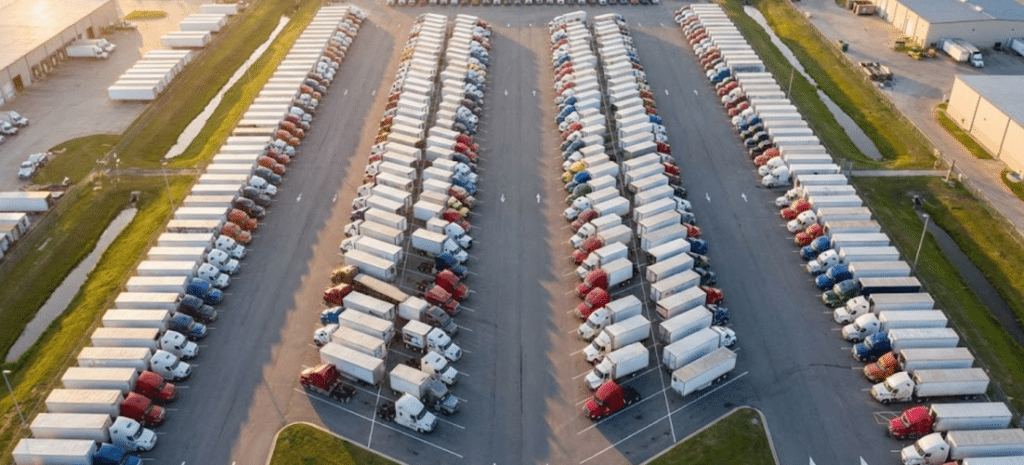
Designing parking for commercial trucks is not simply scaling up a standard car lot. The vehicles are fundamentally different. A loaded semi-truck with a 53-foot trailer weighs up to 80,000 pounds, measures roughly 70 feet bumper to bumper, requires a minimum outer turning radius of 40 to 60 feet, and exerts tire pressures exceeding 100 PSI—compared to roughly 30 PSI for passenger cars.
These realities dictate every decision, from lot dimensions and aisle widths to surface thickness and drainage capacity. Getting any one element wrong creates cascading failures. A lot with adequate dimensions but an undersized surface crumbles under load. A lot with the right surface but inadequate turning radius forces drivers into dangerous maneuvers that damage both vehicles and infrastructure.
The Federal Highway Administration published its Draft Truck Parking Development Handbook in December 2021, establishing guidance for public agencies developing truck parking. ATRI’s subsequent research found that the median cost for a state to construct one truck parking space was $93,500 using traditional methods—with funding, community pushback, and finding suitable land ranking as the top three challenges.
That $93,500 figure underscores why facility developers need to consider every design standard carefully—and why exploring alternatives to traditional concrete and asphalt surfaces can dramatically affect project economics.
Truck Parking Lot Layout and Dimensions
Getting the physical layout right is the foundation of every successful truck parking facility. These dimensions are based on industry standards for accommodating the WB-67 design vehicle—the standard 73-foot tractor-trailer combination used in U.S. highway design.

Parking Stall Dimensions
Individual truck parking stalls must accommodate the full length and width of a tractor-trailer combination plus provide clearance for safe entry and exit:
- Width: 12 to 15 feet per stall. Twelve feet is the minimum, but 14 to 15 feet is preferred for driver comfort and to reduce the risk of vehicle-to-vehicle contact.
- Length: 55 to 75 feet depending on vehicle type. Standard semi-trailers require 55 x 14 feet for storage. Truck-and-trailer combinations need approximately 75 x 14 feet.
- Backing clearance: Drivers need approximately 100 feet of clear space behind stalls for safe backing maneuvers. The central area of your lot must remain unobstructed.
- Vertical clearance: Minimum 14 feet for any covered areas or overhead structures.
For a mixed-use facility expecting a variety of truck types, plan stalls at the larger end of these ranges. Trying to squeeze more trucks into undersized stalls leads to accidents, blocked vehicles, and frustrated drivers who take their business elsewhere.
Drive Aisle Widths and Turning Radius
Drive aisles serve as the circulatory system of your truck lot. Undersized aisles create bottlenecks, vehicle damage, and safety hazards.
The minimum outer turning radius for a medium-sized semi-truck making a 180-degree turn is 40 feet, though 60 feet is recommended for safer, more fluid navigation.
- One-way aisles: Minimum 24 feet wide; 30 feet preferred
- Two-way aisles: Minimum 40 feet wide; 50 feet preferred
- End-of-row turnarounds: Minimum 60-foot outer radius; 80 feet preferred
Pro Tip from Our Project Managers: A common mistake is designing aisles based on straight-line travel only. Trucks don’t just drive in straight lines—they must navigate turns from aisles into stalls, requiring swept-path analysis that accounts for off-tracking (the difference between the front and rear wheel paths during a turn). Engaging a traffic engineer for swept-path analysis during the design phase costs a few thousand dollars and prevents hundreds of thousands in future redesign.
Layout Configurations
Three primary configurations work for truck parking lots, each with trade-offs:
- Parallel (0-degree): Parking spots set parallel to the curb. Best for narrow, elongated lots along highways. Maximizes capacity per linear foot but requires the longest drive aisles for entry and exit.
- Angled (30 to 60 degrees): Stalls arranged at angles to the aisle. Simplifies entry and exit, speeds movement, and reduces accident risk. The most popular configuration for commercial truck parking.
- Perpendicular (90 degrees): Standard right-angle parking. Requires the widest aisles for backing but makes efficient use of lot width. Best for wide, rectangular lots.
For most truck parking facilities, angled parking at 45 to 60 degrees offers the best balance of capacity, driver convenience, and safety. This configuration reduces the backing distance and turning complexity compared to perpendicular layouts while using space more efficiently than parallel.
Space Allocation: How Your Acreage Translates to Capacity
Understanding how your total acreage translates to actual parking capacity requires knowing how space distributes across functions:
| Function | % of Total Area | Notes |
| Parking stalls | 50–60% | Core capacity area |
| Circulation lanes & turning | 25–30% | Aisles, turnarounds |
| Staging & queuing zones | 10–15% | Entry/exit buffers |
| Support facilities | 5–10% | Restrooms, lighting, fencing |
A rough rule of thumb: plan for approximately 900 to 1,000 square feet per semi-truck stall (12 x 75 feet), then add 40 to 50 percent for circulation, staging, and support areas. A 50-truck facility therefore requires roughly 3 to 4 acres of usable land.
Surface Design: Why Traditional Materials Fail Under Trucks
Surface selection is arguably the most consequential decision in truck parking lot design. A loaded semi-truck tire exerts over 4,250 pounds of force—more than eight times the load of a passenger car tire. During turning movements, pressures can spike above 200 PSI. Traditional parking lot surfaces simply weren’t engineered for these forces applied repeatedly, day after day.
The Asphalt Problem
Standard asphalt paving designed for 100 to 120 PSI maximum fails rapidly under truck traffic. The failure cycle is predictable: surface cracks form within 2 to 3 years, water infiltrates the cracks and weakens the base, freeze-thaw cycles accelerate the damage, and within 3 to 5 years major structural repair becomes necessary.
For truck parking specifically, asphalt softens in extreme heat, allowing heavy static loads from parked trucks to create permanent ruts and depressions. Truck-rated asphalt applications cost $7 to $13 per square foot. Add sealcoating every 2 to 5 years, crack repairs, and full resurfacing every 15 to 20 years, and the lifecycle cost escalates dramatically.
The Concrete Limitation
Concrete performs better under static loads but suffers from thermal expansion and contraction that causes slab cracking. Heavy truck loads cause corner breaks and joint failures. A concrete truck parking lot costs $4 to $8 per square foot for materials and labor, with total project costs for a 50-space lot reaching $400,000 to $600,000—before stormwater infrastructure.
Concrete’s rigidity—the quality that seems like strength—becomes a liability as slabs settle differentially, creating trip hazards and drainage problems. Annual repair costs for concrete truck lots average $20,000 to $40,000, with complete reconstruction typically needed within 15 years.
How BaseCore HD Geocell Solves the Surface Problem
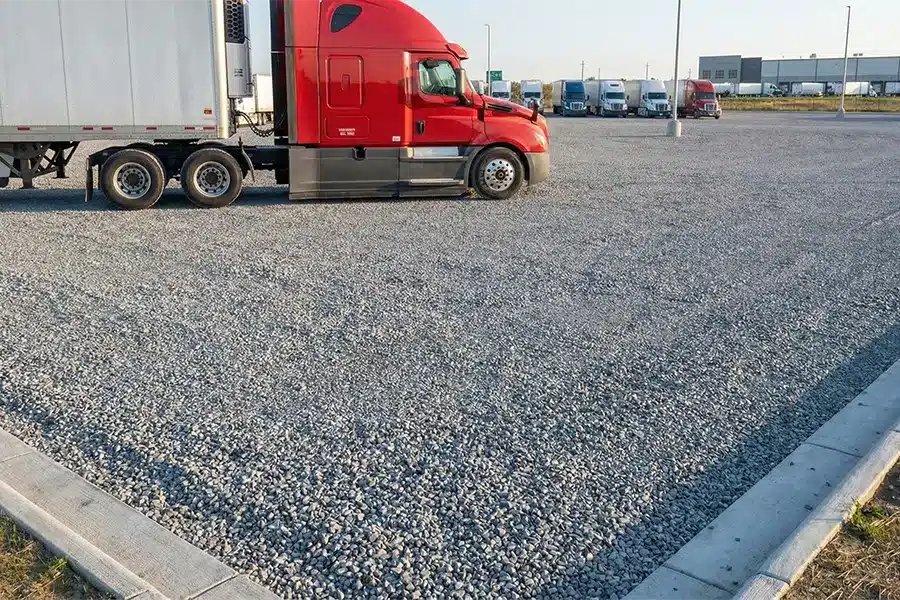
BaseCore HD geocell technology addresses the root cause of traditional surface failures: concentrated point loads that exceed material limits. Instead of fighting truck loads with rigid surfaces, BaseCore HD’s cellular confinement system distributes those loads across a dramatically wider area.
Each HDPE cell confines aggregate infill, creating a composite system where rigid stone and flexible cell walls work together. When a truck tire imposes 4,250 pounds, that load distributes across an area 3 to 4 times larger than the contact patch, reducing effective pressures below the threshold that causes base failure.
The system handles gross vehicle weights up to 60,000 kg (approximately 132,000 pounds) with 200mm (8-inch) deep cells, according to BaseCore’s published weight specifications:
| BaseCore Depth | Gross Vehicle Weight | Application | Truck Parking Use |
| 100mm (4″) | Up to 6,000 kg | Cars & light vans | Passenger overflow areas |
| 100–150mm (4–6″) | Up to 9,000 kg | Delivery vans | Light commercial zones |
| 150mm (6″) | Up to 16,000 kg | Emergency access & tractors | Medium-duty truck areas |
| 150–200mm (6–8″) | Up to 30,000 kg | Standard construction traffic | Standard semi-truck parking |
| 200mm (8″) | Up to 60,000 kg | HGV & crane/piling rigs | Heavy-haul & container yards |
Source: BaseCore published weight specifications (basecore.co)
Real-World Performance: Distribution Center Case Study
An Arizona distribution center spent $12,000 annually maintaining their traditional gravel truck yard—regrading quarterly and replenishing migrated stone. In summer heat, the lot turned into a dusty mess. During monsoon season, it became a rutted disaster.
Management invested $68,000 in a 40,000-square-foot BaseCore installation with heavy-duty specifications for loaded semi-trucks. The breakdown: materials ran about $24,000, site prep and base course cost $28,000, and installation labor came to $16,000 (40 cents per square foot due to the large project scale and experienced installer).
The installation was completed in sections over two weeks, keeping portions of the yard operational throughout. The actual BaseCore installation progressed at about 12,000 square feet per day with an experienced crew of five.
Five years post-installation, they haven’t regraded once. The lot looks nearly identical to installation day despite constant heavy truck traffic. The corten steel edging has developed its characteristic patina and shows no signs of degradation. At their previous $12,000 annual maintenance rate, the system is on track to pay for itself in under six years—and it’s expected to last at least another 10 to 15 years with minimal intervention.
Drainage and Stormwater Management
Water management is the unsung hero of truck parking lot design. Poor drainage accelerates surface failure, creates safety hazards from standing water and ice, and can trigger expensive stormwater compliance requirements.

Slope and Grading Standards
Maintain a minimum 2-percent slope across your parking surface to prevent standing water. For larger lots, design drainage to flow toward perimeter swales, catch basins, or retention areas. Standing water under 80,000-pound trucks accelerates base saturation and undermines structural integrity faster than almost anything else.
Observe your site during and after rain before finalizing grading plans. Where does water currently flow? Are there low spots that collect water? Does runoff need to be directed away from buildings or adjacent properties? These observations inform grading decisions that prevent problems for the life of the facility.
The Stormwater Infrastructure Advantage
Here’s where surface selection creates a potentially massive cost difference. Traditional impervious surfaces like asphalt and concrete require stormwater detention basins, retention ponds, or underground storage systems to manage runoff. These infrastructure requirements can add tens of thousands to hundreds of thousands of dollars to project costs depending on local regulations and lot size.
BaseCore’s permeable geocell system allows water to infiltrate directly through the surface, often qualifying as a pervious surface for stormwater management purposes. In many jurisdictions, this eliminates or dramatically reduces detention basin requirements. For a 40,000-square-foot truck lot, the stormwater infrastructure savings alone can offset a significant portion of the total project cost.
Always verify your local stormwater regulations early in the design process. Your BaseCore project manager can help you understand how a permeable surface may affect your compliance requirements and infrastructure costs.
Subgrade and Base Preparation for Heavy Loads
The layers beneath your driving surface determine long-term performance just as much as the surface itself. Think of your truck lot as a layer cake—each layer serves a purpose, and skimping on base preparation virtually guarantees problems later.
Subgrade Assessment
Soil type fundamentally affects your design. Clay soils retain water and are prone to heaving, while sandy soils drain well but may lack bearing capacity without compaction. If you’re not sure what you have, that’s okay—mention this uncertainty when you contact us, and we’ll help you figure it out.
Grade the subgrade to match your finished drainage plan, compact to the project engineer’s specification, and verify that underground utilities are marked before excavation begins.
Geotextile Fabric
A non-woven geotextile fabric serves as a separation layer between the subgrade soil and the aggregate base course. This prevents soil from migrating upward into the aggregate, which would compromise drainage and structural integrity over time.
BaseCore recommends 6 to 12 oz non-woven geotextile depending on the application: lighter weights (6 oz) for passenger areas, heavier weights (8–12 oz) for truck-traffic zones. Roll the fabric across the prepared subgrade with a minimum 12-inch overlap at seams.
Aggregate Base Course
The aggregate base course—typically 4 to 6 inches of compacted crushed stone depending on the application—provides the stable platform under the geocell system. For heavy truck parking, lean toward the 6-inch end of this range. Compact the base to 95% Modified Proctor density minimum.
For the geocell infill itself, BaseCore recommends #57 crushed stone with 15 to 20 percent fines. The angular stone locks together within cells, and the fines improve compaction and long-term stability.
Compaction matters more than most people realize. A contractor installing a 40,000-square-foot truck yard in Texas found that their initial 3-ton roller wasn’t achieving adequate density in 8-inch BaseCore cells. They upgraded to a 7-ton vibratory roller and achieved 96% density throughout the installation. The yard has handled constant heavy truck traffic for five years without any settlement or rutting. The lesson: heavier applications demand appropriate compaction equipment.
Edge Restraint and Perimeter Design
Proper edge restraint prevents lateral spreading of your geocell system and maintains clean lot boundaries. For truck parking, this is even more critical than passenger-car lots because the dynamic forces from heavy vehicles push outward at lot edges.
Four edge restraint options work well with BaseCore geocell systems:
- Concrete curbs: Maximum permanence and load resistance. Best for high-traffic entrances and lots integrated with existing hardscape. Higher cost but virtually maintenance-free.
- Corten steel edging: Available from BaseCore. Creates clean, modern lines with exceptional durability. Develops a natural weathered patina that blends with industrial aesthetics. The Arizona distribution center mentioned earlier used corten steel edging that has shown no signs of degradation after five years of constant truck traffic.
- Pressure-treated wood: Cost-effective option with a natural appearance. A Georgia church used pressure-treated wood borders for their 15,000-square-foot overflow parking area; the wood weathered naturally within months to blend with the landscape aesthetic.
- Flush excavation: Most economical option. The geocell system is set flush with the surrounding grade. Works best where a natural transition to adjacent surfaces is desired. Not recommended for areas with significant grade changes at the lot perimeter.
Cost Comparison: Traditional vs. BaseCore for Truck Parking
Understanding the true cost of truck parking surfaces requires looking beyond initial construction to account for maintenance, repairs, and the operational disruptions they cause.
| Factor | Asphalt | Concrete | BaseCore HD |
| Install cost/sq ft | $7–$13 | $4–$8 | 40–50% less than concrete |
| 50-space lot total | $300K–$500K | $400K–$600K | Significantly lower |
| Annual maintenance | $15K–$30K | $20K–$40K | ~$2,000 |
| Major repair cycle | Every 3–5 years | Every 5–8 years | Minimal over 20+ years |
| Lifespan | 15–20 years | 20–30 years | 20+ years |
| Detention basin needed? | Yes | Yes | Often eliminated |
| Installation speed | 2–4 weeks | 2–4 weeks + cure time | ~10,000 sq ft/day |
| Immediate use? | No (cure time) | No (cure time) | Yes—drive on immediately |
Costs are approximate and vary by region, site conditions, and project specifications. Contact BaseCore for a project-specific quote.
Installation labor for BaseCore typically runs $0.50 to $1.00 per square foot, with experienced crews installing approximately 10,000 square feet per day on a prepared surface. A 40,000-square-foot truck lot saves $200,000 to $300,000 in first costs compared to concrete, according to BaseCore’s published project data. When stormwater infrastructure savings are factored in, the total project economics shift even further.
Practical Implementation: From Planning to Parking
Designing a truck parking lot involves many moving pieces. This implementation sequence, based on successful BaseCore installations, keeps your project on track.

Phase 1: Site Assessment and Planning (1–2 Weeks)
- Measure total area and calculate target capacity using the space allocation percentages above
- Identify your heaviest regular vehicle and design for that load—not the average vehicle
- Take comprehensive site photos from multiple angles (these help BaseCore project managers provide accurate recommendations without an immediate site visit)
- Research local stormwater regulations and determine if permeable surfaces affect detention requirements
- Contact BaseCore for a project consultation (typically 15–20 minutes by phone)
Phase 2: Design and Specification (1–2 Weeks)
- Work with a traffic engineer for swept-path analysis on your lot layout
- Finalize geocell depth specification based on your load requirements (6–8 inch for standard truck parking)
- Select edge restraint type: concrete curbs, corten steel edging, pressure-treated wood, or flush excavation
- Confirm geotextile weight (8–12 oz non-woven for truck applications) and aggregate base depth (4–6 inches)
- Receive a detailed quote from BaseCore including panel quantities, custom sizing options, and delivery timeline
Phase 3: Material Procurement (1–3 Weeks)
BaseCore keeps most standard products in stock for quick turnaround. Larger orders, custom panel sizes, or colors beyond standard black (beige and green are available) may require up to 6 weeks. Standard panel sizes include 10×12, 10×20, and 9×18 feet, though custom sizing is available to minimize waste on your specific lot dimensions.
Materials ship on pallets or full trucks. Ensure your site has access for delivery vehicles and a staging area for materials until installation begins.
Phase 4: Site Preparation and Installation (1–3 Weeks)
- Site prep and base course: 3–7 days depending on lot size and soil conditions
- Edge restraint installation: Concurrent with site prep, or 1–2 additional days for concrete curbs
- BaseCore panel expansion and connection: An experienced crew of 4–5 covers approximately 10,000 square feet per day
- Infill and compaction: Typically follows panel installation at the same pace
- Surface is ready for immediate use after compaction. No curing time. No waiting. Drive on it right away.
For a typical 50-truck facility (approximately 40,000–50,000 square feet), expect 2 to 3 weeks from groundbreaking to trucks parking.
Phase 5: What Happens When You Contact BaseCore
Reaching out starts a consultative process—not a high-pressure sales pitch. A project manager will ask about your site, intended use, timeline, and concerns. This typically takes 15 to 20 minutes and can happen over the phone, via email, or through video call if you want to show the site.
Based on that conversation, you’ll receive system specifications matched to your needs and vehicle loads, estimated material quantities, geotextile fabric recommendations, edge restraint guidance, and transparent pricing. BaseCore can quote installation on some jobs, work with your existing contractor using their installation guides, or refer installers in your region.
Making Your Decision and Moving Forward
You now have the framework to design a truck parking lot that works as hard as the drivers who use it. The design standards covered here—proper dimensions, adequate turning radius, appropriate surface systems, effective drainage, and robust base preparation—are the difference between a facility that performs for decades and one that becomes a maintenance headache within years.
The truck parking shortage costs the industry $100 billion annually and ranks among the top concerns for trucking professionals. Property owners who invest in well-designed facilities that actually withstand heavy truck traffic are positioned to serve a critical market need—while protecting their infrastructure investment with surfaces that don’t crack, rut, or require constant repair.
Your next step is simple: visit basecore.co/quick-basecore-quote/ to request your customized quote, or call 888-511-1553 for phone support to speak with a project manager. Whether you’re ready to start construction or still gathering information, the BaseCore team provides expert guidance without pressure.
No pressure, just expert guidance from people who’ve helped thousands of facility managers and property owners build truck parking that lasts. Your project starts with a conversation. Let’s have it.
Frequently Asked Questions
What are the standard dimensions for a semi-truck parking stall?
Standard stalls measure 12 to 15 feet wide and 55 to 75 feet long, depending on vehicle type. A standard 53-foot semi-trailer requires at minimum a 55 x 14-foot stall. Allow approximately 100 feet of clear backing space.
How much land do I need for a 50-truck parking lot?
Plan for roughly 3 to 4 acres. Individual stalls consume 50 to 60% of total area, with the remainder allocated to circulation lanes (25–30%), staging zones (10–15%), and support facilities (5–10%).
Why does asphalt fail so quickly under truck traffic?
Standard asphalt handles 100 to 120 PSI, but truck tires can impose over 200 PSI during turns. This exceeds asphalt’s design capacity, causing cracks that allow water infiltration and progressive base failure within 3 to 5 years.
Can BaseCore geocell really handle 80,000-pound trucks?
Yes. BaseCore’s published weight specifications show that 150–200mm (6–8 inch) deep cells support gross vehicle weights up to 30,000 kg for standard construction traffic, with 200mm cells handling up to 60,000 kg for the heaviest applications.
Does a permeable truck parking surface eliminate detention basin requirements?
In many jurisdictions, yes. BaseCore’s permeable system allows stormwater infiltration on-site rather than requiring collection and detention infrastructure. Always verify with your local stormwater authority, and your BaseCore project manager can help assess this during consultation.
Helpful Resources
- Full warranty details: basecore.co/warranty/
- Request a quote: basecore.co/quick-basecore-quote/
- Phone support: 888-511-1553
- Downloadable spec sheets and installation guides: Available at basecore.co and upon request
This article references publicly available information from the American Transportation Research Institute (ATRI), the Federal Highway Administration (FHWA), Truck Parking Club, and Transport Futures, including official research reports, published case studies, and press releases dated 2021–2025. BaseCore product specifications and project data are sourced from basecore.co. All metrics and quotes are from documented sources. Results described are specific to the organizations and installations mentioned and may vary based on industry, scale, site conditions, and implementation approach. For current information about any products or services mentioned, consult the official websites.