
Spec Roads That Don't Fail When the Rig Shows Up
Engineered ground stabilization for well pads, lease roads, pipeline ROW, and facility yards—designed for heavy loads, wet conditions, and remote locations.

Well pad access

Lease roads

Pipeline ROW

Tank batteries

Compressor stations

What Oil & Gas Teams Are Saying
The Engineering Problem: Why
Conventional Roads Fail in Oil & Gas
You already know the failure modes. The question is whether there's a
solution that actually works.

Axle loads exceed design assumptions.
Frac fleets, coiled tubing units, workover rigs, and water haulers push loads that conventional gravel roads weren't designed for.

Subgrade conditions vary across the site.
One weak section means truck traffic finds it, exploits it, and turns it into a failure point.

Wet weather creates operational shutdowns.
When roads become impassable, rig moves get delayed. Frac schedules slip. Production gets deferred.

Remote locations make maintenance expensive.
Every grader mobilization costs money. Maintenance that's manageable at $5K becomes painful at $25K.

Lease roads need to last for asset life.
Roads built for drilling rarely survive 20-30 years of production traffic.

Environmental and landowner constraints limit options.
Disturbed area minimization, stormwater management, and surface owner requirements all affect what you can build.
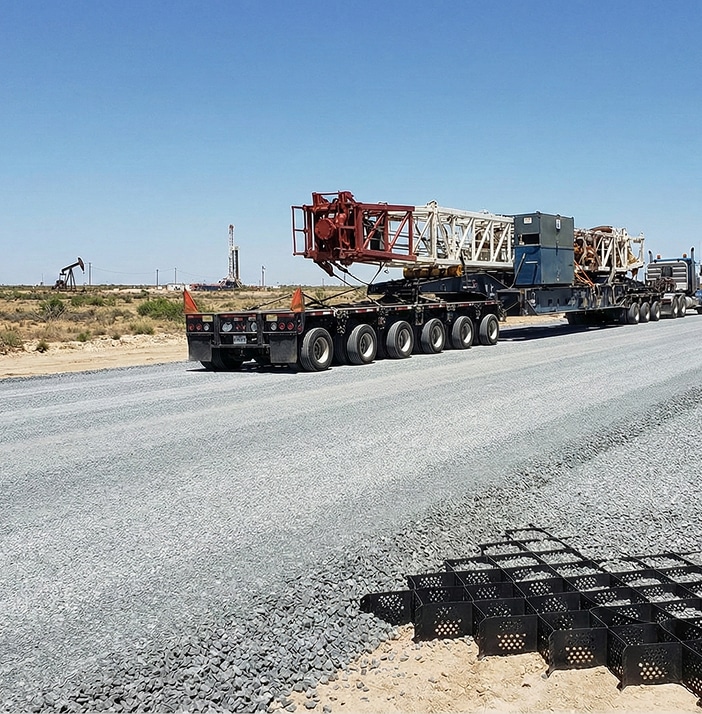
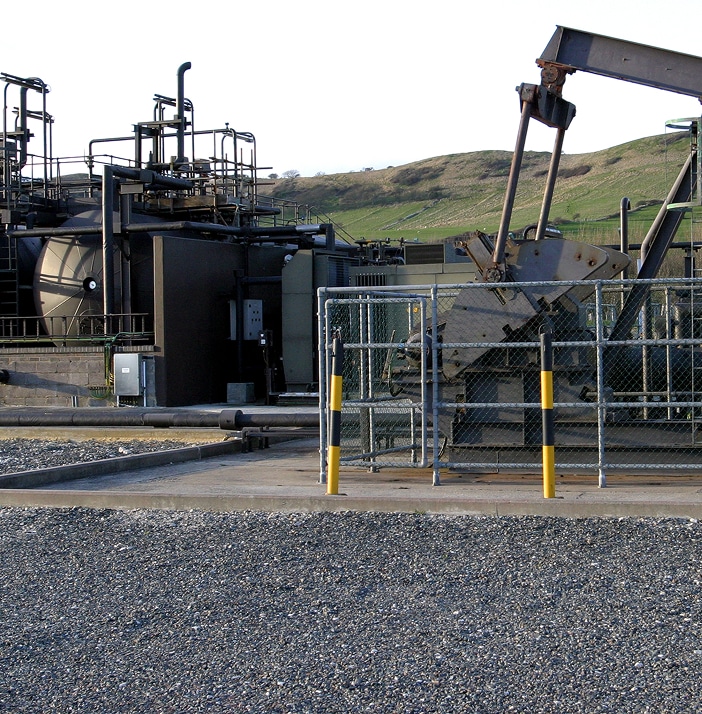

For Land & Environmental Teams
BaseCore addresses common land and environmental constraints:
- Reduced disturbed area footprint — Thinner section means less excavation and smaller road prism
- Removable for full restoration — Panels can be pulled for pipeline ROW restoration if required
- Permeable surface — Reduces stormwater infrastructure requirements
- Less aggregate import — Fewer truck trips, less surface disturbance, easier landowner conversations
- Consistent with reclamation plans — Can be removed or left for permanent access depending on permit requirements
Where BaseCore Fits in Oil
& Gas Applications
BaseCore geocells confine aggregate within a three-dimensional honeycomb structure—creating load-distributing, permeable surfaces that handle heavy traffic without the failure modes of conventional aggregate roads.
The engineering principle: Lateral confinement prevents aggregate migration under load. Vertical load gets distributed across a wider subgrade area. Result: higher effective bearing capacity from the same aggregate section.
Engineering Considerations
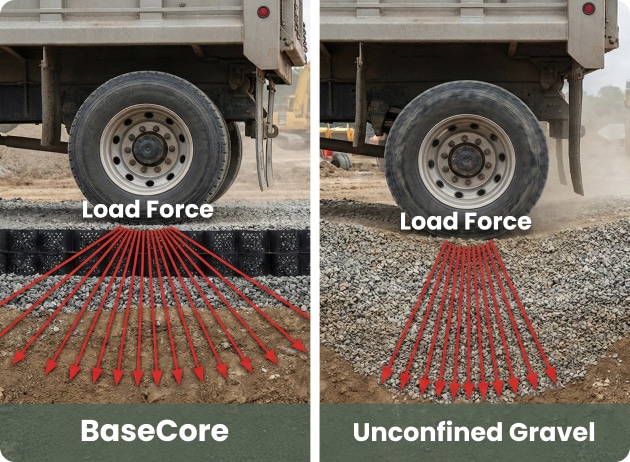
Load Distribution
BaseCore's cellular confinement increases the effective structural number of the aggregate layer. A 6" BaseCore HD section with crushed stone infill provides load distribution equivalent to significantly thicker conventional aggregate sections.
Practical implication: You can often achieve required bearing capacity with less imported aggregate—reducing cost and environmental footprint.
Subgrade Independence
The geocell structure bridges localized soft spots rather than transmitting point loads directly to subgrade. This reduces sensitivity to subgrade variability—a common failure mode on sites with inconsistent soil conditions.


Permeability
Water drains through the aggregate surface rather than ponding or sheeting. This maintains trafficability during and after precipitation events while reducing erosion and sediment transport.
Before and After
Before
- Roads that fail during frac ops
- Quarterly regrading on facility yards
- Lease roads that need rebuild every few years
- Soft spots that trucks find and destroy
- Maintenance costs that blow budgets on remote pads
After
- Frac fleet traffic without road failures — Heavy loads, tight turns, wet conditions—roads hold up
- Facility yards that don't need regrading — Install once, operate for decades
- Lease roads that last asset life — 20-30 year access without reconstruction
- Consistent performance across variable subgrades — Soft spots don't become failure points
- Maintenance budgets that stay intact — Spec it right, don't touch it again
Why Procurement Teams Spec BaseCore

Reduced aggregate volume
Lower material cost, especially on remote sites where aggregate is expensive

Near-zero maintenance
Predictable lifecycle cost, no annual regrading line item

Faster install
10,000+ SF/day means lower mobilization cost and faster rig-ready dates

One product across applications
Same system for upstream, midstream, and facilities simplifies vendor management

75+ year product life
Spec it once for the life of the asset
Products for Oil & Gas Applications
BaseCore HD
Best for: Well pad access, frac fleet routes, facility yards, any application with heavy repeated loads
- Smaller cell aperture (180mm x 218mm) for maximum confinement
- Double-welded seams for seam integrity under heavy loads
- Virgin HDPE—consistent material properties, no recycled content variability
- 4-8" cell depths for heavy-duty applications
BaseCore Geocell
Best for: Lighter lease roads, pipeline ROW, slopes, erosion control, drainage channels
- Larger cell aperture (287mm x 320mm)
- General reinforcement applications
- 2-6" cell depths available
Quick Selector
| Application | Typical Loads | Subgrade Risk | Recommended Product | Cell Depth |
|---|---|---|---|---|
| Well pad access (drilling/completions) | Rig moves, frac fleets | High | BaseCore HD | 6-8" |
| Lease roads (production phase) | Water haulers, service vehicles | Moderate | BaseCore HD | 4-6" |
| Tank battery/equipment pads | Truck traffic, equipment | Moderate-high | BaseCore HD | 4-6" |
| Compressor station yards | Maintenance vehicles | Moderate | BaseCore HD | 4-6" |
| Pipeline ROW access | Construction equipment | Variable | BaseCore HD | 4-6" |
| SWD facility access | Water haulers | High | BaseCore HD | 4-6" |
| Gathering system access | Light/medium vehicles | Low-moderate | BaseCore HD or BC | 3-4" |
Get a Section + ROM for Your Project
Tell us about your project. We'll send back a recommended section, quantities, and budgetary pricing within 1-2 business days.

Budgetary only. Final design confirmed by your Engineer of Record. We typically respond within 1-2 business days.
Reach Us Directly: 888-511-1553
Frequently Asked Questions
Yes. BaseCore HD with 6-8" cell depths handles the heaviest oilfield traffic including frac fleets, coiled tubing units, and workover rigs. The cellular confinement distributes loads and prevents the rutting that destroys conventional roads.