


Commercial property owners routinely save 60% or more on parking lot construction by choosing gravel over asphalt or concrete. For a 50-space lot, that difference can exceed $50,000 in upfront costs alone—funds that can be redirected toward other facility improvements or held in reserve for future maintenance.
This guide breaks down exactly what you’ll spend on a gravel parking lot in 2025, from material costs per square foot to the hidden expenses that catch first-time builders off guard. You’ll learn the specific budgets for different lot sizes, how material choices affect long-term costs, and a practical framework to calculate your project’s total investment.
What a Gravel Parking Lot Actually Costs
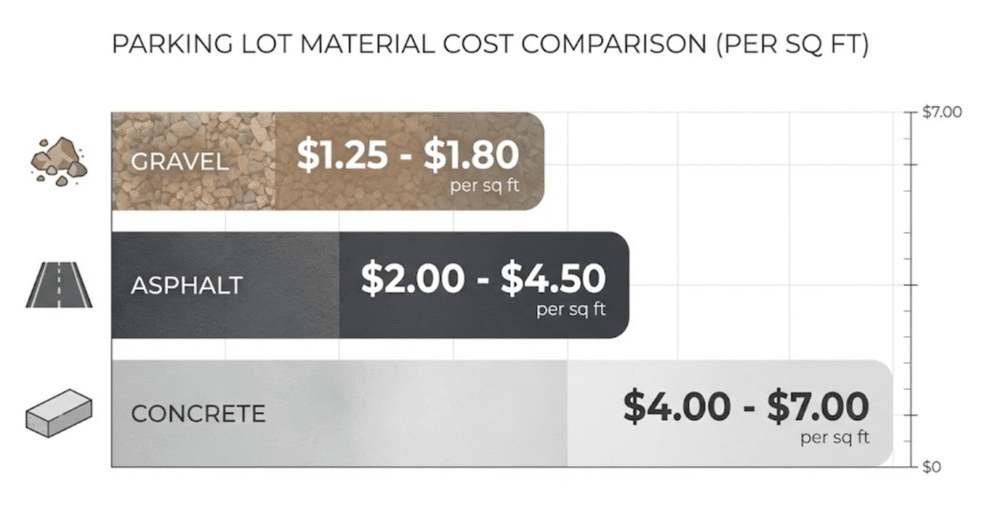
A gravel parking lot costs between $1.25 and $1.80 per square foot for materials and basic installation, according to 2025 data from HomeAdvisor. This translates to approximately $400 to $1,130 per parking space when accounting for driving aisles and maneuvering room.
For context, the average parking space requires 300 to 350 square feet including circulation areas. A 10-space lot measuring approximately 4,000 square feet would cost between $5,000 and $7,200 for a basic gravel installation. A 50-space commercial lot at roughly 16,250 square feet ranges from $20,300 to $29,250.
These figures represent the entry point. The total project cost depends on site conditions, gravel type, and whether you’re installing stabilization systems. Properties requiring significant grading, drainage infrastructure, or ADA-compliant accessible spaces will see higher totals.
Cost Comparison: Gravel vs. Alternatives
The price differential between gravel and paved alternatives explains why many commercial properties choose aggregate surfaces. According to Angi’s 2025 cost data, asphalt parking lots run $2 to $4.50 per square foot, while concrete costs $4 to $7 per square foot.
For a 20,000-square-foot parking lot, the material and installation cost comparison breaks down as follows:
- Gravel: $25,000 to $36,000
- Asphalt: $40,000 to $90,000
- Concrete: $80,000 to $140,000
Industry data from CMC Solutions, an Iowa-based construction firm, indicates that gravel represents approximately 60% savings compared to asphalt and concrete on an initial installation basis. However, the total cost of ownership depends on maintenance frequency and the expected lifespan of each surface type.
How Project Scope Affects Your Budget
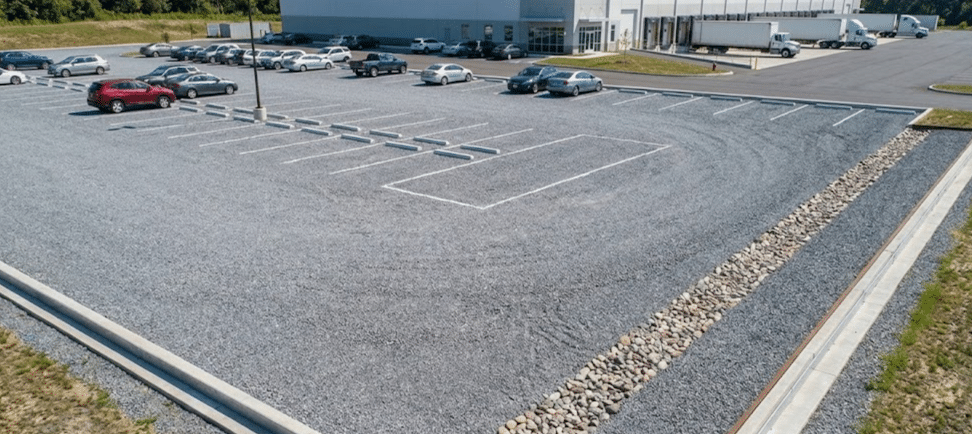
The base cost per square foot tells only part of the story. Parking lot management professionals identify five primary cost factors that determine final project budgets.
Site Preparation and Grading
Preparing the site for a gravel parking lot costs between $1,000 and $2,500 for residential-scale projects, with commercial lots potentially running $50,000 to $100,000 for extensive earthwork. According to HomeAdvisor data, grading specialists charge $50 to $200 per hour.
Properties with significant slopes, poor drainage, or unstable soil types like clay require additional excavation and base preparation. These conditions can increase site preparation costs by 20% to 50%.
Gravel Material Selection
The type of gravel you select significantly impacts both initial cost and long-term performance. Based on 2025 pricing from HomeGuide, common materials include:
- Crusher run (quarry process): $20 to $40 per ton—the most affordable option, combining crushed stone with stone dust for a compact, stable surface
- Crushed stone #3: $38 to $46 per ton—larger 1-2 inch diameter stones used for base layers
- Crushed stone #57: $50 to $65 per ton—angular stones providing excellent drainage
- Pea gravel: $25 to $53 per ton—smooth, rounded stones offering aesthetic appeal but less stability
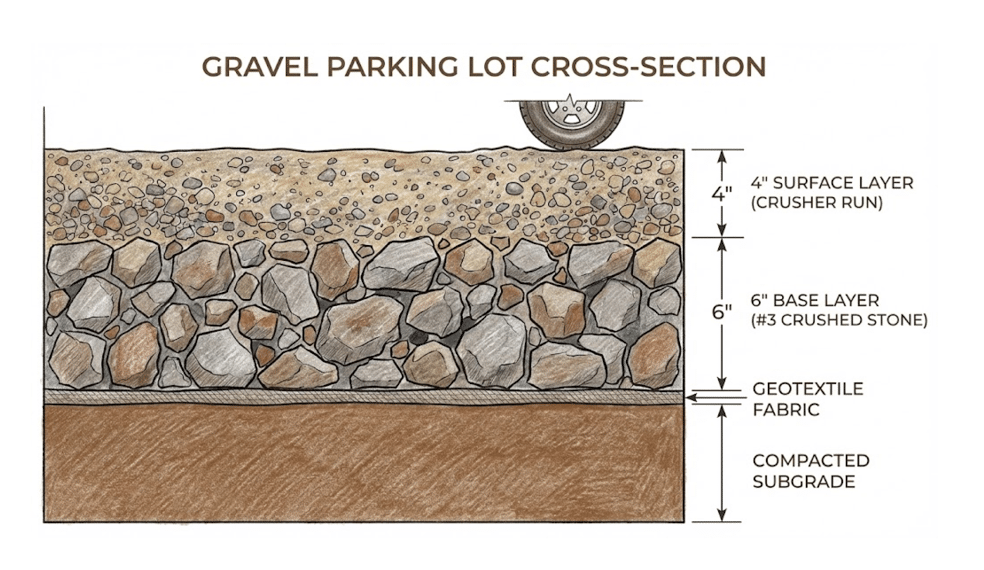
For parking lots, contractors typically recommend a layered approach: 6 to 8 inches of base gravel (#3 or #57) topped with 2 to 4 inches of crusher run. One ton of gravel covers approximately 60 to 80 square feet at a 4-inch depth.
Delivery and Labor
Gravel delivery costs $100 to $500 per load depending on distance, though many suppliers include delivery within 10 miles. HomeGuide reports spreading costs of $10 to $25 per cubic yard or $40 to $50 hourly for a crew.
For a 10,000-square-foot lot requiring approximately 125 tons of material, delivery and labor typically add $3,000 to $6,000 to the project cost.
Edging and Containment
Without proper edging, gravel migrates beyond the parking area, requiring frequent maintenance. Industry best practices recommend concrete, metal, or heavy-duty plastic edging to contain gravel and maintain clean boundaries.
Driveway edging costs $5 to $18 per linear foot according to HomeGuide. A 100-by-100-foot lot with 400 linear feet of perimeter edging adds $2,000 to $7,200 to the project.
Stabilization Systems
Traditional loose gravel lots require regrading one to two times annually and periodic gravel replenishment. Stabilization grids—cellular confinement systems that lock gravel in place—change this equation substantially.
Permeable paver and grid stabilization systems typically cost $8 to $10 per square foot installed, including gravel fill. While this exceeds loose gravel’s initial cost, industry documentation shows 70% to 80% lower annual maintenance costs for stabilized systems and extended lifespans of 25 to 60 years compared to 8 to 10 years for unstabilized gravel.
Real-World Budget Scenarios
Understanding how different project types affect budgets helps you plan more accurately.
Scenario 1: County Fueling Station
A county government in the Mountain West region needed a heavy-duty surface for a commercial vehicle fueling station. The surface had to withstand sharp turns and braking from large trucks while managing stormwater runoff.
The project encompassed approximately 45,000 square feet using stabilized gravel on a 6-inch compacted sub-base. By selecting gravel with stabilization over traditional asphalt, the county achieved an estimated $20,000 to $25,000 in installation savings while gaining a surface more resistant to the rutting and damage that asphalt experiences under heavy truck traffic.
Scenario 2: Event Venue Overflow Parking
A rural event center needed to expand parking capacity without compromising the property’s natural aesthetic. Concrete or asphalt would have triggered additional permitting requirements due to stormwater runoff regulations.
By installing a grass-and-gravel stabilization system, the venue maintained pervious cover equivalent to the surrounding meadowland. This approach avoided permitting complications and eliminated approximately $5,000 to $8,000 in drainage infrastructure costs that would have been required for impervious surfaces. Total savings versus concrete installation typically reach $30,000 to $50,000 for projects of this scope.
Scenario 3: Commercial Truck Parking
Large commercial vehicle lots face unique challenges: heavy loads, sharp turning movements, and the need for maximum land utilization. Traditional concrete lots in these applications often require dedicating 15% to 25% of site area for detention ponds to manage stormwater.
Permeable gravel systems allow the parking surface itself to serve as stormwater detention, eliminating separate pond requirements. For a 100,000-square-foot commercial lot, this land reclamation can represent $200,000 to $500,000 in recovered property value, depending on location and land costs.
Budget Planning: Complete Cost Breakdown
For a 50-space commercial gravel parking lot (approximately 16,250 square feet), here’s a realistic budget framework based on aggregated 2024-2025 industry data:
Basic Gravel Installation
- Site preparation and grading: $8,000-$15,000
- Base gravel (6-inch depth, ~200 tons): $8,000-$12,000
- Surface gravel (4-inch depth, ~135 tons): $5,400-$8,100
- Delivery: $1,000-$2,500
- Spreading and compaction labor: $4,000-$8,000
- Perimeter edging (500 linear feet): $2,500-$9,000
- Subtotal: $28,900-$54,600
With Stabilization Grid System
- Add stabilization pavers: $65,000-$81,250 (at $4-$5/sq ft for materials)
- Reduced base material requirements: ($2,000-$4,000 savings)
- Adjusted Total: $91,900-$131,850
ADA Compliance Addition According to the U.S. Access Board, parking facilities of this size require at least two accessible spaces with firm, stable, slip-resistant surfaces. For gravel lots, this typically means installing paved or stabilized surfaces specifically for accessible spaces and access aisles.
Adding two ADA-compliant spaces with adjacent access aisles (approximately 400 square feet) using a stabilized surface system: $2,000-$4,000.
Maintenance Costs: The Long-Term Picture
The initial installation cost represents only part of total ownership expense. HomeAdvisor data indicates unstabilized gravel parking lots typically last 8 to 10 years before requiring significant renovation, while properly maintained stabilized surfaces can exceed 25 years.
Annual Maintenance for Unstabilized Gravel
- Regrading (1-2 times annually): $0.50-$2.20 per square foot
- Gravel replenishment (every 1-2 years): $1,500-$4,000 per application
- Pothole and erosion repair: $500-$2,000 annually
- Estimated annual cost for 16,250 sq ft lot: $3,500-$8,000
Annual Maintenance for Stabilized Gravel
Industry data shows that commercial properties using stabilization systems report maintenance costs reduced by 70% to 80% compared to unstabilized surfaces. Gravel loss decreases by up to 90%, virtually eliminating periodic resurfacing requirements.
- Periodic inspection and minor repair: $500-$1,500 annually
- Surface cleaning: $500-$1,000 annually
- Estimated annual cost for 16,250 sq ft lot: $1,000-$2,500
10-Year Total Cost Comparison
For a 16,250-square-foot commercial lot:
Unstabilized Gravel
- Initial installation: $28,900-$54,600
- 10-year maintenance: $35,000-$80,000
- 10-Year Total: $63,900-$134,600
Stabilized Gravel
- Initial installation: $91,900-$131,850
- 10-year maintenance: $10,000-$25,000
- 10-Year Total: $101,900-$156,850
The break-even point typically occurs between years 3 and 4, after which the stabilized system generates ongoing savings.
When Gravel Makes Financial Sense
Gravel parking lots deliver the strongest return on investment under specific conditions.
Ideal Applications:
- Rural or industrial properties where aesthetics are secondary to function
- Temporary or seasonal parking needs with uncertain long-term requirements
- Properties with stormwater management challenges where permeable surfaces reduce infrastructure costs
- Sites where detention pond elimination creates significant land value recovery
- Budget-constrained projects requiring immediate parking capacity
Less Suitable Applications:
- High-traffic retail locations where customer experience affects revenue
- Properties in areas with strict accessibility requirements and limited space for paved accessible routes
- Cold climates with significant snow removal needs (gravel complicates plowing)
- Urban locations where dust control and appearance affect property values
ADA Compliance Considerations
The Americans with Disabilities Act applies to gravel parking lots just as it does to paved surfaces. According to the U.S. Access Board, accessible parking spaces in gravel lots must be marked and have “firm, stable, and slip resistant surfaces.”
Standard loose gravel typically does not meet ADA requirements for accessible spaces. The Access Board notes that “most loose materials, including gravel will not meet these requirements unless properly treated to provide sufficient surface integrity.”
Solutions for ADA compliance in gravel lots include:
- Installing stabilization grid systems in accessible spaces and access aisles
- Paving only the accessible spaces while leaving the remainder as gravel
- Using compacted crusher fines (1/4-inch minus) with proper maintenance
For a lot requiring two accessible spaces, budget an additional $2,000 to $4,000 for compliant surfaces.
Implementation Checklist
Based on industry best practices, follow this sequence:
- Survey the site to identify soil conditions, drainage patterns, and required grading
- Calculate required gravel tonnage using depth requirements (minimum 10-12 inches total for commercial applications)
- Obtain necessary permits including stormwater management approvals where applicable
- Select appropriate gravel prioritizing crusher run or crushed stone for stability
- Install geotextile fabric as a separation barrier between subgrade and base material
- Compact base layer before adding surface material
- Consider stabilization grids for high-traffic areas or where long-term maintenance reduction justifies initial investment
- Address ADA requirements by installing firm, stable surfaces for accessible spaces
The Bottom Line
Gravel parking lots cost $1.25 to $1.80 per square foot for basic installations—60% less than asphalt and up to 80% less than concrete. For a 50-space commercial lot, expect to budget $29,000 to $55,000 for unstabilized gravel or $92,000 to $132,000 for a stabilized system with dramatically reduced long-term maintenance.
Whether gravel represents the right choice for your project depends on traffic volume, aesthetic requirements, and whether you’re optimizing for initial cost or total cost of ownership. Properties with stormwater management challenges often find that permeable gravel systems deliver additional value through eliminated detention pond requirements and recovered land area.
Request quotes from at least three local contractors, specifying both unstabilized and stabilized options. The comparison will clarify which approach delivers the best value for your specific requirements.
Frequently Asked Questions
How much does a 10-space gravel parking lot cost?
A 10-space lot (approximately 4,000 square feet) costs $5,000 to $7,200 for basic gravel installation. Add $16,000 to $20,000 if including a stabilization grid system for reduced maintenance and extended lifespan.
How long does a gravel parking lot last?
Unstabilized gravel lots typically last 8 to 10 years before requiring significant renovation. Stabilized gravel surfaces with grid systems can last 25 to 60 years depending on traffic and maintenance.
Can gravel parking lots be ADA compliant?
Yes, with modifications. The U.S. Access Board confirms that gravel lots must provide accessible spaces with firm, stable, slip-resistant surfaces. This typically requires stabilization grids or paved sections specifically for accessible spaces and access aisles.
How often do gravel parking lots need maintenance?
Unstabilized lots require regrading one to two times annually and gravel replenishment every one to two years. Stabilized systems reduce maintenance frequency by 70% to 80%.
Is a gravel parking lot cheaper than asphalt?
Yes, initially. Gravel costs $1.25 to $1.80 per square foot versus $2 to $4.50 for asphalt. However, unstabilized gravel requires more frequent maintenance. Over a 10-year period, stabilized gravel and asphalt may have comparable total costs depending on usage.