

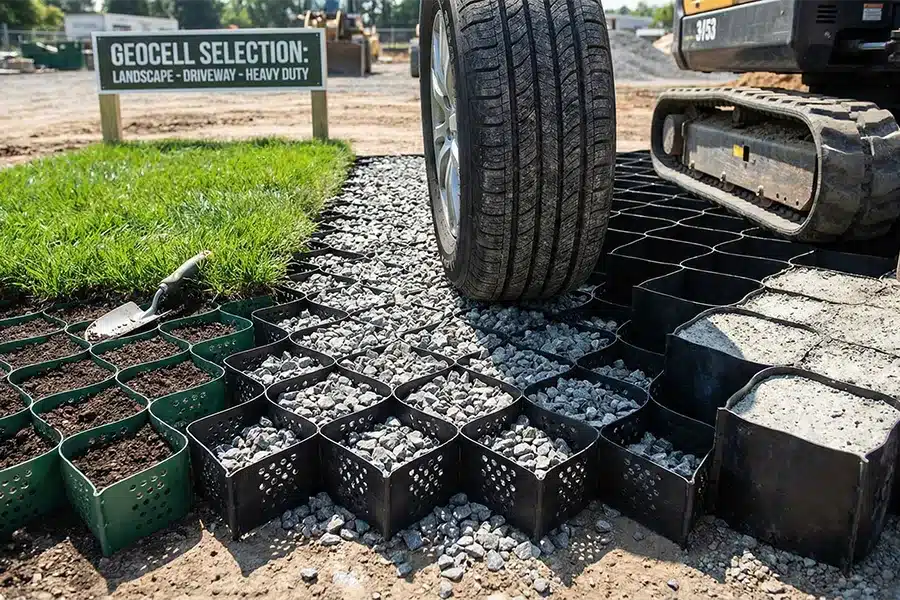
Why the Proper Geocell Selection Matters More Than You Think
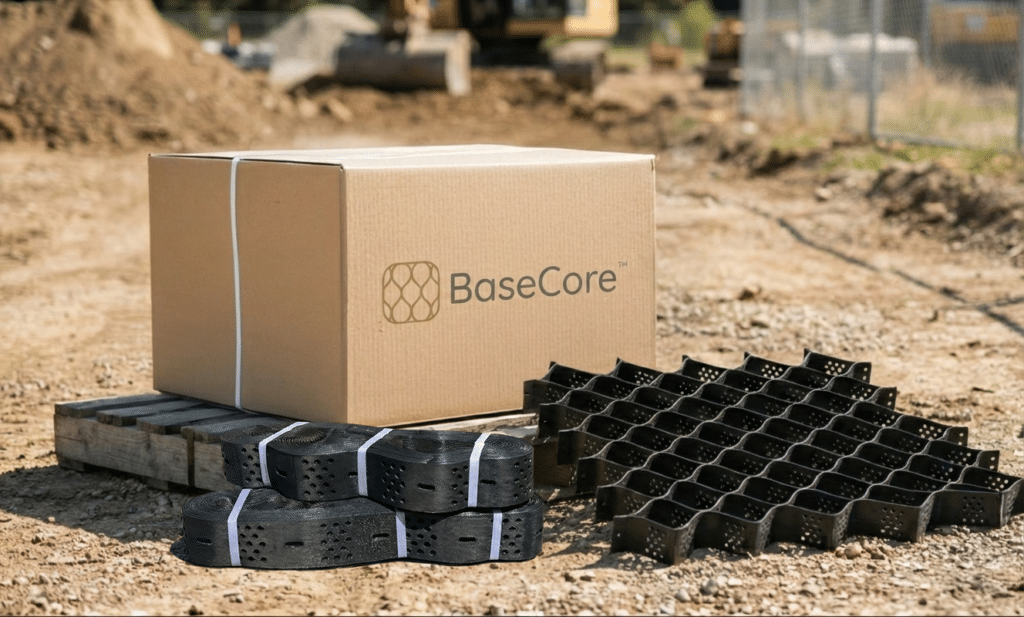
You’ve decided geocells are the right solution for your project. Maybe you’ve read about how they stabilize gravel parking lots, reinforce slopes, or eliminate the rutting and maintenance headaches of traditional surfaces. Now comes the practical question that trips up first-time buyers and experienced contractors alike: which geocell do you actually need?
It’s a fair question. BaseCore manufactures geocells in multiple depths, two product lines (standard and HD), perforated and non-perforated configurations, three color options, and custom panel sizes. Each combination is engineered for specific applications—and choosing the wrong one means either overspending on more product than you need or underspecifying and risking premature failure.
This guide walks you through every selection factor in plain language. By the end, you’ll know exactly which BaseCore geocell fits your project—or you’ll have the right questions to ask our project managers when you call for a quote.
Step 1: Start With Your Application
Before diving into specifications, answer one fundamental question: what is this geocell going to do?
Every specification decision flows from your application. A pedestrian walking trail has completely different requirements than a truck yard. A gentle slope needs a different approach than a near-vertical embankment. Knowing your application narrows your choices dramatically and keeps you from overthinking the technical details.
BaseCore geocells serve three broad categories of applications, each with distinct requirements:
Base Stabilization (Load-Bearing Surfaces)
This is the most common use. You’re creating a surface that vehicles or equipment will drive on, park on, or operate on. Think parking lots, driveways, access roads, construction staging areas, and industrial yards.
The critical question here is: what’s the heaviest vehicle that will regularly use this surface? Your answer determines cell depth, product line, and infill requirements. We’ll cover specifics in the next section.
Slope Stabilization and Erosion Control
You’re preventing soil from moving on a slope, embankment, channel, or shoreline. The geocell holds infill material (soil, stone, or vegetation) in place against gravity, water flow, or both.
The critical question here is: how steep is the slope, and what forces act on it? Steeper slopes and higher water velocities demand deeper cells and, in some cases, the tighter confinement of BaseCore HD.
Retaining Walls and Structural Earth Features
You’re building vertical or near-vertical structures using stacked geocell layers filled with compacted aggregate. These applications combine load-bearing and slope stabilization requirements.
The critical question here is: what height and angle does the wall need to achieve? This determines cell depth, number of layers, and whether you need engineering review.
Step 2: Choose Your Cell Depth
Cell depth—the height of the geocell walls—is the single most important specification affecting performance and cost. Deeper cells confine more infill material, distribute heavier loads, and resist greater lateral forces. But they also cost more and require more aggregate to fill.
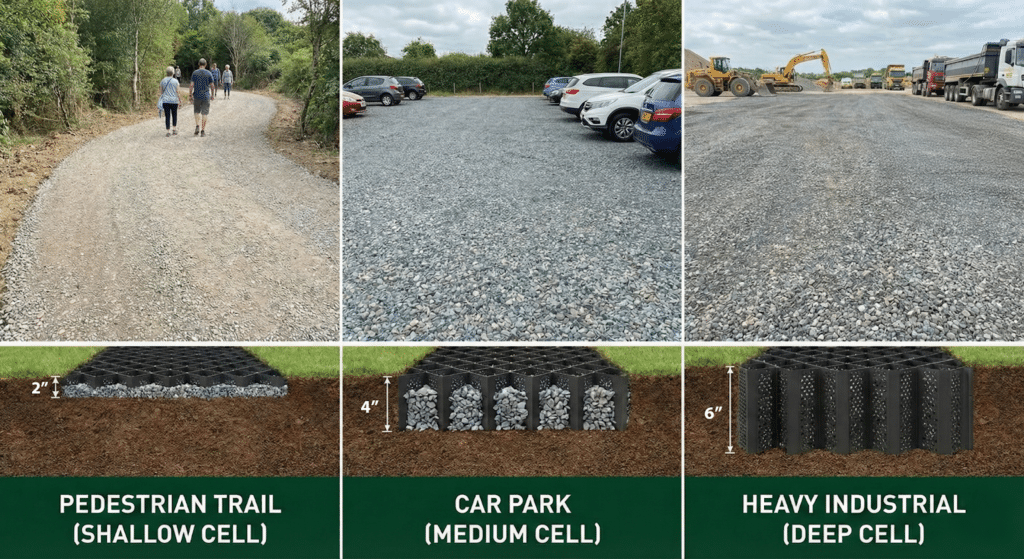
BaseCore manufactures geocells in 2, 3, 4, 6, and 8-inch depths, with the ability to customize other sizes per project requirements. Here’s how to match depth to application, based on BaseCore’s published Selection Guide:
Base Stabilization: Depth by Vehicle Load
| Application | Recommended Depth | Other Materials |
| Light applications — trails, bike lanes, ATV trails, foot/horse paths | 2″ (5 cm) or 3″ (7.5 cm) | 6 oz non-woven geotextile fabric |
| Non-industrial — passenger vehicles and light industrial | 3″ (7.5 cm) or 4″ (10 cm) | 6 oz non-woven geotextile fabric |
| Industrial — 18-wheelers, oil & gas, mining, heavy industrial | 4″ (10 cm) or 6″ (15 cm) | 6 oz non-woven fabric + BaseGrid |
| Heavy applications — fire trucks, H-20 loading | 6″ (15 cm) or 8″ (20 cm) | BaseGrid high-strength woven fabric |
Source: BaseCore GeoCell Selection Guide (BSC-1)
In each row, the first depth listed is for BaseCore HD and the second is for BaseCore standard. We’ll explain the difference between those two product lines in Step 3.
Pro Tip from Our Project Managers: The single biggest specification mistake is underestimating vehicle loads. If your parking lot handles “mostly passenger cars with occasional delivery trucks,” you need to specify for the delivery trucks—not the cars. A parking surface designed for 3,000-pound sedans will fail under a 26,000-pound box truck. Always design for your heaviest regular vehicle.
Slope Stabilization: Depth by Steepness
| Slope Steepness | Cell Depth |
| 6:1 or 5:1 (gentle) | 2″ (5 cm) or 3″ (7.5 cm) |
| 4:1 (moderate) | 3″ (7.5 cm) or 4″ (10 cm) |
| 3:1 (moderate-steep) | 4″ (10 cm) |
| 2:1 (steep) | 4″ (10 cm) or 6″ (15 cm) |
| 1:1 or steeper (very steep) | 6″ (15 cm) or 8″ (20 cm) |
Source: BaseCore GeoCell Selection Guide (BSC-1)
As slopes get steeper, gravitational forces trying to pull infill material downhill increase dramatically. Deeper cells provide more confinement to resist those forces. For slopes steeper than 2:1, anchoring with rebar stakes or tendons is typically required to maintain panel positioning.
Channel and Waterway Protection: Depth by Flow Velocity
| Flow Velocity | Cell Depth | Infill Material |
| Up to 10 ft/s (3 m/s) | 3″ (7.5 cm) or 4″ (10 cm) | Angular rock |
| Up to 20 ft/s (6 m/s) | 3″ (7.5 cm), 4″ (10 cm), or 6″ (15 cm) | Vegetated soil |
| Over 20 ft/s (6 m/s) | 3″ (7.5 cm) or 4″ (10 cm) | Concrete |
Source: BaseCore GeoCell Selection Guide (BSC-1)
For channels, both cell depth and infill material matter. Higher flow velocities require heavier, more erosion-resistant infill. Concrete-filled geocells in channels handling extreme flows create essentially permanent armored surfaces.
Step 3: BaseCore Standard vs. BaseCore HD — Which Product Line?
BaseCore offers two product lines, and understanding the difference helps you optimize performance and cost for your specific application.
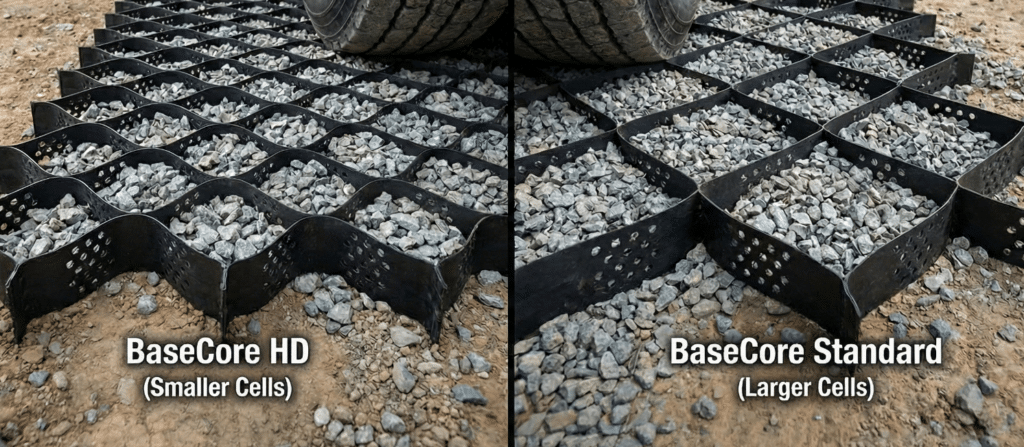
BaseCore Standard Geocell
The standard BaseCore geocell features an expanded cell size of approximately 12.6 x 11.3 inches (287 mm x 320 mm). It’s manufactured from high-density polyethylene (HDPE) with textured, perforated walls and robust welded seams. This is a versatile, proven product that handles the majority of residential and commercial applications effectively.
Best for: Residential driveways, light commercial parking, moderate slopes (3:1 and gentler), landscaping, and general erosion control where loads are moderate and cell depth can accommodate the application.
BaseCore HD (Heavy-Duty) Geocell
BaseCore HD features a significantly smaller expanded cell size of approximately 8.5 x 7 inches (180 mm x 218 mm)—roughly 40% smaller than the standard cell. This tighter cell geometry provides substantially greater confinement of infill material, resulting in better load distribution and higher performance at equivalent depths.
What does that mean practically? BaseCore HD at a given depth often delivers performance equivalent to a deeper standard geocell. A 4-inch BaseCore HD, for example, can match the performance of a 6-inch standard product in many applications—which means less excavation, less aggregate, and lower total project cost even though the per-panel price is higher.
Additional HD advantages:
- Double-welded seams — provides redundancy at the highest-stress points in the system. Standard geocell products typically use single welds.
- Thicker material — BaseCore HD uses 65–75 mil sheet thickness (before/after texturing), compared to 50–60 mil in standard products. This translates to greater puncture resistance and longer service life under demanding conditions.
- Higher seam peel strength — BaseCore HD achieves 88 lbf/in minimum seam peel strength per ASTM D6392 testing, with long-term seam strength reaching 190 lbs. These are among the highest published seam strength values in the industry.
- 2-inch depth availability — BaseCore HD is one of the few geocell products available in a true 2-inch depth, making it suitable for lightweight stabilization applications where standard products start at 3 inches.
Best for: Heavy commercial and industrial loads (truck parking, oil and gas, mining), steep slopes (2:1 and steeper), high-flow channels, any application where you want maximum performance or where reducing cell depth saves significant excavation and fill costs.
Quick Decision Framework
Ask yourself: Can I use a shallower cell depth if I choose HD, and will the excavation/fill savings outweigh the panel cost difference? If yes, HD is likely the better economic choice. If your application fits comfortably within standard geocell capabilities with no need to optimize depth, standard is the straightforward, cost-effective option.
When in doubt, your BaseCore project manager can run the comparison for your specific application and show you the total project cost both ways.
Side-by-Side Comparison
| Property | BaseCore Standard | BaseCore HD |
| Expanded cell size | 12.6″ x 11.3″ (287 x 320 mm) | 8.5″ x 7″ (180 x 218 mm) |
| Available depths | 3″, 4″, 6″, 8″ | 2″, 3″, 4″, 6″, 8″ |
| Sheet thickness | 50–60 mil | 65–75 mil |
| Double-welded seams | No | Yes |
| Seam peel strength (min) | Standard | 88 lbf/in (ASTM D6392) |
| Long-term seam peel strength | Standard | 190 lbs |
| Environmental stress crack resistance | Standard (>1,500 hrs per ASTM D1693) | 7,000 hours (ASTM D1693) |
| Best applications | Residential, light commercial, moderate slopes | Heavy industrial, truck traffic, steep slopes, optimized depth projects |
Source: BaseCore product specifications and Universal Product Comparison data
Step 4: Perforated vs. Non-Perforated Cells
BaseCore geocells are available in perforated and non-perforated configurations. This is a simpler decision than cell depth or product line—perforated is the right choice for the vast majority of projects.
Perforated Geocells (Standard — Recommended for Most Projects)
Perforated geocell walls have rows of small, uniform holes punched through the HDPE. These perforations serve multiple critical functions:
- Drainage: Water flows freely between cells and into the ground, relieving hydrostatic pressure buildup. This is crucial on slopes and in wet areas—trapped water can push cells out of position and cause system failure.
- Interlock: Infill material in adjacent cells partially connects through the perforations, creating a semi-integrated matrix rather than isolated pockets. This improves overall load distribution across the panel.
- Root penetration: For vegetated applications, plant roots grow through the perforations from cell to cell, creating a stronger reinforced green surface. This is particularly valuable for slope erosion control where long-term vegetation establishment is the goal.
- Reduced deformation: Studies have shown that perforated geocells actually reduce deformation under load compared to solid-wall alternatives, because the interlock effect distributes forces more evenly.
The perforations typically comprise 5 to 20 percent of the cell wall area—enough to enable drainage and interlock without compromising wall strength. Practically all modern geocell installations for driveways, parking lots, slopes, retaining walls, and erosion control use perforated panels.
Choose perforated for: Parking lots, driveways, access roads, slopes, retaining walls, channels, shoreline protection—essentially any project where water is present or where you want maximum load distribution.
Non-Perforated Geocells (Special Order)
Non-perforated geocells have solid walls with no holes. They completely contain infill material, which is advantageous in specialized scenarios:
- Railroad ballast stabilization — solid walls hold dense ballast fill tightly and prevent pumping of fines under dynamic rail loads.
- Contaminated soil encapsulation — when you need to fully isolate fill material from surrounding soil or groundwater.
- Fine-grained infill containment — when using sand, fine clay, or other material that would wash through perforations.
Non-perforated cells are a niche product. If you’re unsure whether you need them, you almost certainly don’t. BaseCore manufactures non-perforated geocells as special orders only.
Important: If you use non-perforated cells, ensure you have alternate drainage (such as a geotextile underdrain) to prevent water from accumulating inside the cells.
Step 5: Choosing the Right Color
BaseCore geocells are available in three colors: black (standard), green, and beige. Color does not affect structural performance—it’s about UV protection strategy and visual integration with your environment.

Black (Standard — Best for Most Projects)
Black is the default for good reason. The HDPE is infused with carbon black during manufacturing, which acts as a highly effective UV stabilizer. Black geocells offer maximum sunlight resistance and the longest documented service life. They’re also the most economical since no additional pigments are needed.
Choose black when: The geocell will be buried under gravel, aggregate, or pavement and won’t be visible after installation. This covers the vast majority of base stabilization projects—parking lots, driveways, access roads, and any application where the cells are fully covered by infill material.
Green
Green geocells blend with vegetation, making them ideal when cell edges may remain partially visible. Parks, bioswales, living retaining walls, golf courses, and vegetated slopes sometimes show small portions of the cell structure, especially before plants fully establish. Green cells visually recede into the landscape.
Green geocells use HALS (Hindered Amine Light Stabilizers) instead of carbon black for UV protection. Modern formulations deliver 20+ year UV resistance—comparable to black in practical terms.
Choose green when: You’re building vegetated slopes, green retaining walls, grass-reinforced parking areas, or any application where visible cell edges should blend with surrounding vegetation.
Beige/Tan
Beige geocells match sandy, desert, or earth-toned environments. They’re used on desert slopes, coastal dunes, roadside embankments with light-colored soil, and exposed retaining wall faces where green wouldn’t match the surroundings.
Like green, beige geocells use chemical UV stabilizers and deliver comparable long-term durability to black.
Choose beige when: Your project is in an arid, sandy, or rocky landscape where exposed cell edges should blend with earth tones rather than vegetation.
The Simple Decision Rule
Ask: Will the geocell be visible after installation? If no, choose black. If yes, choose the color that matches your surroundings—green for vegetated environments, beige for earth-toned landscapes.
Step 6: Selecting the Right Infill Material
The geocell is the framework. The infill material you choose determines the surface characteristics—how it handles loads, drains water, supports vegetation, and looks when complete.
Crushed Stone (#57 with 15–20% Fines)
This is the standard recommendation for load-bearing applications: parking lots, driveways, access roads, and any surface that vehicles will drive on. The angular crushed stone locks together within cells, creating a stable, firm surface. The fines (smaller particles mixed in) fill gaps between larger stones, improving compaction and long-term stability.
Use a vibratory roller (3 tons minimum for standard applications, 4–8 tons for heavy-duty) to compact infill to 95% Modified Proctor density minimum. Proper compaction transforms the geocell-and-stone composite into an integrated structural system.
Topsoil (for Vegetated Applications)
Topsoil infill allows grass, ground cover, or other vegetation to establish and grow through the geocell structure. This is the choice for green slopes, grass-reinforced parking areas, erosion control projects, and anywhere you want living vegetation integrated with the stabilization system.
Some projects use a layered approach: crushed stone in the lower portion of deep cells for structural support, topped with topsoil in the upper layer for grass growth. This provides both load capacity below and green appearance above.
Angular Rock (for Channel Protection)
Channels and waterways subject to erosive flow velocities use angular rock infill sized to resist displacement. The geocell confines the rock against the flowing water forces. Larger rock sizes are used as flow velocities increase.
Concrete (for Extreme Conditions)
For the highest-flow channels or applications requiring a fully rigid surface, concrete can be poured directly into geocell panels. This creates an armored surface with the added benefit of the geocell framework preventing large-scale cracking and slab displacement. BaseCore’s Selection Guide specifies concrete infill for channel flows exceeding 20 ft/s (6 m/s).
Step 7: Panel Sizing and Custom Options
BaseCore manufactures stock panels designed to fit most applications efficiently, but custom sizing is available to minimize waste on specific projects.
In-Stock Expanded Panel Sizes
| Geocell Height | Product Line | Expanded Panel Size |
| 2″ | BCHD | 6.2′ x 9′ (1.89 m x 2.74 m) |
| 3″ | BC (standard) | 9.4′ x 24′ (2.83 m x 7.32 m) |
| 3″ | BCHD | 6.2′ x 9′ or 6.2′ x 18′ |
| 4″ | BC (standard) | 9′ x 18′ (2.74 m x 5.49 m) |
| 4″ | BCHD | 8′ x 24′ (2.44 m x 7.32 m) |
| 6″+ | BC and BCHD | Upon request per specifications |
Source: BaseCore GeoCell Selection Guide (BSC-1)
Panels ship collapsed flat on pallets, dramatically reducing shipping volume. On-site, they expand to their full honeycomb dimensions.
Custom Sizing
BaseCore can customize panel dimensions to better fit your specific project layout and minimize cutting waste. This is particularly valuable for large projects where even small waste percentages translate to meaningful material and cost savings. Standard stock panels like 10×12, 10×20, and 9×18 feet fit most applications, but discuss custom options with your project manager if your site dimensions don’t align well with standard sizes.
Add 5 to 10 percent to your calculated square footage to account for cuts, waste, and irregular boundaries—even with custom sizing.
Step 8: Putting It All Together — Your Selection Checklist
Before contacting BaseCore for a quote, run through this checklist. Having clear answers speeds the consultation process and ensures you get accurate recommendations on the first call.
1. Application type:
- [ ] Base stabilization (parking, driveway, access road, industrial yard)
- [ ] Slope stabilization / erosion control
- [ ] Channel / waterway protection
- [ ] Retaining wall
- [ ] Other: _______________
2. Load requirements (for base stabilization):
- [ ] Pedestrian / bike / light trail only
- [ ] Passenger vehicles only (cars, SUVs)
- [ ] Mixed — passenger vehicles plus delivery trucks
- [ ] Heavy industrial — semi-trucks, heavy equipment, oil & gas
- [ ] Extreme — fire trucks, H-20 bridge loading, crane access
3. Slope steepness (for slope/erosion applications):
- [ ] 6:1 to 5:1 (gentle)
- [ ] 4:1 (moderate)
- [ ] 3:1 to 2:1 (steep)
- [ ] 1:1 or steeper (very steep)
4. Will the geocell be visible after installation?
- [ ] No → Black is recommended
- [ ] Yes, in a vegetated area → Green
- [ ] Yes, in a desert/earth-tone area → Beige
5. Drainage requirements:
- [ ] Standard drainage needed → Perforated (standard)
- [ ] Full containment needed (rail, contaminated soil) → Non-perforated (special order)
6. Project size:
- [ ] Total square footage: _______________
- [ ] Site photos taken: Yes / No
7. Timeline:
- [ ] When do you need materials delivered? _______________
- [ ] Is this a hard deadline or flexible? _______________
What Happens When You Contact BaseCore
With your checklist complete, reaching out to our team starts a consultative conversation—not a sales pitch. Here’s what to expect:
A project manager will review your application, loads, site conditions, and timeline. Based on that conversation (typically 15–20 minutes by phone, email, or video call), you’ll receive a recommendation specifying the product line (standard or HD), cell depth, panel size, geotextile fabric weight, infill material, and edge restraint options.
You’ll also receive a detailed quote with material quantities including 5–10% overage for cuts and waste, delivery timeline, and supporting documentation including technical data sheets and installation guides.
BaseCore can quote installation on some projects, work with your existing contractor using our installation guides, or refer experienced installers in your region. Installation labor typically runs $0.50 to $1.00 per square foot, with experienced crews covering approximately 10,000 square feet per day on a prepared surface.
Your project is backed by BaseCore’s 10-year warranty on product and seam strength. Full warranty details are available at basecore.co/warranty/.
Frequently Asked Questions
How do I know if I need BaseCore standard or BaseCore HD?
If your project involves heavy vehicles (trucks, heavy equipment), steep slopes (2:1 or steeper), or if reducing excavation depth would save significant cost, BaseCore HD is likely the better choice. For residential driveways, light commercial parking, and moderate slopes, standard BaseCore handles the job well. Your project manager can compare total project costs both ways.
What’s the most common geocell depth for commercial parking lots?
For lots handling mixed traffic (passenger vehicles plus occasional delivery trucks), 3- to 4-inch cells are typical. For lots with regular semi-truck traffic, 4- to 6-inch cells are recommended. Always design for the heaviest vehicle that will regularly use the surface.
Can I use geocells on a slope steeper than 1:1?
Yes. BaseCore HD in 6- to 8-inch depths handles slopes at 1:1 and steeper. These steep applications typically require anchoring with rebar stakes or tendons and may benefit from engineering review. Contact our team to discuss your specific slope conditions.
Do I need perforated or non-perforated geocells?
Perforated for nearly every project. Non-perforated is a special-order product used almost exclusively for railroad ballast stabilization and contaminated soil encapsulation. If you’re building a parking lot, driveway, slope, wall, or channel, you need perforated.
How long do BaseCore geocells last?
BaseCore geocells are manufactured from HDPE with UV stabilization and are designed for 20+ year service life. The material is resistant to degradation from UV exposure, chemicals, and environmental factors. Properly installed systems with appropriate infill and compaction routinely perform for decades with minimal maintenance.
Helpful Resources
- Request a custom quote: basecore.co/quick-basecore-quote/
- BaseCore standard geocell specs: basecore.co/basecore-geocell/
- BaseCore HD geocell specs: basecore.co/basecore-geocell-hd/
- Downloadable Selection Guide PDF: Available at basecore.co and upon request
- Installation guides: Available at basecore.co and upon request
- Warranty details: basecore.co/warranty
- Phone support: 888-511-1553
This article references product specifications, selection guides, and technical data published by BaseCore (basecore.co) including the BaseCore GeoCell Selection Guide (BSC-1), Universal Product Comparison data, and BaseCore Submittal Sheet specifications. Testing references include ASTM D5199, ASTM D6392, ASTM D1505, and ASTM D1693 standards. All specifications are current as of February 2026 and are subject to manufacturing tolerances. Results vary based on application, site conditions, installation quality, and infill material. For current product information and project-specific recommendations, consult basecore.co or contact the BaseCore project management team.