

The Infrastructure Gap Nobody Is Talking About
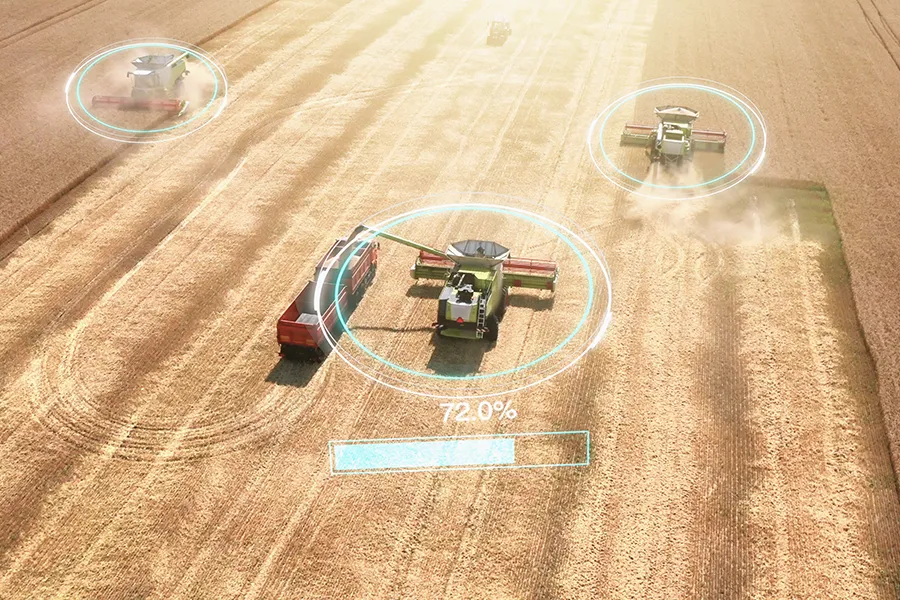
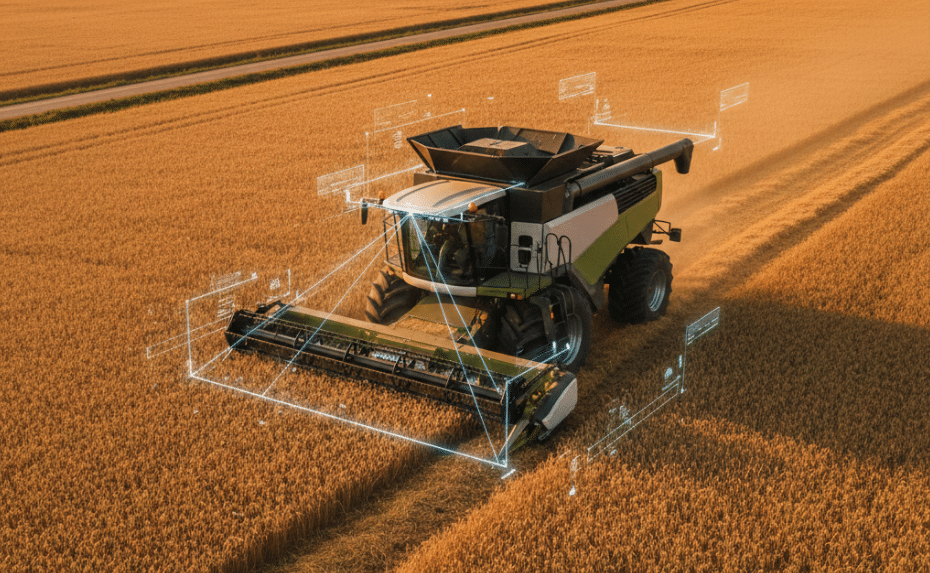
In January 2026, John Deere showcased its X9 combine at CES in Las Vegas. Deere VP of production systems Aaron Wetzel described the machine as “essentially autonomous” — capable of steering itself, adjusting speed to crop volume automatically, and managing the unloading process at the push of a button. The combine’s stereo cameras, GNSS receivers, and predictive ground speed automation represent generations of advancement from the S770 Deere brought to CES in 2019.
Meanwhile, PTx Trimble’s OutRun autonomous grain cart system went on sale in 2025, enabling a driverless tractor-and-cart to sync with a combine, collect grain on the go, and shuttle it to a staging area — all controlled from an iPad in the combine cab.
These aren’t concept vehicles. They’re production machines and retrofit kits shipping to farms right now. And they represent a fundamental shift that most farm infrastructure isn’t prepared for.
The machines are getting smarter. The labor to run them is disappearing — the American Farm Bureau Federation reports agricultural labor costs are forecast to exceed $53 billion in 2025, with 56% of farmers reporting labor shortages. Autonomy isn’t a luxury feature anymore. It’s becoming operational necessity.
But here’s the gap: the roads, staging areas, and transfer zones that connect these autonomous machines to the rest of the supply chain — the on-farm roads that grain carts travel from field to truck, that combines traverse between fields, that fuel tankers and semi-trailers use to reach the operation — were never engineered for what autonomous systems are about to demand of them.
This article examines why autonomous harvest equipment creates fundamentally different infrastructure demands than conventional equipment, and how to engineer road bases that match the capability of the machines running on them.
Why Autonomous Equipment Changes the Infrastructure Equation
If you’ve been farming for decades, you might reasonably ask: my roads handle combines and grain carts now — what changes with autonomy? The answer lies in three operational shifts that autonomy introduces. Each one amplifies the stress your farm roads absorb.

Shift 1: Extended Operating Hours
A human operator runs a combine 12 to 16 hours on a good day. Fatigue, meals, and darkness set the limits. An autonomous combine or grain cart doesn’t have those constraints. John Deere’s vision for full-season autonomous crop production by 2030 explicitly targets 24-hour field operations. PTx Trimble’s OutRun marketing materials describe the system as enabling farmers to “harvest 50-60% faster” by eliminating the downtime of waiting for a grain cart operator.
What does this mean for your roads? A farm road that currently handles 20 loaded grain cart passes per day during a 14-hour harvest window might handle 30 to 35 passes over a 20-hour autonomous window. Over a 25-day harvest season, that’s the difference between 500 total passes and 750 to 875. Your road absorbs 50 to 75% more cumulative load per season under autonomous operations — with the same equipment weights.
And this isn’t just harvest. John Deere released autonomy retrofit kits in January 2025 for its 8R, 8RX, 9R, and 9RX tractors to enable autonomous tillage. PTx Trimble is developing an autonomous tillage kit that converts the same OutRun tractor to fieldwork after harvest. Roads that were “harvest-only heavy traffic” become year-round heavy traffic corridors.
Shift 2: Concentrated Wheel Paths (Controlled Traffic)
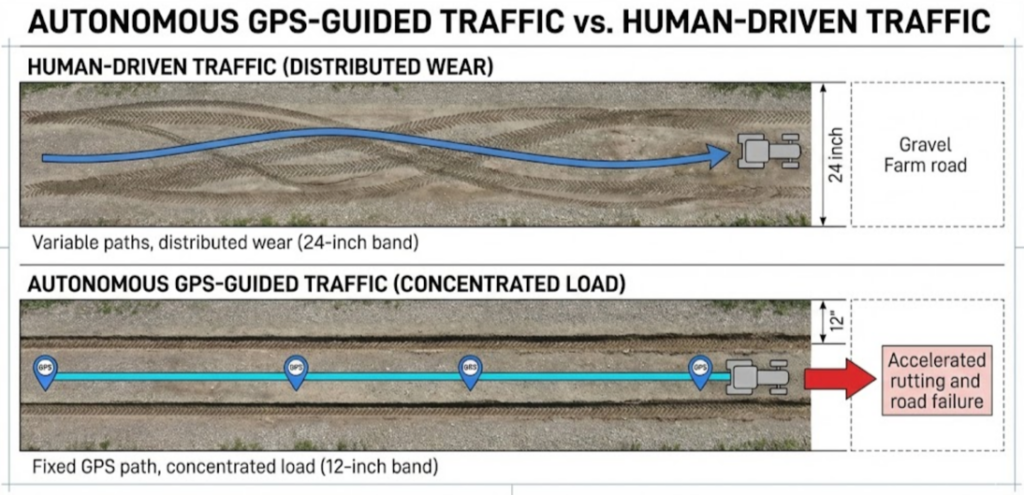
Human operators drive approximate paths. They wander a few inches left and right, distributing wear across a wider band of road surface. GPS-guided autonomous machines don’t wander. They follow the same path within centimeters, every pass, every time.
This is excellent for field operations — controlled traffic farming reduces soil compaction across the growing area by confining wheels to permanent tramlines. Research consistently shows yield benefits from reduced compaction.
But it’s brutal on roads. Instead of distributing wear across, say, 24 inches of road width (the natural wander band of a human driver), an autonomous system concentrates every pass on the same 12-inch strip. The cumulative load per unit area doubles. Rut formation accelerates dramatically because the same subgrade zone absorbs every single pass rather than sharing the load with adjacent zones.
An unstabilized gravel road that survives 500 human-driven passes per season may fail at 300 autonomous passes — because every one of those 300 hits the exact same spot.
Shift 3: Heavier Machines, Heavier Loads
Farm equipment has been getting heavier for decades, and the trend isn’t reversing. According to AllMachines.com, modern John Deere combine harvesters weigh between 42,231 and 59,020 lbs — and that’s empty, before grain fills the tank. A full grain tank on an X9 1100 holds over 410 bushels of corn at 56 lbs per bushel — adding roughly 23,000 lbs. A loaded X9 in the field approaches 80,000 lbs gross weight.
Grain carts are just as demanding. A 1,300-bushel grain cart loaded with corn weighs approximately 80,000 to 90,000 lbs including the tractor pulling it. These loads travel your farm roads every time they shuttle from the combine to the truck staging area.
Here are the gross operating weights farm roads routinely handle during harvest:
| Equipment | Empty Weight | Loaded Weight | Typical Axle Load |
| John Deere X9 1100 combine (no header) | ~59,000 lbs | ~82,000 lbs (full tank) | 25,000-35,000 lbs per axle |
| Large grain cart + tractor | ~35,000 lbs | ~85,000-90,000 lbs | 20,000-30,000 lbs per axle |
| Loaded grain semi-trailer | 33,000 lbs (tractor only) | 80,000 lbs legal max | 34,000 lbs (tandem) |
| Fuel/service truck | 10,000-14,000 lbs | 25,000-33,000 lbs | 10,000-15,000 lbs per axle |
Sources: John Deere published specifications (deere.com); FHWA bridge formula weight limits; manufacturer specifications.
These aren’t occasional loads. During harvest, a busy farm road sees loaded grain carts every 15 to 30 minutes. When those carts run autonomously on fixed paths for 20 hours a day, your road surface is absorbing more concentrated punishment per square foot than many county roads handle in a year.
What Happens When Autonomous Equipment Meets Unprepared Roads
The consequences of the three shifts above compound. Here’s what happens when autonomous harvest equipment operates on roads that were built for conventional, human-operated traffic patterns.
Accelerated Rut Formation
Concentrated wheel paths create ruts faster than distributed traffic. On unstabilized gravel, ruts of 3 to 4 inches can develop within a single harvest season under autonomous fixed-path loading. These ruts collect water, soften the subgrade, and deepen progressively with each subsequent pass — a self-reinforcing failure cycle.
For human-driven equipment, an operator sees the rut forming and instinctively adjusts — moving a few inches to the side, choosing a different line, slowing down through the soft spot. Autonomous systems in their current generation follow the programmed path. While obstacle detection (like the sensors on PTx Trimble’s OutRun tractor) will stop a machine for safety hazards, subtle road degradation doesn’t trigger avoidance. The machine drives through the developing rut at full speed and load, accelerating the damage.
Downtime During Critical Windows
A road failure during harvest isn’t just an inconvenience — it’s a direct yield loss. Grain deteriorates in the field. Moisture content changes daily. Weather windows close. The American Farm Bureau estimates that harvest timing directly affects both yield quantity and grain quality, with late harvest reducing corn yields by approximately 1% per day of delay once the optimal window passes.
If a grain cart bogs down on a failed road section at 2 AM during an autonomous run, the entire harvest chain stops — but there may be no one physically present to respond immediately. The combine’s grain tank fills. The combine stops harvesting. Hours pass before the situation is resolved. On a 3,000-acre operation harvesting 200+ bushels per acre corn, every hour of downtime represents significant lost throughput.
Compounding Maintenance Costs
The gravel regrading cycle that many farms already endure accelerates under autonomous traffic patterns. If a road currently requires regrading 3 times per harvest season under conventional use, it may need regrading 5 to 6 times under autonomous use — or more frequently — due to the concentrated loading. Each regrading requires labor (the very resource autonomy was supposed to free up), fuel, and equipment time that competes with productive fieldwork.
Engineering the Road Base: What Autonomous-Ready Means
Designing farm roads for autonomous equipment requires addressing the three operational shifts — more hours, concentrated paths, and heavy loads — with infrastructure that doesn’t degrade progressively under these conditions. This is where the engineering of the road base layer becomes critical.
The Fundamental Problem With Unstabilized Aggregate
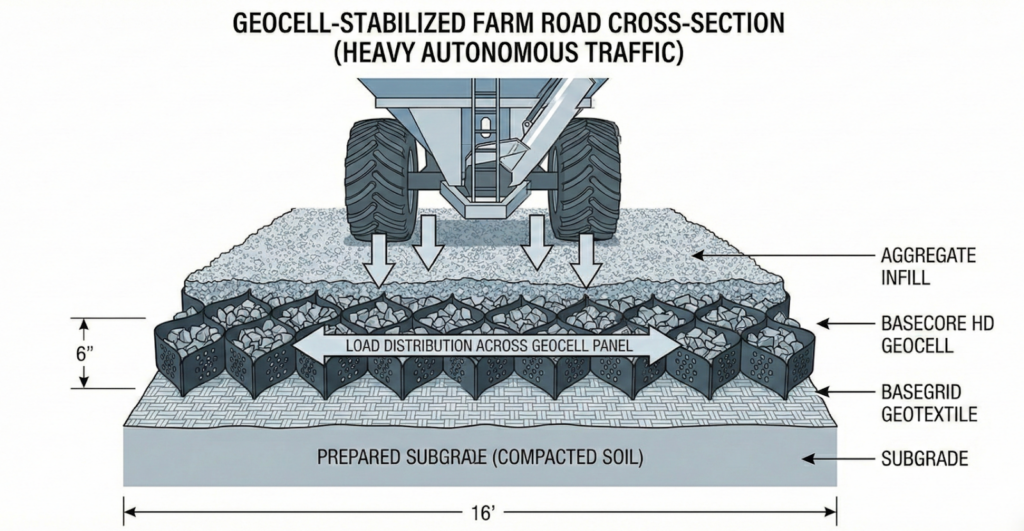
Loose gravel on a native soil subgrade fails under concentrated heavy loading because of lateral displacement: each tire pass shoves aggregate sideways out of the wheel path, and there’s nothing to push it back. The displaced aggregate creates berms along the rut edges while the wheel path sinks.
Periodic regrading scrapes the berms back into the rut, temporarily restoring the surface. But regrading doesn’t restore the structural integrity of the base — it just redistributes the same aggregate that will displace again on the next pass.
Under human-driven traffic with natural wander, this process is slow enough to manage. Under autonomous fixed-path traffic, it’s fast enough to overwhelm maintenance capacity.
How Geocell Stabilization Addresses Each Shift
Geocell road base stabilization directly counters the three autonomous traffic shifts:
Against extended hours (more passes): Geocell cells physically contain aggregate, preventing lateral displacement regardless of how many passes occur. Pass number 1 and pass number 10,000 produce the same surface response because the aggregate literally cannot move sideways. The cell walls absorb the lateral forces that would otherwise push gravel into ruts. There’s no progressive degradation curve to manage.
Against concentrated wheel paths: This is where geocell stabilization provides its most significant advantage for autonomous applications. Even when every pass hits the exact same 12-inch strip, the cellular structure distributes load across the full panel width. A loaded wheel on a geocell surface doesn’t just compress the cells directly beneath it — the interconnected cell structure transfers force to adjacent cells, spreading the load across a wider area of subgrade.
This is fundamentally different from loose aggregate, where a wheel compresses only the gravel directly beneath it and shoves the rest aside. The geocell system turns a point load into an area load — exactly what concentrated autonomous traffic demands.
Against heavy loads: BaseCore’s weight specification chart maps geocell depth directly to gross vehicle weight. For the loads autonomous harvest equipment generates:
| Application | Gross Vehicle Weight | BaseCore HD Depth | BaseCore Standard Depth | Geotextile |
| Autonomous grain cart corridor (loaded) | 80,000-90,000 lbs | 6″ | 8″ | BaseGrid high-strength woven |
| Combine transport road | 60,000-82,000 lbs | 4″ or 6″ | 6″ or 8″ | 6 oz non-woven or BaseGrid |
| Semi-trailer staging/loading area | 80,000 lbs | 6″ | 8″ | BaseGrid high-strength woven |
| Service/fuel truck access | 25,000-33,000 lbs | 4″ | 4″ or 6″ | 6 oz non-woven |
| Light vehicle/pickup roads | 6,000-10,000 lbs | 3″ | 3″ or 4″ | 6 oz non-woven |
Source: BaseCore GeoCell Selection Guide (BSC-1) and Weight Specifications chart.
BaseCore HD is the preferred product for autonomous-traffic roads because its smaller cell geometry (8.5″ x 7″ versus 12.6″ x 11.3″ for standard) provides tighter aggregate confinement — critical when the same cells absorb concentrated loading on every pass. HD cells in 4-inch depth can match the performance of 6-inch standard cells, reducing both excavation depth and infill material volume. For the heaviest applications (loaded grain cart corridors), 6-inch BaseCore HD with BaseGrid high-strength woven geotextile provides the maximum available support.
HD’s published specifications support this application: double-welded seams, 88 lbf/in minimum seam peel strength per ASTM D6392 (190 lb long-term), 65-75 mil cell wall thickness after texturing, and 7,000-hour environmental stress crack resistance per ASTM D1693.
Designing for the Autonomous Farm: A Zone-Based Approach
Not every road on your farm needs the same specification. A zone-based approach matches infrastructure investment to actual traffic intensity and load requirements.
Zone 1: Primary Grain Corridor (Highest Priority)
This is the road between your fields and the grain truck staging area — the path your autonomous grain cart will travel dozens of times per day during harvest. It absorbs the highest frequency of the heaviest loads and is the single most critical piece of on-farm road infrastructure.
Specification: BaseCore HD 6-inch depth with BaseGrid high-strength woven geotextile. #57 crushed angular stone with 15-20% fines as infill. 3-inch aggregate overfill, compacted with a 4-8 ton vibratory roller. Minimum 16-foot width for two-way traffic (a loaded grain cart plus the tractor is approximately 12-14 feet wide depending on tire/track configuration). 2% crown for drainage.
Why this specification: The primary grain corridor sees the full weight of every loaded grain cart pass (80,000-90,000 lbs) and every empty return pass. Under autonomous operation, these passes follow GPS-fixed paths. The 6-inch HD specification with high-strength geotextile provides maximum load distribution and subgrade separation for this concentrated, repetitive heavy loading.
Zone 2: Combine Transfer Road
The road combines use to move between fields or from field to the farmstead. Traffic frequency is lower than the grain corridor (a few passes per day rather than dozens), but vehicle weight is comparable — a loaded X9 approaches 82,000 lbs.
Specification: BaseCore HD 4-inch or 6-inch depth (4-inch may be sufficient if traffic frequency is low and subgrade is stable). 6 oz non-woven geotextile for most conditions; upgrade to BaseGrid if subgrade is clay-heavy or frequently saturated. Minimum 14-foot width for single-lane with turnouts.
Zone 3: Truck Staging and Loading Area
Where grain carts dump into waiting semi-trailers. This area handles both grain cart weight and the starting/stopping forces of loaded semis pulling away. Turning stress is significant — trucks execute tight maneuvers under full load, creating lateral shear forces that tear at unstabilized surfaces.
Specification: BaseCore HD 6-inch depth with BaseGrid. Consider 8-inch standard cells if consistent 80,000-lb loads occur daily and subgrade is weak (clay, silt, high water table). Extend the stabilized area 50 feet beyond the expected footprint to account for vehicle positioning variations.
Zone 4: Service and Fuel Access Roads
Lower-weight, lower-frequency roads for fuel trucks, service vehicles, and farm pickups. These don’t need heavy-duty specification but still benefit from stabilization to remain passable year-round, including during the wet conditions that often coincide with harvest.
Specification: BaseCore HD 3-inch or 4-inch depth. 6 oz non-woven geotextile. 12-foot width minimum.
Zone 5: Field Access Points and Headland Transitions
Where roads transition into fields — the entry and exit points where combines and grain carts move between the stabilized road surface and the field surface. These zones take disproportionate abuse because equipment slows, turns, and accelerates through them, often while changing from firm road to soft field surface.
Specification: BaseCore HD 4-inch depth extending 30-50 feet into the field from the road edge. These transitions prevent the “mud bowl” that develops at field entry points, which can trap autonomous equipment that lacks the human instinct to pick its line carefully through a soft spot.
Building Now for Equipment That’s Coming
One of the most practical aspects of geocell road stabilization for autonomous farming infrastructure is the timing: you can build the roads before the autonomous equipment arrives.
The Economic Case for Early Investment
Most farms adopting autonomy will do so incrementally. The PTx Trimble OutRun grain cart system, for example, is a retrofit kit that fits an existing John Deere 8R tractor. John Deere’s autonomy Precision Upgrades kit retrofits 2022-and-newer 9R, 9RX, 8R, and 8RX tractors for autonomous tillage. These systems are available now and shipping.
However, the autonomous machines are only as effective as the infrastructure they operate on. An autonomous grain cart that bogs down on an unstabilized road at 2 AM doesn’t just cost you the machine’s time — it defeats the entire purpose of the autonomy investment.
Building road infrastructure in the off-season — late summer or early fall — means the roads are ready before the autonomous system arrives for its first harvest. The geocell surface is immediately trafficable after installation with no curing time, so there’s no gap between construction completion and operational readiness.
Future-Proofing Versus Reactive Rebuilding
Farm operations that wait until autonomous equipment is already damaging their roads face a worse situation: they’re trying to rebuild infrastructure during or between the very harvest windows when the roads are most needed and least available for construction. Off-season proactive installation avoids this conflict entirely.
The 20-plus-year service life of HDPE geocell systems also means that a road built today will still be performing when the second and third generations of autonomous farm equipment arrive. The machines will evolve rapidly — sensors, AI, power systems, implements — but the fundamental physics of heavy equipment on aggregate surfaces won’t change. A properly engineered road base serves multiple equipment generations.
What to Build First
If budget requires phased implementation, prioritize by traffic intensity and operational criticality:
Phase 1: Primary grain corridor and truck staging area. These carry the most load at the highest frequency and represent the highest failure risk during autonomous operations. A road failure here stops the entire harvest chain.
Phase 2: Combine transfer roads and field access transitions. These carry heavy but less frequent loads. Failure is disruptive but doesn’t stop harvesting if alternative field access exists.
Phase 3: Service access roads. These carry lighter loads and can tolerate some surface degradation without operational impact.
For a typical 3,000-acre Midwest grain operation with a quarter-mile primary grain corridor, the Phase 1 investment — stabilizing the grain corridor and a 5,000-square-foot staging area — represents a fraction of the cost of a single autonomous system retrofit kit, with payback through eliminated maintenance and downtime avoidance beginning in year one.
Installation Considerations for Autonomous-Traffic Roads
Building roads for autonomous traffic follows the same general installation process as any geocell stabilization project, with a few additional considerations specific to the autonomous use case.

Precision in Grade and Crown
Autonomous vehicles follow precise paths, which means any grade irregularities in the road surface are hit on every pass rather than averaged out by driver wander. Crown must be consistent — 2% from center to edge — throughout the road length. Low spots that collect water will be traversed at full load on every pass, so there’s no tolerance for “soft spots that drivers can avoid.”
Take extra care during subgrade preparation to eliminate localized soft zones. If a section of subgrade is consistently weaker (clay lens, high water table, buried organic material), address it before geocell installation with additional excavation and aggregate base, or specify a heavier geotextile in that section.
Width Considerations for Autonomous Traffic
Autonomous grain carts follow precise center-of-road paths, but they still need road width for safety margins and for non-autonomous vehicles that share the road. Build roads 16 to 20 feet wide for primary corridors where autonomous grain carts and conventional vehicles may share access. Even if the autonomous cart only uses 12 feet of travel width, the additional margin accommodates passing, emergency access, and the occasional manually driven vehicle that doesn’t follow GPS lines.
Drainage Is Non-Negotiable
Every principle of drainage that applies to conventional farm roads applies double to autonomous-traffic roads. Because autonomous vehicles can’t “see” saturated subgrade conditions the way an experienced operator can (and adjust accordingly — slowing down, choosing a dryer line), the road must handle water without any human intervention.
Install culverts at every drainage crossing. Grade ditches along the full road length. Ensure the geocell system’s permeable surface works with positive grade to move water off the road continuously. Standing water that an experienced driver might steer around becomes a full-speed-full-load hit zone for an autonomous system.
Your Next Step
The autonomous harvest revolution isn’t coming — it’s here. John Deere’s autonomous tractor kits are shipping. PTx Trimble’s OutRun grain carts are in fields. AGCO is targeting $2 billion in precision agriculture revenue by 2028. Every major manufacturer is converging on the same vision: autonomous machines running longer, operating on fixed paths, at the same or greater weights than today’s equipment.
The question for every farm operation investing in this technology is simple: are your roads ready?
BaseCore’s project managers work with farm operations across the country, sizing and specifying geocell road systems for the specific vehicles and traffic patterns each operation handles. If you’re evaluating autonomous harvest technology — or already running it — a 15-to-20-minute conversation about your road infrastructure can identify exactly where your current roads are vulnerable and what it takes to bring them up to the demands autonomous equipment will place on them.
Request a consultation: basecore.co/quick-basecore-quote/
Call: 888-511-1553
Your $500,000 autonomous system is only as reliable as the $3-per-square-foot road it drives on.
Frequently Asked Questions
How heavy are modern autonomous-capable combines?
John Deere’s X9 1100 — the model showcased with autonomous capabilities at CES 2026 — weighs approximately 59,000 lbs empty. With a full grain tank (410+ bushels of corn at 56 lbs/bushel), gross operating weight approaches 82,000 lbs. This classifies as heavy-duty loading, requiring 6-inch BaseCore HD or 8-inch BaseCore standard geocell depth per the BaseCore Selection Guide.
Does geocell stabilization work for the concentrated wheel paths created by GPS-guided equipment?
Yes — this is actually where geocell provides its greatest advantage over loose aggregate. The interconnected cell structure distributes a concentrated point load across adjacent cells, effectively turning a narrow wheel path into a broader area load on the subgrade. Loose gravel cannot do this; it simply displaces sideways under concentrated loading.
Can I install geocell roads before purchasing autonomous equipment?
Absolutely. Most operations benefit from building infrastructure in advance during an off-season window. The geocell surface requires no curing time and is trafficable immediately after compaction. Roads installed this fall are ready for autonomous harvest operations next season — and they improve conventional traffic performance in the meantime.
What width should I build autonomous grain cart corridors?
Minimum 16 feet for primary corridors where autonomous grain carts operate. Although the cart and tractor occupy approximately 12-14 feet, the additional width provides a safety margin, accommodates conventional vehicle passing, and allows for occasional manual operation where the operator may not follow the precise GPS line.
How long does a geocell-stabilized farm road last under heavy autonomous traffic?
BaseCore geocell systems are designed for 20-plus years of service. The HDPE material is UV stabilized and embedded below the aggregate surface. Both BaseCore standard and HD carry 10-year product and seam strength warranties. Under autonomous concentrated loading, the geocell’s physical containment of aggregate prevents the progressive rut formation that shortens the life of unstabilized surfaces.
Helpful Resources
- Request an autonomous-ready road consultation: basecore.co/quick-basecore-quote/
- BaseCore HD specifications: basecore.co/basecore-geocell-hd/
- Farm driveway stabilization guide: basecore.co/farm-driveway-stabilization-guide/
- Road construction applications: basecore.co/geocell-for-road-construction/
- Phone support: 888-511-1553
This article references publicly available information from John Deere (autonomous X9 combine specifications, CES 2026 display, Next Generation Perception System retrofit kits, published weight specifications), PTx Trimble (OutRun autonomous grain cart system specifications and pricing structure), AGCO Corporation (PTx Trimble joint venture precision agriculture revenue targets), the American Farm Bureau Federation (2025 agricultural labor cost forecasts and farm labor shortage data dated 2024-2025), the USDA Economic Research Service (farm labor employment data dated 2024), FTI Consulting (agricultural labor shortage statistics dated 2025), AllMachines.com (combine harvester weight ranges), and BaseCore product specifications including the GeoCell Selection Guide (BSC-1), Weight Specifications chart, Side-by-Side HD Comparison, and published ASTM testing standards (D5199, D6392, D1505, D1693). Equipment weights cited are manufacturer-published specifications; actual field weights vary by configuration, header, and grain load. This guide provides general engineering guidance for farm road infrastructure. For project-specific recommendations, consult a BaseCore project manager or qualified civil engineer.