

The Cost Nobody Puts on a Balance Sheet
Somewhere right now, a loaded grain truck is stuck on a farm access road that was fine three days ago. A semi-trailer carrying 45,000 pounds of soybeans is taking a 12-mile detour because the direct route to the elevator has turned into a slurry after two days of rain. A combine sits idle at the field edge because the staging area where it needs to offload is an impassable mud pit.

None of these costs show up on a line item. There’s no invoice for “mud.” But every farm operation pays it — in lost hours, burned fuel, damaged equipment, missed delivery windows, degraded product quality, and the compounding stress of knowing that your most time-sensitive operations depend on surfaces that fail exactly when you need them most.
We call this the “Mud Tax” — the cumulative, largely invisible cost that inadequate ground infrastructure imposes on agricultural logistics. And for operations that depend on just-in-time delivery to elevators, processors, and markets, this tax isn’t just an inconvenience. It’s a competitive threat.
The Scale of the Problem: Agriculture’s Infrastructure Gap

American agriculture depends on trucking more than any other freight mode. According to the USDA Agricultural Marketing Service, trucks carry 70% of agricultural and food products and represent 30% of all ton-miles moved on U.S. transportation systems. Every crop, every animal, every input starts or ends its journey on a truck — and that truck starts or ends its journey on a farm road.
The American Farm Bureau Federation reported that according to TRIP, a national transportation research group, 15% of U.S. roads are in poor condition and 21% are in mediocre condition. Among rural bridges, 9% are in poor or structurally deficient condition — often restricted to lower weight vehicles or closed entirely, cutting off access for loaded agricultural equipment. In Mississippi alone, over 2,000 county road bridges are weight-posted, and approximately 500 are fully closed.
But those statistics describe public roads. The infrastructure gap is even wider on private farm roads and surfaces — the driveways, access lanes, staging areas, equipment yards, and field access routes that farmers themselves build and maintain. These are the surfaces where mud exacts its highest toll, because there’s no government agency maintaining them and no budget line item tracking their cost.
What Modern Farm Equipment Demands
The equipment moving across farm surfaces has grown dramatically heavier and wider over the past two decades. A modern combine harvester weighs 30,000 to 40,000 pounds empty and up to 65,000 pounds when the grain tank is full. A loaded grain cart can exceed 60,000 pounds. Semi-trailers hauling grain to the elevator run at 80,000 pounds gross vehicle weight.
These loads would challenge well-engineered highways. On unpaved farm surfaces — particularly during the harvest windows when timing is everything — they destroy unstabilized ground in a matter of passes. The first truck creates ruts. The second truck deepens them. By the third or fourth pass, you have a surface that slows traffic to a crawl, damages undercarriages, and in wet conditions, traps vehicles entirely.
This isn’t a hypothetical. It’s Tuesday in October on a corn farm.
Anatomy of the Mud Tax: Where Your Operation Bleeds Money
The mud tax isn’t one cost — it’s a cascade of interconnected losses that compound across every wet-weather event and every season. Understanding each component reveals why the total cost is far higher than most operations realize.
1. Direct Maintenance: The Regrading Treadmill
Most farm operations with unstabilized gravel or dirt surfaces regrade 2 to 4 times per year. Each regrading event involves equipment time (either your own or contracted), fresh gravel to replace what’s migrated into the subgrade or been pushed to the road edges, and the fuel to run it all. For a mid-sized operation with 2,000 to 5,000 linear feet of access roads plus staging areas, annual regrading costs typically run $5,000 to $15,000.
The frustrating reality: regrading is a temporary fix that addresses symptoms, not causes. The gravel migrates because nothing confines it. The ruts return because the loads exceed the surface’s bearing capacity. You’re paying thousands per year to restore a surface to a condition that will fail again the next time it rains during heavy use.
2. Productivity Loss: The Hours You Can’t Get Back
When a farm road becomes marginal, everything slows down. Trucks that should move at 15–20 mph creep along at 5 mph. Loading operations that should take 30 minutes stretch to an hour because vehicles have to navigate around the worst spots. Drivers who should make 6 round trips per day make 4.
During harvest — when every hour of good weather represents thousands of dollars in crop value — this slowdown is devastating. A single day lost to impassable roads during peak harvest can cost a grain operation $10,000 to $50,000 or more in delayed delivery, depending on scale and commodity.
For perishable operations (produce, dairy, livestock), the window is even tighter. A delivery truck that can’t reach your loading dock on time doesn’t just delay a shipment — it can result in spoiled product, missed market windows, and contract penalties.
3. Equipment Damage: The Repair Bills Nobody Tracks
Mud and ruts don’t just slow equipment — they break it. Constant pounding through ruts accelerates wear on suspension systems, drivetrain components, and tires. Mud packed into undercarriages corrodes electrical connections, clogs radiators, and fouls brake systems. Trucks that get stuck require extraction, which can damage both the stuck vehicle and the towing equipment.
Most farms don’t track these costs as “road-related.” The repair bill goes under “equipment maintenance.” The tire replacement goes under “operating supplies.” The costs are real, but they’re invisible in the accounting because nobody connects the failed wheel bearing to the 6 inches of ruts the truck hammered through 500 times last quarter.
4. Carrier Reluctance: When Trucks Stop Coming
Here’s a mud tax component that blindsides operations when it hits. Commercial carriers — the trucking companies that move your grain to the elevator or your cattle to market — evaluate your farm roads before accepting loads. If your access is poor, several things happen:
Carriers charge premium rates for difficult access (sometimes 15–25% above standard rates). Some carriers refuse loads from farms with known access problems, especially during wet seasons. Contract haulers build road-condition clauses into agreements, allowing them to skip pickups when conditions deteriorate.
During harvest, when carrier capacity is already tight, being the farm that trucks don’t want to visit means you’re last in line for available capacity. Your neighbors with paved or stabilized access get served first.
5. Seasonal Weight Restrictions: The Spring Surprise
Forty-one states impose seasonal weight restrictions on certain roads during spring thaw, according to data compiled by transportation researchers. These frost laws can reduce allowable loads by 25 to 50% on affected routes. In the Midwest, spring thaw restrictions often coincide exactly with the window when operations need to move stored grain, receive spring inputs (seed, fertilizer, chemicals), and prepare for planting.
The result: operations that planned to ship a full semi-load of 80,000 pounds may be restricted to 60,000 or even 40,000 pounds, requiring additional trips that increase cost per bushel and eat into already-slim margins.
While these restrictions apply to public roads, the principle extends to private farm surfaces: wet spring conditions destroy unstabilized farm roads at the same time public restrictions are limiting your transport options on the routes beyond your gate.
Just-in-Time Agriculture: Why Infrastructure Resilience Is No Longer Optional
Modern agriculture operates on increasingly tight logistics schedules. The romantic image of grain sitting in a bin until prices look good has given way to contract delivery windows, forward-sold commitments, and processor supply chains that expect reliability.
The Harvest Window
Combine manufacturers and agronomists have optimized equipment and varieties to squeeze maximum yield from narrow harvest windows. A modern corn operation might have a 15 to 25-day optimal harvest window. Every day within that window, the operation needs to harvest, truck grain to the elevator or on-farm storage, and return equipment to the field — a continuous loop that depends entirely on the road between field and destination being passable.
One significant rain event during this window doesn’t just stop field operations — it can make access roads impassable for days after the rain stops, extending the real downtime well beyond the weather event itself. With unstabilized surfaces, it’s not unusual to lose 3 to 5 working days for every major rain during harvest — the rain day itself plus 2 to 4 drying days before surfaces can handle loaded trucks again.
Input Delivery Timing
Seed, fertilizer, and crop protection products arrive on schedules coordinated with planting windows. A fertilizer delivery that can’t reach your storage because the farm entrance road has become a mud pit doesn’t just sit on the truck — it delays your application timing, which can affect yield. With some crop protection products, a 48-hour delay in application during the optimal window can reduce efficacy by 10 to 20%.
Livestock Operations: No Days Off
Livestock operations face the most relentless logistics demands. Feed deliveries, milk pickup, and livestock transport happen on fixed schedules regardless of weather. A dairy farm that can’t get milk trucks to the bulk tank because the access road is impassable faces spoilage within hours. Cattle operations that can’t load for market-scheduled delivery face contract penalties and holding costs.
For these operations, every day of access is a production day. There is no “we’ll catch up next week.”
The Solution: Ground Stabilization That Eliminates the Mud Tax Permanently
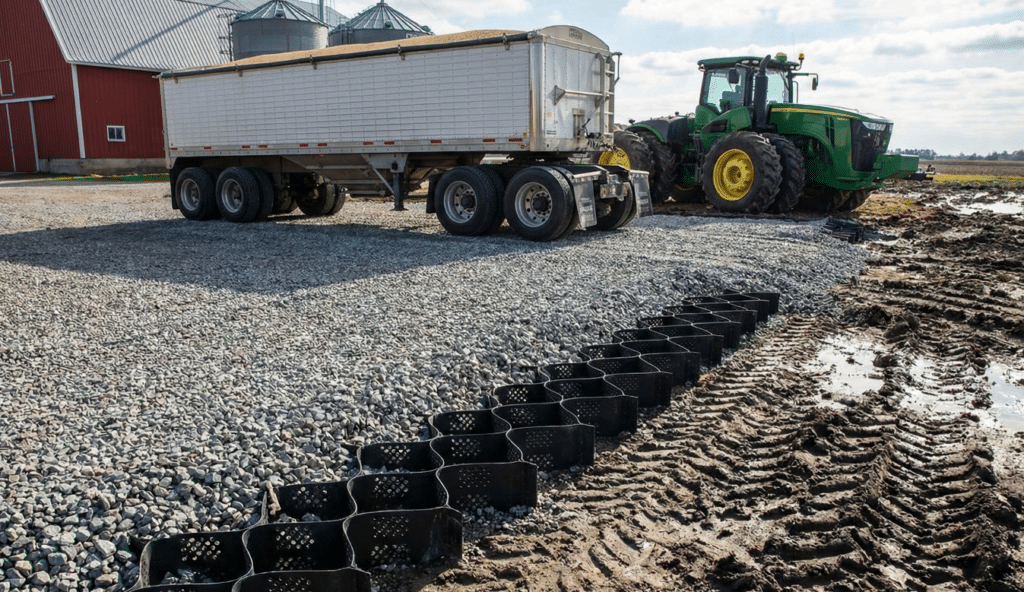
The mud tax exists because unstabilized ground surfaces can’t handle the loads, traffic, and weather conditions that agricultural operations impose on them. Gravel without confinement migrates. Dirt without structure turns to mud. The fix isn’t better gravel or more frequent regrading — it’s a structural system that permanently confines fill material and distributes loads across a wider area.
How BaseCore Geocell Works on Farm Surfaces
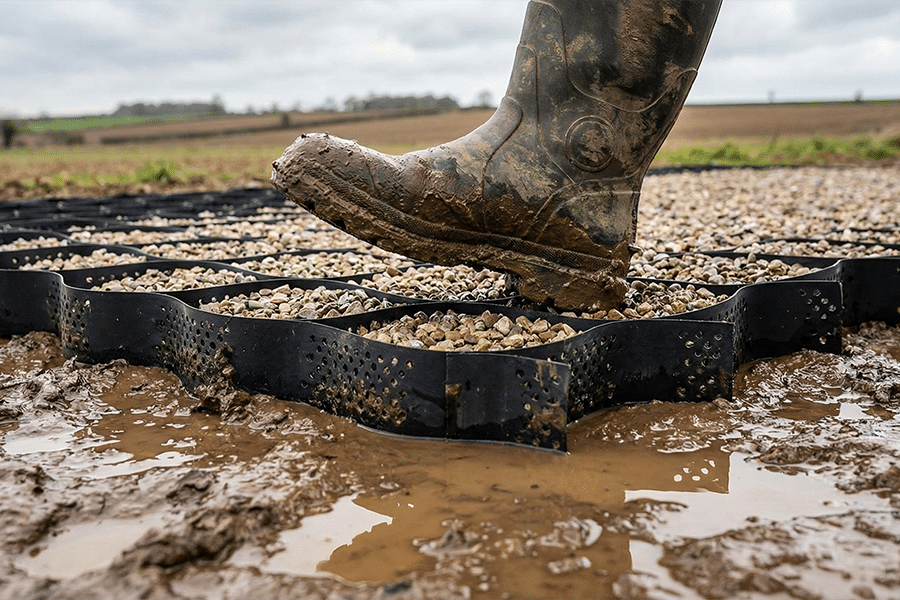
BaseCore geocell is a three-dimensional HDPE honeycomb structure that creates individual confinement cells for aggregate fill. When expanded and filled with crushed stone, each cell locks its infill in place — the aggregate can’t migrate laterally, can’t be pushed into the subgrade, and can’t rut under repeated heavy loads.
The cellular structure distributes point loads (like a truck tire imposing 4,250 pounds of force) across an area 3 to 4 times larger than the contact patch. This reduces effective pressure on the subgrade below the threshold that causes failure — even in wet, soft soils that would swallow an unstabilized gravel surface.
The system is permeable, allowing water to infiltrate rather than pooling on the surface. This means your access road drains as fast as the subgrade allows, rather than holding standing water in ruts that deepen with every pass.
Matching the System to Farm Applications
BaseCore manufactures geocells in two product lines — standard and HD (heavy-duty) — and in depths from 2 to 8 inches. The right specification depends on your loads, as outlined in BaseCore’s published Selection Guide:
| Farm Application | BaseCore Product | Recommended Depth | Additional Materials |
| Foot/horse paths, ATV trails | BCHD or BC | 2″ or 3″ | 6 oz non-woven geotextile |
| Passenger vehicles, light pickup trucks | BCHD or BC | 3″ or 4″ | 6 oz non-woven geotextile |
| Farm trucks, loaded grain carts, feed delivery | BCHD or BC | 4″ or 6″ | 6 oz non-woven fabric + BaseGrid |
| Loaded semi-trailers, combines, heavy equipment | BCHD or BC | 6″ or 8″ | BaseGrid high-strength woven fabric |
Source: BaseCore GeoCell Selection Guide (BSC-1). First depth listed is for BaseCore HD; second is for standard.
For most farm access roads handling loaded grain trucks and semi-trailers, 4- to 6-inch BaseCore HD provides the best balance of performance and cost. The HD product’s smaller cell aperture (8.5″ x 7″ versus 12.6″ x 11.3″ in standard) provides tighter aggregate confinement, which means a 4-inch HD cell can often match the performance of a 6-inch standard cell — reducing excavation depth and aggregate volume.
The Farm Infrastructure Zones
Most farm operations have five to seven distinct ground surfaces that benefit from stabilization. Prioritizing the highest-impact zones first lets you eliminate the worst mud tax costs while spreading the investment across seasons.
Priority 1 — Main access road (gate to farmstead). This is the bottleneck. Every truck, every delivery, every piece of equipment uses this road. If it fails, everything stops. Stabilize this first.
Priority 2 — Equipment staging and loading areas. The flat areas where grain carts dump to trucks, where implements are loaded and unloaded, where deliveries stage before distribution. These take concentrated heavy loads in tight areas and fail fastest.
Priority 3 — Field access roads. The routes from the farmstead to individual fields. These can be longer (thousands of feet) but may be lower priority if you can sequence stabilization across multiple seasons.
Priority 4 — Livestock areas. Feed bunks, holding pens, and paths between barns and pastures. Constant animal traffic in confined areas creates chronic mud problems that affect animal health, worker safety, and daily operations.
Priority 5 — Storage and maintenance yards. Equipment storage areas, shop approaches, and fuel tank pads. These take intermittent but heavy loads and benefit from stabilization for both access and equipment protection.
What Installation Looks Like on a Working Farm
Farm operations can’t shut down for infrastructure upgrades. BaseCore installations work around active operations by design.
Timeline and Process
For a typical farm access road (12 feet wide by 1,000 feet long = 12,000 square feet), expect:
- Site preparation and base course: 2–3 days. Grade the subgrade to your drainage plan, lay geotextile fabric (6–12 oz non-woven depending on application), and compact 4–6 inches of aggregate base.
- BaseCore panel installation: 1 day. An experienced crew of 4–5 covers approximately 10,000 square feet per day. Panels expand from their collapsed shipping form into the full honeycomb pattern, are connected to adjacent panels, and positioned on the prepared base.
- Infill and compaction: 1–2 days. Fill cells with #57 crushed stone with 15–20% fines, overfill 2–3 inches above cell tops, and compact with a vibratory roller (minimum 3 tons for standard applications, 4–8 tons for heavy-duty).
- Immediate use. No curing time. Drive on it right away. This is a critical difference from concrete or asphalt, which require days to weeks of curing.
Total timeline for a 12,000-square-foot access road: 4 to 6 working days. For operations that can’t take their main road offline for a week, installations can be sequenced — stabilize one lane while traffic uses the other, then switch.
Seasonal Timing
The best time to install is when ground conditions are driest and farm activity is lowest — typically late summer before harvest or early spring before planting. However, BaseCore installations can happen in most conditions as long as the subgrade can be adequately prepared and compacted.
Avoid installing during peak harvest or planting windows when every piece of equipment and every hour of labor is committed to production. The week before harvest starts, not the week harvest ends, is the smart installation window.
The Math: Mud Tax vs. One-Time Investment

Let’s make this concrete with a common scenario: a 12-foot-wide by 1,000-foot-long farm access road.
Annual Mud Tax (Unstabilized Gravel)
| Cost Component | Annual Estimate |
| Regrading (3x/year including equipment, labor, fuel) | $3,000–$6,000 |
| Replacement gravel (migration and subgrade loss) | $1,500–$3,000 |
| Productivity loss (slower traffic, stuck vehicles, detours) | $2,000–$10,000 |
| Equipment repair acceleration (suspension, tires, drivetrain) | $1,000–$3,000 |
| Carrier surcharges (difficult access premiums) | $500–$2,000 |
| Annual total | $8,000–$24,000 |
One-Time BaseCore Investment (Same Road)
| Cost Component | Estimate |
| BaseCore HD geocell panels (12,000 sq ft) | Contact for quote |
| Geotextile fabric (6–12 oz non-woven) | ~$0.10–$0.15/sq ft |
| Aggregate base course (4–6″ compacted) | $0.50–$1.50/sq ft |
| Infill material (#57 crushed stone) | $0.50–$1.00/sq ft |
| Installation labor | $0.50–$1.00/sq ft |
| Total investment | Contact for project-specific quote |
The Payback
With annual mud tax costs ranging from $8,000 to $24,000 on a single access road, most farm BaseCore installations pay for themselves within 2 to 4 years — after which the savings accumulate year over year with minimal maintenance (occasional top-up of infill material is the only recurring cost). The system is designed for 20+ years of service life.
For operations with multiple high-cost mud zones, the cumulative savings compound rapidly. A farm spending $15,000 per year across all its ground maintenance will redirect more than $250,000 over 20 years if the underlying cause — unstabilized ground — is eliminated.
Getting Started: A Conversation, Not a Commitment
If you’ve been nodding along while reading this — if you know exactly which road on your operation is the problem, which staging area turns into a quagmire every spring, which access point makes truckers grumble — your next step is a conversation.
BaseCore’s project managers work with agricultural operations regularly. They understand that farm budgets are seasonal, that installation timing has to work around production schedules, and that the person making the call is probably the same person driving the tractor, managing the books, and fixing the fence.
A typical consultation takes 15 to 20 minutes. Bring your approximate square footage, your heaviest vehicle, and a few photos of the problem area. You’ll leave with a recommended specification and a clear path to a quote.
Visit basecore.co/quick-basecore-quote/ to start the conversation, or call 888-511-1553 for phone support. You can also email site photos and project details to begin asynchronously — whatever fits your schedule.
The mud tax is real, but it’s not permanent. The infrastructure exists to eliminate it. The math works. The only question is how many more seasons you want to pay it.
Frequently Asked Questions
How heavy of equipment can BaseCore handle on farm roads?
BaseCore HD geocell in 6- to 8-inch depths supports gross vehicle weights up to 60,000 kg (approximately 132,000 lbs), according to BaseCore’s published weight specifications. This accommodates loaded semi-trailers, combines, grain carts, and the heaviest farm equipment in common use.
Can I install BaseCore geocell myself, or do I need a contractor?
Many farm operations install BaseCore themselves using their existing equipment — a tractor, skid steer, or small excavator for site prep and aggregate placement, plus a vibratory roller for compaction. BaseCore provides detailed installation guides, and your project manager can walk you through the process. Contractor installation is also an option at approximately $0.50–$1.00 per square foot.
Will BaseCore work in areas with poor clay soil?
Yes. The geotextile fabric layer separates the geocell system from the subgrade, preventing clay migration into the aggregate. The cellular confinement distributes loads broadly enough to prevent the system from sinking into soft subgrade. For extremely poor soils, your project manager may recommend a deeper aggregate base course or heavier geotextile.
How does the permeable surface handle spring thaw and heavy rain?
Water infiltrates through the geocell surface rather than pooling in ruts. This means the surface drains as fast as the subgrade allows and doesn’t develop the standing water that makes unstabilized roads impassable for days after rain events. Most operations report that their stabilized surfaces are usable within hours of heavy rain, not days.
Does BaseCore geocell work for livestock areas like feeding pads and holding pens?
Yes. Livestock areas benefit from the permeable, stable surface that geocells provide. A 3- to 4-inch system with aggregate fill creates a mud-free surface that improves animal health (reducing hoof problems and disease transmission from standing mud), worker safety, and daily operational efficiency. For areas with heavy equipment access (feed trucks, loaders), specify 4- to 6-inch depth.
Helpful Resources
- Request a farm project consultation: basecore.co/quick-basecore-quote/
- BaseCore geocell selection guide: basecore.co/geocell-selection-guide/
- BaseCore HD product specifications: basecore.co/basecore-geocell-hd/
- Installation guides: Available at basecore.co and upon request
- Warranty details: basecore.co/warranty/
- Phone support: 888-511-1553
This article references publicly available data from the USDA Agricultural Marketing Service (trucking share of agricultural freight), the American Farm Bureau Federation Market Intel report “Trucking Along: Where Rural Roads Are and Where They Are Going” (citing TRIP national transportation research data on rural road and bridge conditions), the Mississippi Department of Transportation (bridge posting data), and BaseCore product specifications including the GeoCell Selection Guide (BSC-1) and published weight specifications. Cost estimates for farm ground maintenance are based on industry ranges and may vary by region, operation scale, and site conditions. Results described are specific to the applications and conditions mentioned. For current product information and project-specific recommendations, consult basecore.co or contact the BaseCore project management team.