

You’re Searching for a Stabilization Solution. Let’s Make Sure You Find the Right One.
If you’ve been researching Dirt Locker, gravel stabilizer sprays, soil binders, or erosion control products, you’re trying to solve one of a few specific problems: a hillside that’s eroding, a gravel surface that won’t stay put, a path or driveway that turns to mud, or a slope that’s losing soil after every rain.
The challenge is that “stabilization” means different things depending on the product category, and choosing the wrong type of stabilization for your problem wastes money and leaves the underlying issue unresolved.
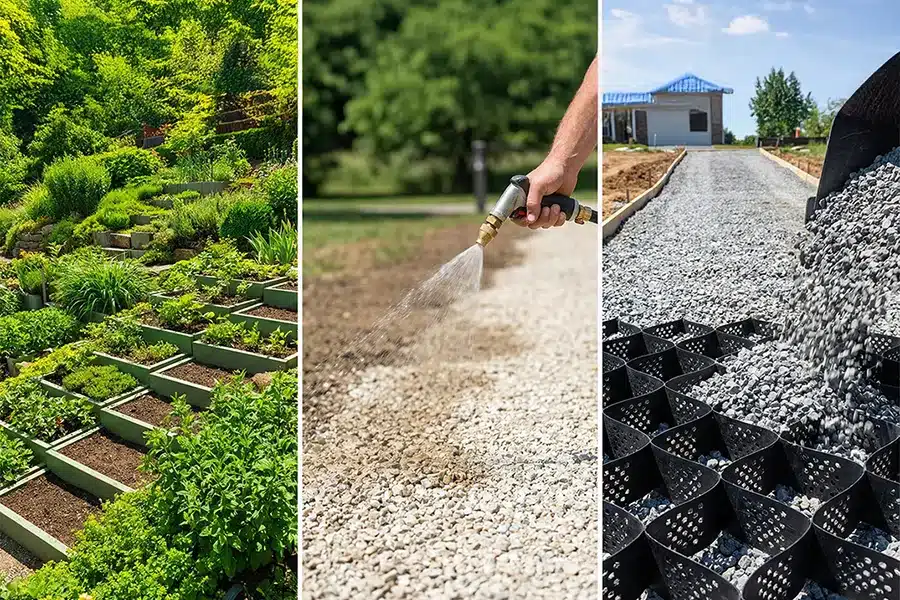
This guide breaks down three distinct categories of stabilization products — terracing systems like Dirt Locker, spray-on liquid stabilizers, and structural geocell systems — so you can match the right product to your specific situation. We’ll be straightforward about where each category works well, where it doesn’t, and where products can work together.

Category 1: Dirt Locker — Terraced Slope Planters for Erosion Control
What Dirt Locker Is
Dirt Locker is a patented terracing system designed specifically for residential hillside erosion control. Made from 100% recycled plastic, Dirt Locker creates individual planter cells that you install in rows across a slope, fill with soil, and plant. The system is available for mild slopes (under 25 degrees) and steep slopes (25-35 degrees), with interlocking “networked” configurations and standalone “detached” units.
The core concept is rooted in ancient agricultural terracing: by breaking a continuous slope into a series of level steps, you interrupt the downhill flow of water and create conditions where plant roots can establish and permanently reinforce the soil structure. Dirt Locker’s website states that “roots are the key to slope stability” and requires that 50-70% of installed cells be planted and maintained for the system to function as designed.
What Dirt Locker Does Well
Dirt Locker solves a specific, common residential problem: a sloped yard or hillside that’s eroding, losing topsoil, creating runoff, or is simply unusable space. The terracing approach works because it addresses the physics of slope erosion — water velocity increases on long uninterrupted slopes, gaining erosive energy. Terracing breaks that energy into manageable segments.
For homeowners dealing with eroding hillsides in their front or back yards, Dirt Locker provides a DIY-friendly installation (no tools required), aesthetic appeal (the slope becomes a terraced garden), water retention (the cells capture and hold moisture for plants), and long-term biological reinforcement (as plants establish, their root networks add structural integrity).
The product is priced for residential consumers, sold in packs from their website (dirtlocker.com), and includes accessories like step guards for creating walkable paths through the terraced area, J-hooks for anchoring, and alignment tools for installation precision.
Where Dirt Locker Has Limitations
Dirt Locker is designed for planted slopes. That specific focus means it has clear boundaries:
No load-bearing capacity. Dirt Locker cells are filled with soil and planted with vegetation. They are not designed to support vehicle weight, foot traffic at scale, or any structural load beyond the soil and plants they contain. You would not use Dirt Locker for a driveway, parking area, access road, or any surface that needs to support vehicles or heavy equipment.
Requires ongoing plant maintenance. Dirt Locker explicitly states that the system relies on plants growing roots into the hillside to prevent erosion long-term. If plants don’t establish or aren’t maintained, the erosion control function diminishes. This makes it a living system that requires sustained attention — watering, replanting dead plants, managing drainage.
Slope-specific application only. Dirt Locker is designed for slopes between approximately 10 and 35 degrees. Flat or near-flat surfaces, horizontal paths, driveways, roads, and parking areas are outside its design scope.
Residential scale. The product is marketed to homeowners and residential landscapers. Commercial, agricultural, or infrastructure-scale erosion control on large slopes, channels, embankments, or high-flow waterways requires different solutions.
Category 2: Spray-On Liquid Stabilizers — Surface Binders and Soil Glues
What Spray Stabilizers Are
This is a broad product category that includes many brands and formulations: polymer emulsions, acrylic binders, enzyme treatments, organic soil stabilizers, and resin-based gravel glues. Products in this category include names like DirtGlue, Ground Glue, Soil-Loc, Gravel-Lok, Perma-Zyme, Stabilizer Binder, and numerous mulch glue and gravel adhesive products.
Despite the brand variety, the basic mechanism is similar across the category: a liquid is sprayed or poured onto the surface of soil, decomposed granite, gravel, or mulch. The liquid penetrates the surface material, bonds particles together as it cures, and creates a hardened or semi-hardened crust that resists erosion, displacement, and dust.
What Spray Stabilizers Do Well
Spray-on stabilizers are effective for several specific applications:
Dust suppression on unpaved surfaces. Binding surface particles reduces the fine dust that traffic kicks up from dirt roads, unpaved lots, and construction sites. For operations where dust is the primary concern — environmental compliance, neighbor relations, air quality — spray stabilizers are often the right tool.
Surface binding for decorative paths and patios. Products like decomposed granite stabilizer or gravel binder create a firm, walkable surface from materials that would otherwise be loose. For garden paths, patio areas, and decorative walkways with pedestrian traffic only, these products work well when properly installed with edge restraint.
Erosion control on exposed soil surfaces. Spray stabilizers can temporarily or semi-permanently bind exposed soil on construction sites, bare slopes, stockpiles, and excavation areas to prevent wind and water erosion while awaiting permanent cover.
Tackifiers for hydroseeding and mulch. Some spray stabilizers double as tackifiers that help seed and mulch stay in place on slopes during the germination period. This is a temporary application — the stabilizer holds material in place until vegetation establishes.
Where Spray Stabilizers Have Limitations
The spray stabilizer category has significant boundaries that matter if your project involves any kind of structural load:
Surface-only binding depth. Most spray stabilizers penetrate 1 to 3 inches of material at best. They create a bound surface layer, but the aggregate or soil below that crust remains loose and unconfined. When a vehicle or heavy load breaks through the bound surface, the material beneath has no structural integrity.
Limited load-bearing capacity. Spray stabilizers are generally rated for pedestrian traffic, light residential vehicles at most, or “dust suppression” applications where the road surface itself is providing the structural support and the spray is simply binding the surface fines. Products in this category do not provide the structural load distribution required for commercial vehicle traffic, heavy equipment, or repeated heavy loading.
Reapplication requirements. Most spray stabilizers degrade over time. UV exposure, traffic wear, freeze-thaw cycles, and moisture cycles break down the binder. Manufacturers typically recommend reapplication every 6 to 24 months depending on the product and traffic conditions. This creates an ongoing maintenance cost that accumulates over the years.
Weather sensitivity during application. Spray stabilizers generally require dry conditions during application and curing — typically 24 to 72 hours without rain, with temperatures above 50°F. A surprise rainstorm during the curing window can wash away uncured product, requiring reapplication. This makes scheduling unpredictable, especially in spring and fall when these products are most needed.
Cannot address subgrade failure. Spray stabilizers treat the surface. If your problem is a weak subgrade — clay soil that turns to mud under load, a high water table, or poor soil structure — binding the surface doesn’t prevent the underlying soil from deforming under vehicle weight. The bound surface layer cracks and collapses into the deforming subgrade, and you’re back to square one.
Category 3: Geocell Stabilization — Structural Aggregate Confinement
What Geocell Systems Are
Geocell is a three-dimensional honeycomb structure made from high-density polyethylene (HDPE) that creates containment cells for infill material — typically crushed stone, but also soil, concrete, or other aggregates depending on the application. BaseCore manufactures geocell in two product lines: BaseCore standard (12.6″ x 11.3″ cells) and BaseCore HD (8.5″ x 7″ cells with tighter confinement geometry).
Geocell systems are installed as a full structural layer — placed on a prepared subgrade over geotextile separation fabric, filled with aggregate, compacted, and overfilled to create a finished surface. Cell depths range from 2 inches (light-duty) to 8 inches (heavy-duty) depending on load requirements.
What Geocell Does That Other Categories Cannot
Geocell addresses the fundamental physics that spray stabilizers and terracing systems don’t touch:
Full-depth aggregate confinement. The cell walls contain infill material through the entire depth of the structural layer — 3, 4, 6, or 8 inches deep — not just the surface. Every particle of aggregate within the cells is physically prevented from moving sideways under load. This is not a chemical bond that degrades; it’s a physical barrier that lasts as long as the HDPE material (20-plus years with UV protection).
Load distribution. When a vehicle tire presses down on a geocell surface, the cell walls transfer force to adjacent cells, spreading the load across a wider area of subgrade. A point load becomes an area load. This is the mechanism that allows a gravel surface to support vehicles weighing 80,000 lbs or more — something no spray stabilizer can achieve because spray doesn’t change the structural behavior of the aggregate layer.
Subgrade separation. The geotextile fabric installed beneath geocell panels creates a permanent barrier between the structural aggregate and the native soil. Gravel doesn’t sink into the subgrade. Subgrade soil doesn’t pump up into the gravel. The structural layer maintains its designed thickness for the life of the system. Spray stabilizers offer no subgrade separation because they’re applied to the surface, not the interface between aggregate and soil.
Permanent installation with no reapplication. Geocell doesn’t degrade under traffic, weather, or UV exposure (the cells are embedded below the aggregate surface). Once installed, the system provides consistent performance for 20-plus years without reapplication, retreatment, or re-spraying. The ongoing maintenance requirement is limited to occasional light top-dressing of surface aggregate — a fraction of the effort and cost of spray reapplication programs.
BaseCore Specifications That Matter
BaseCore HD — the product line most relevant for load-bearing applications — provides:
- Cell geometry: 8.5″ x 7″ (180mm x 218mm), approximately 40% smaller than standard geocell cells, creating tighter aggregate confinement
- Cell wall thickness: 65-75 mil after texturing (compared to 50-60 mil for standard)
- Seam construction: Double-welded for redundancy at the highest-stress points
- Seam peel strength: 88 lbf/in minimum per ASTM D6392 (190 lb long-term)
- Environmental stress crack resistance: 7,000 hours per ASTM D1693
- Available depths: 2″, 3″, 4″ (6″ and 8″ upon request)
Per the BaseCore GeoCell Selection Guide (BSC-1), depth recommendations by application include: 3-4″ for passenger vehicles and light industrial, 4-6″ for 18-wheelers, oil and gas, mining and heavy industrial, and 6-8″ for fire trucks, H-20 loading, and the heaviest applications.
When to Use Each Product: A Decision Framework

The right product depends entirely on what you’re asking the surface to do. Here’s a clear framework:
Use Dirt Locker (Terracing) When:
- Your problem is a residential hillside losing soil to erosion
- You want to create a terraced garden on a slope between 10 and 35 degrees
- The slope will be planted with vegetation (this is required for the system to work)
- No vehicles or heavy loads will traverse the slope
- You want a DIY-friendly residential project
- You value the aesthetic of a living, planted slope
Use Spray-On Stabilizers When:
- Your primary concern is dust suppression on an existing dirt or gravel road
- You’re creating decorative walkways or garden paths with pedestrian traffic only
- You need temporary erosion control on exposed soil during construction
- You’re applying tackifier for a hydroseeding operation
- The surface will only handle foot traffic or very light residential vehicles
- You accept the need for periodic reapplication (typically every 6-24 months)
Use Geocell (BaseCore) When:
- The surface must support vehicle weight — any vehicle heavier than a riding mower
- You need a permanent solution that doesn’t require reapplication
- The problem involves structural failure: ruts forming, gravel sinking into subgrade, surface deforming under load
- You’re building or stabilizing a driveway, parking area, access road, staging area, or any trafficked surface
- The application involves slopes with flowing water (channels, swales, embankments) where erosive velocities exceed what spray binders can withstand
- Loads include commercial trucks, farm equipment, construction vehicles, or heavy industrial traffic
- You need the surface to remain functional year-round including through freeze-thaw, heavy rain, and spring thaw conditions
Where These Products Work Together
In some projects, different areas need different solutions. A well-designed property might use multiple stabilization approaches, each matched to its specific zone:
Example: Rural homestead with a long driveway, a decorative courtyard, and an eroding hillside.
- Driveway (800 feet, 12 feet wide): BaseCore HD 3-4″ geocell filled with crushed stone. This is the structural backbone of the property — it handles pickup trucks, delivery vehicles, and occasional heavy trucks. Geocell provides the load-bearing capacity and permanent aggregate confinement that spray stabilizers cannot.
- Courtyard/patio area (400 sq ft): Decomposed granite with spray-on stabilizer binder creates a firm, attractive pedestrian surface with a natural appearance. The area handles foot traffic only, so a spray binder provides adequate surface stability at a lower installed cost than geocell.
- Hillside behind the house (600 sq ft slope): Dirt Locker terracing with native plantings controls erosion, retains soil, and creates a terraced garden that improves the property’s appearance and long-term slope stability through root establishment.

Each product handles its zone effectively because it’s matched to the actual demands of that zone. Problems arise when products are used outside their effective range — when someone sprays a gravel binder on a driveway that handles trucks, or installs terracing planters on a surface that needs to support vehicles.
Can You Spray Stabilizer on Top of Geocell Surfaces?
This question comes up occasionally, and the answer is: you can, but you rarely need to. Some property owners apply a light spray binder to the surface of a geocell-stabilized gravel area to reduce surface dust or “lock” the top layer of decorative stone for aesthetic purposes. This is a cosmetic enhancement, not a structural addition — the geocell system provides all the structural stabilization.
If you do apply a spray product over a geocell surface, keep in mind that the surface will still need periodic reapplication as the spray degrades. The geocell beneath continues performing regardless of whether there’s a spray coating on top.
The Real Cost Comparison
Upfront cost per square foot doesn’t tell the full story. Total cost of ownership — including maintenance, reapplication, and eventual replacement — determines the real economics.
Spray Stabilizers: Lower Entry, Higher Lifecycle
A spray-on gravel stabilizer typically costs $0.15 to $0.50 per square foot per application, depending on the product and application method. At first glance, that’s very affordable compared to geocell installation.
But spray stabilizers require reapplication. At once per year on a trafficked surface, a $0.30/sq ft application on a 5,000 square foot driveway costs $1,500 per year. Over 10 years, that’s $15,000 in reapplication cost alone — with no structural improvement to the surface. The gravel still sinks. The subgrade still deforms. The ruts still form between applications.
And each reapplication requires dry weather, proper temperature, and 24-72 hours of no traffic during curing. For a primary driveway or access road, taking the surface offline for 2-3 days twice a year creates real operational inconvenience.
Geocell: Higher Entry, Lower Lifecycle
A BaseCore geocell installation — including geotextile, geocell panels, crushed stone fill, and compaction — typically runs $3 to $6 per square foot installed (varies by depth, region, and whether you DIY or hire a contractor). That same 5,000 square foot driveway costs $15,000 to $30,000 upfront.
But that’s a one-time cost. After installation, the maintenance requirement is limited to occasional light top-dressing with surface aggregate — perhaps $200 to $500 every few years. Over 10 years, total cost is $16,000 to $32,000. Over 20 years, it’s $17,000 to $35,000.
Compare that to the spray-only approach: $15,000 in spray reapplication over 10 years ($30,000 over 20 years) — plus the underlying driveway is still failing structurally, still rutting, and still requiring periodic regrading. Add gravel replenishment and regrading costs, and the spray approach easily exceeds geocell’s total cost by year 8 to 10, with an inferior structural result.
Dirt Locker: Priced for Residential Slope Projects
Dirt Locker pricing is structured per unit (individual planter cell), with networked and detached options at different price points, plus accessories. The product is well-priced for its designed application — residential hillside terracing. It’s not a cost comparison against geocell because the two products solve completely different problems. You wouldn’t price-compare a terraced garden planter against a road base system any more than you’d compare a flower pot to a foundation footing.
Your Next Step
If your project involves a sloped residential hillside that needs erosion control and beautification, Dirt Locker and similar terracing products are worth evaluating through dirtlocker.com.
If your project involves dust control on a light-traffic path or temporary erosion protection on exposed soil, spray-on stabilizers from the product category may be appropriate.
If your project involves any surface that must support vehicle traffic — a driveway, parking area, access road, staging area, or any load-bearing application — the physics require structural stabilization that spray products and terracing systems simply cannot provide. That’s where geocell comes in.
BaseCore’s project managers help you determine the right geocell specification for your specific vehicles, loads, and site conditions. The consultation is free and typically takes 15-20 minutes.
Request a consultation: basecore.co/quick-basecore-quote/
Call: 888-511-1553
Browse BaseCore HD specifications: basecore.co/basecore-geocell-hd/
Read the geocell selection guide: basecore.co/geocell-selection-guide/
Frequently Asked Questions
Is Dirt Locker a spray-on stabilizer?
No. Dirt Locker (dirtlocker.com) is a terraced planter system for hillside erosion control — it’s a physical product you install on slopes, fill with soil, and plant with vegetation. It is not a liquid spray product. The spray-on gravel and soil stabilizer category includes separate products like DirtGlue, Ground Glue, Soil-Loc, and similar brands.
Can I use a spray stabilizer instead of geocell on my driveway?
For a driveway that handles only passenger cars and light traffic, a spray stabilizer may provide temporary surface binding. However, it won’t prevent ruts, subgrade intrusion, or gravel migration under repeated vehicle loads. For any driveway handling trucks, equipment, or regular traffic, geocell provides the structural load distribution that spray products cannot match. The spray-only approach also requires periodic reapplication, while geocell is a one-time installation.
Can spray stabilizers and geocell be used together?
Yes. Some property owners apply a light spray binder to the surface of a geocell-stabilized area for dust reduction or to lock decorative surface stone in place. The geocell provides all structural function; the spray adds a cosmetic finish. The spray will still need periodic reapplication regardless of the geocell beneath it.
How deep does a spray stabilizer penetrate versus geocell?
Most spray stabilizers penetrate 1-3 inches of surface material, creating a bound crust. BaseCore geocell confines aggregate through the full structural layer — 3, 4, 6, or 8 inches depending on specification. The geocell’s physical confinement extends from the surface to the subgrade interface, providing structural support through the entire aggregate depth.
Which product handles slopes with flowing water?
For slopes with flowing water (drainage channels, swales, waterway embankments), spray stabilizers wash away under sustained water flow. Dirt Locker is designed for planted slopes, not water channels. BaseCore geocell filled with angular rock or concrete is specifically designed for channel stabilization — the BaseCore Selection Guide recommends 3-4″ cells with angular rock for flows up to 10 ft/s, 4-6″ for flows up to 20 ft/s, and concrete-filled cells for flows exceeding 20 ft/s.
Helpful Resources
- Request a project consultation: basecore.co/quick-basecore-quote/
- BaseCore HD specifications: basecore.co/basecore-geocell-hd/
- BaseCore standard specifications: basecore.co/basecore-geocell/
- Geocell selection guide: basecore.co/geocell-selection-guide/
- Erosion control applications: basecore.co/geocell-for-erosion-control/
- Phone support: 888-511-1553
- Dirt Locker product information: dirtlocker.com
This article references publicly available product information from Dirt Locker (dirtlocker.com, including product descriptions, slope specifications, installation requirements, and maintenance guidelines as published February 2026), and the broader spray-on soil/gravel stabilizer product category including DirtGlue, Ground Glue (Corrosion Technologies), Soil-Loc, Gravel-Lok, Perma-Zyme (Substrata), and SealMaster — all based on published product specifications and application guides from manufacturer websites. BaseCore specifications reference the GeoCell Selection Guide (BSC-1), Weight Specifications chart, Side-by-Side HD Comparison document, and published ASTM testing standards (D5199, D6392, D1505, D1693). Cost ranges are general industry estimates and vary by region, supplier, and project scope. For current pricing and project-specific recommendations, consult the relevant manufacturer or supplier directly.