

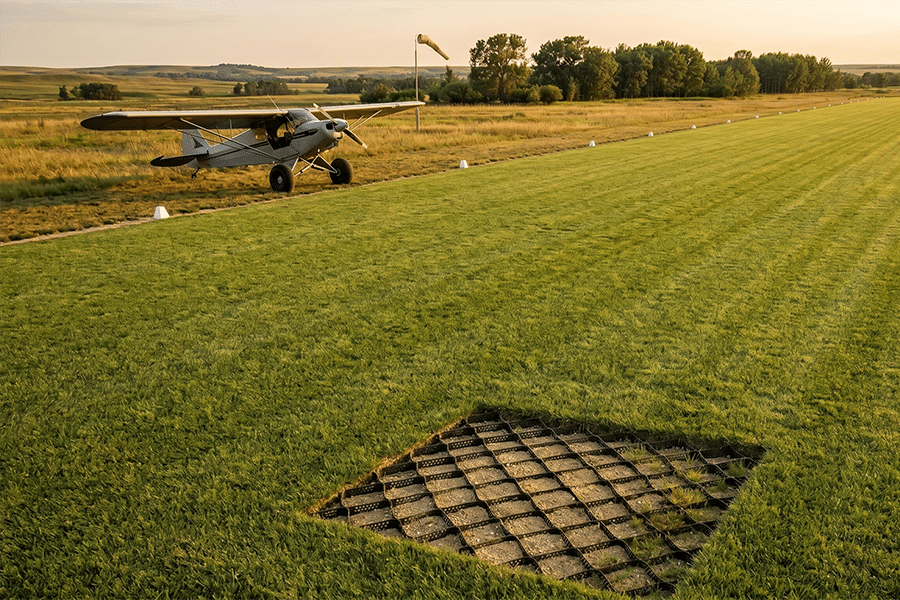
Unpaved airstrips serve a meaningful portion of U.S. general aviation. The FAA acknowledges that pilots of ultralights, tailwheels, tundra-tire aircraft, gliders, agricultural aircraft, and powered parachutes regularly operate from unpaved surfaces, both on dedicated turf runways and on the unpaved portions of Runway Safety Areas adjacent to paved runways. The operational problem is consistent across all of these: unpaved strips rut, wash out, lose their crown, and close after heavy rain. An airplane runway grid solves that problem by locking the aggregate or turf infill in place, distributing aircraft loads across a broad footprint, and keeping the strip drained. This guide answers what an airplane runway grid is, which aviation applications it fits, how load specifications map to aircraft categories, how the system installs, and how it compares to paved alternatives.
What Is an Airplane Runway Grid?
An airplane runway grid is a three-dimensional honeycomb structure, typically manufactured from UV-stabilized high-density polyethylene (HDPE), that is installed over a prepared base course and filled with aggregate, crushed stone, asphalt screenings, milled recycled asphalt, or vegetated soil. The honeycomb cells contain the infill so aircraft tire loads distribute across the interconnected grid rather than concentrating at tire contact points.
BaseCore manufactures its airplane runway grid in Scottsdale, Arizona, in two primary product lines: BaseCore Standard (BC) and BaseCore HD (BCHD). Cell depths for aviation applications typically range from 4 inches for light sport and single-engine general aviation aircraft up to 8 inches for heavier turboprops, military applications, and combined aircraft-plus-ground-equipment loading.
The system is not a replacement for FAA-funded paved commercial runways designed under AC 150/5320-6. It is an engineered solution for unpaved runways, airstrips, helipads, taxiways, tie-downs, and Runway Safety Areas where permeable, stabilized, and low-maintenance performance is the operational goal.

How Long Does an Airplane Runway Grid Last?
A BaseCore airplane runway grid is engineered to last 60+ years. The HDPE material is UV-stabilized (70% strength retained at 1,500 hours per ASTM D4355), chemically resistant, and rated for temperature service from -50°C to 80°C. Seam peel strength ranges from 1,420 N to 2,000 N depending on cell height, per ASTM D6392.
This durability is particularly relevant for aviation applications where paved alternatives require ongoing FAA-compliant maintenance cycles (crack sealing, resurfacing, and pavement condition rating inspections), while unpaved strips without reinforcement require constant regrading after rain, frost heave, and heavy aircraft operations.
Which Aviation Applications Use an Airplane Runway Grid?

The airplane runway grid adapts to essentially every unpaved aviation surface. Here are the most common deployments.
Private Turf and Grass Airstrips
The most common aviation application. Private landowners, fly-in communities, and rural residential airstrips use a runway grid with vegetated soil infill to maintain a green turf appearance while providing structural support for aircraft takeoff, landing, and taxi loads. The grid prevents the rutting, bald spots, and soft-field conditions that ground a turf strip after heavy rain.
Gravel and Crushed-Stone Airstrips
Remote airstrips, ranch strips, backcountry strips, and agricultural airstrips often use crushed-stone infill for durability and faster drainage. A runway grid with angular crushed stone eliminates stone migration from propeller wash and tire load, maintains the runway crown, and keeps the surface stable under repeated operations.
Backcountry and Bush Airstrips
Backcountry airstrips serving tundra-tire, tailwheel, and STOL aircraft face extreme conditions: seasonal freeze-thaw, heavy rain, and long periods between maintenance visits. A runway grid installed once stabilizes the strip for decades without the logistics of repeated fly-in maintenance crews.
Helipads
Helipads for private estates, emergency medical services (EMS), corporate operations, oil and gas sites, and search-and-rescue stations use a runway grid to provide a stable, permeable landing surface that survives repeated rotor-wash erosion. Vegetated soil infill maintains landscape aesthetics for residential and corporate pads; crushed stone suits industrial and EMS sites.
Aircraft Taxiways (Unpaved)
Unpaved taxiways connecting hangars, parking areas, or fuel points to the runway are prime runway grid applications. The grid handles the repeated low-speed turning loads that rapidly destroy unreinforced gravel taxiways.
Aircraft Parking Aprons and Tie-Down Areas
Static aircraft parking produces concentrated point loads at tire contact patches over long durations, which is exactly the failure mode a runway grid prevents. Tie-down areas for tailwheel aircraft, gliders, and light sport aircraft benefit from stabilized, permeable, rut-free surfaces that drain quickly after rain.
Runway Safety Areas (RSAs)
The FAA’s Advisory Circular 150/5300-13B recognizes that unpaved RSAs adjacent to paved runways regularly see takeoffs, landings, and off-runway operations by specific aircraft types. A runway grid stabilizes RSAs so they remain safe and serviceable under incidental aircraft use and standard maintenance-vehicle operations.
Agricultural and Crop-Duster Strips
Agricultural operators using Air Tractors, Thrushes, and other ag aircraft need strips that survive constant heavy loading, chemical exposure, and tight turnaround cycles. The HDPE material resists agricultural chemicals, and the grid structure handles both the aircraft and the support vehicles that service it.
Flight School and Tailwheel Training Strips
Primary flight training and tailwheel training operations generate high cycle counts on the same touchdown zones. A runway grid distributes the repeated load concentration, extending the usable life of the training strip substantially.
Fly-In Community and Residential Airpark Strips
Residential airparks and fly-in communities combine aviation and residential use, and runway grids with vegetated infill preserve the green aesthetic of the community while providing the structural performance the shared airstrip requires.
How Do Aircraft Loads Map to Runway Grid Specifications?
BaseCore cell depth specification is driven by the gross weight of the heaviest regular aircraft using the strip, plus any ground equipment operating on the surface. BaseCore’s weight chart and selection guide map application loads to cell depths from 3 inches for pedestrian and very light uses up to 8 inches for H-20 loading and heavy aircraft or crane operations.

Here is how common aviation loads map to BaseCore specifications:
| Aircraft Category | Example Aircraft | Gross Weight | Recommended Cell Depth |
| Light sport | Cessna 152, Piper Cub | 1,200–1,700 lbs | 3″ (BC or BCHD) |
| Single-engine GA | Cessna 172, Piper PA-28 | 2,450–3,000 lbs | 3″–4″ (BC or BCHD) |
| High-performance single | Cessna 182, Cirrus SR22 | 3,100–3,600 lbs | 4″ (BC or BCHD) |
| Light twin | Beechcraft Baron, Piper Seneca | 5,500–7,400 lbs | 4″–6″ (BCHD) |
| Turboprop single | Pilatus PC-12, TBM 930 | 9,500–10,450 lbs | 6″ (BCHD) |
| Light turboprop twin | Beechcraft King Air 90/200 | 10,500–12,500 lbs | 6″–8″ (BCHD) |
| Agricultural aircraft | Air Tractor AT-502, AT-802 | 7,500–16,000 lbs loaded | 6″–8″ (BCHD) |
| Helipad, rotorcraft | R44, Bell 206, EMS helicopters | 2,500–6,000 lbs | 4″–6″ (BCHD) |
| H-20 / heavy applications | Larger turboprops, combined equipment | Up to ~60,000 kg | 8″ (BCHD) |
Always specify for the heaviest regular aircraft, not the average aircraft. Ground support equipment — fuel trucks, tow tractors, maintenance vehicles — frequently drives the spec higher than the aircraft alone.
What Are the Infill Options for an Airplane Runway Grid?
The infill placed inside the BaseCore cells determines the runway’s visual finish, drainage behavior, and operational feel. Options include angular crushed stone (classic gravel strip), asphalt screenings (paved-style finish, still permeable), milled recycled asphalt (sustainable dark finish), vegetated soil (turf strip), and angular rock (severe-exposure installations).
Crushed Stone
Three-quarter-inch or #57 angular crushed stone is the standard infill for gravel airstrips, taxiways, and aprons. It compacts well inside the cells, drains at 90%+ permeability, and produces a familiar gravel airstrip appearance. Round river rock and pea gravel should be avoided — round stones do not lock together inside cells and can shift under tire load.
Asphalt Screenings
Asphalt screenings — the fine dust-and-chip byproduct of asphalt production — produce a darker, tighter, asphalt-style finish that behaves more like a paved surface while remaining permeable through the grid structure. This is a useful option for strips where pilots prefer a firmer, paved-like feel on landing rollout but where full hot-mix paving is cost-prohibitive.
Milled Recycled Asphalt (RAP)
Reclaimed asphalt pavement milled from a demolished paved surface can be repurposed directly as airplane runway grid infill. The finished surface reads as a dark paved airstrip, diverts demolition material from landfill, and is often sourced cheaply or free from local road rehabilitation projects.
Vegetated Soil (Turf Runway Finish)
For private airstrips, fly-in community strips, and helipads where the aesthetic expectation is grass, vegetated soil infill allows turf to grow through the cells while the HDPE grid carries aircraft loads underneath. The finished runway looks like a reinforced lawn.
Angular Rock for Channels and Erosion-Prone Strip Edges
Where strip edges, approach paths, or drainage channels are exposed to severe water flow, angular rock infill combined with appropriate cell depth per BaseCore’s channel selection guide handles flow velocities up to 20 feet per second, with concrete-filled configurations available for faster flows.
How Does an Airplane Runway Grid Compare to Paved Runways?
A runway grid is not a one-for-one replacement for FAA-compliant paved commercial runways, but it is the standard engineered upgrade for unpaved airstrips and is often the best alternative to asphalt for private airstrips, helipads, taxiways, and tie-downs where a full paved runway is cost-prohibitive or not justified by operational tempo.
| Surface | Upfront Cost | Maintenance | Lifespan | Permeability | Best Fit |
| Unreinforced turf | Lowest | High (regrading, rut repair) | Failure cycle | High initially | Very light operations, seasonal use |
| Loose gravel strip | Low | High (regrading, fresh gravel) | Failure cycle | High initially | Low-traffic remote strips |
| BaseCore runway grid | Moderate | Minimal | 60+ years | 90%+ | Private airstrips, helipads, taxiways, RSAs |
| Asphalt runway | High | Moderate (cracking, resurfacing) | 15–20 years | None | Higher-traffic paved facilities |
| Concrete runway | Highest | Low | 25–40 years | None | Primary commercial runways |
For a fuller category comparison of paved versus permeable surfaces, see our asphalt alternative guide.
How Do You Plan an Airplane Runway Grid Installation?

Measure the airstrip footprint and add 5–10% for waste. Document the heaviest regular aircraft and all ground equipment. Observe current drainage behavior after rain. Confirm FAA and state coordination requirements for any public-use or RSA surface. Request a tailored quote from BaseCore confirming cell depth, fabric specification, infill, and edge restraint.
Step 1: Measure and Calculate
Measure the runway length, width, and any shoulder or overrun areas being stabilized. Typical private turf airstrips measure between 1,500 and 3,500 feet long by 60 to 150 feet wide. Add 5–10% overage for cuts, waste, and irregular edges. Long straight runways benefit from custom-sized BaseCore panels, which reduce field connections and speed installation substantially.
Step 2: Document Aircraft and Ground-Equipment Loads
Record the gross weight of the heaviest regular aircraft and any fuel trucks, tow tractors, snow-clearing equipment, or maintenance vehicles that will operate on the surface. Specify cell depth for the heavier of those loads. Under-specification for a strip that occasionally sees a turboprop or ag aircraft is the most expensive mistake in airstrip projects.
Step 3: Observe Drainage and Crown
Walk the strip during or immediately after rain. Note low spots, crown loss, and erosion patterns on approach and departure ends. The 90%+ permeability of a BaseCore runway grid generally resolves drainage problems, but confirming current flow informs where permeability matters most.
Step 4: Confirm Regulatory Coordination
For public-use airports, coordination with the FAA Flight Standards District Office (FSDO) and the state aviation authority is standard when modifying runway surfaces or RSAs. For private strips, state and local land-use requirements still apply. Confirm these before finalizing construction plans.
Step 5: Request a Tailored Quote
BaseCore offers quotes at basecore.co/quick-basecore-quote or by phone at 888-511-1553. A 15-minute consultation covers recommended cell depth, material quantities, geotextile fabric specification (typically 6–12 oz non-woven for standard aviation, BaseGrid woven fabric for H-20 applications), edge restraint options, and pricing.
How Is an Airplane Runway Grid Installed?
An airplane runway grid installs in five layers: prepared subgrade, non-woven geotextile fabric, compacted crushed-stone base course, expanded BaseCore panels, and the final infill. A 4–5 person experienced crew can install up to 25,000 square feet per day, which is typically 300–500 linear feet of a 60–80 foot wide airstrip.
The Five Layers
- Subgrade — native soil graded to runway crown specifications with centerline slope typically 1.5%–2.0% for drainage.
- Non-woven geotextile fabric (6–12 oz) over the subgrade to prevent soil migration into the aggregate above. For H-20 loading, BaseGrid high-strength woven fabric is specified.
- Compacted crushed-stone base course, typically 4 inches of #57 stone.
- BaseCore runway grid panels, expanded and connected with BaseClips. Custom-sized panels reduce the number of field connections and speed installation on long runway runs.
- Infill of choice — crushed stone, asphalt screenings, milled RAP, or vegetated soil — slightly overfilled 2–3 inches above cell tops and compacted with a vibratory roller (typically 9-ton for aviation applications).
Edges are closed with concrete curbs, corten steel edging, pressure-treated wood, or flush excavation, depending on the runway’s operational and aesthetic context. Full professional installation standards are documented in BaseCore’s installation guide.
What Are the Permeability and Operational Advantages?
An airplane runway grid maintains 90%+ permeability even under sustained aircraft operations because the cellular structure prevents infill compaction. Permeable runways drain faster after rain, resist frost heave more effectively than paved surfaces, and keep the strip operational in weather conditions that would close an unreinforced turf or gravel runway.
For private airstrip owners, faster return to service after rain is operationally meaningful — a strip that closes for 24–72 hours after every heavy rain loses significant flying days per year. A runway grid substantially shortens that closure window.
For helipad operators, permeability eliminates the standing-water and rotor-wash erosion patterns that degrade unreinforced pads. For tie-down and parking areas, permeability eliminates the puddling and soft-field conditions that cause aircraft to sink at tire contact patches during extended parking.
Conclusion
An airplane runway grid is a focused, engineered solution for unpaved aviation surfaces — private airstrips, backcountry strips, helipads, taxiways, aircraft parking aprons, tie-down areas, Runway Safety Areas, and agricultural strips. BaseCore’s HDPE system installs at up to 25,000 square feet per day with a 4–5 person crew, handles aircraft loading through H-20 specifications, maintains 90%+ permeability, and is built to last 60+ years. Infill choice — crushed stone, asphalt screenings, milled RAP, or vegetated soil — determines the finished runway appearance and feel. The next step is a 15-minute consultation. Request a tailored quote at basecore.co/quick-basecore-quote or call 888-511-1553.
Frequently Asked Questions
Can an airplane runway grid replace a paved commercial runway?
No. Airplane runway grids are designed for unpaved airstrips, helipads, taxiways, tie-downs, and Runway Safety Areas. FAA-funded paved commercial runways designed under AC 150/5320-6 use hot-mix asphalt or concrete and are outside the runway grid application scope.
What aircraft loads does a BaseCore runway grid support?
BaseCore runway grids span light sport aircraft through H-20 loading. Cell depths from 3 inches (light sport, Cessna 152) up to 8 inches (turboprops, agricultural aircraft, heavy equipment). Specify for the heaviest regular aircraft plus ground support equipment.
How long does a BaseCore airplane runway grid last?
BaseCore airplane runway grids are engineered to last 60+ years. The HDPE material is UV-stabilized, chemically resistant, and rated from -50°C to 80°C. This significantly exceeds asphalt (15–20 years) and rivals concrete (25–40 years) on lifespan.
Does an airplane runway grid work for helipads?
Yes. Helipads for private estates, EMS, corporate operations, oil and gas sites, and search-and-rescue stations use BaseCore runway grids with vegetated soil, crushed stone, or asphalt screening infill. The grid prevents rotor-wash erosion while supporting repeated landings.
Can I install a runway grid on a backcountry airstrip?
Yes. Backcountry and bush strips are strong use cases because a one-time installation replaces repeated fly-in maintenance. Custom panel sizing reduces logistics burden, and no specialized paving equipment is required — standard grading and compaction equipment suffices.
This article references publicly available information from BaseCore (Scottsdale, Arizona), including the BaseCore Submittal Sheet, BaseCore Installation Guide, BaseCore Geocell Selection Guide, BaseCore Weights chart, and BaseCore vs. Asphalt vs. Concrete comparison sheet. External references include FAA Advisory Circular 150/5300-13B (Airport Design) and FAA Advisory Circular 150/5320-6 (Airport Pavement Design and Evaluation). Technical specifications for BaseCore HDPE performance are drawn from ASTM D5199, D6392, D1693, and D4355 test references documented in the BaseCore Submittal Sheet. Application of an airplane runway grid to any public-use airport or Runway Safety Area should be coordinated with the appropriate FAA Flight Standards District Office and state aviation authority. For current specifications, pricing, and warranty details, consult basecore.co or call 888-511-1553.