

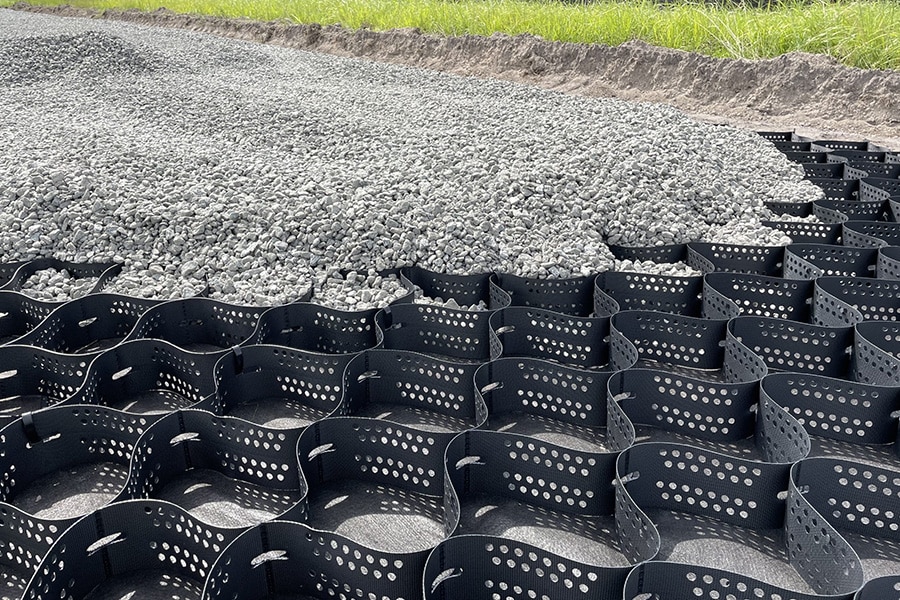
A logistics company in Ohio was spending $8,000 annually on regrading and replacing gravel that had migrated, rutted, and turned their parking lot into a maintenance nightmare. Three years after installing a gravel grid system, they haven’t touched it once. The total savings paid for the original installation cost in just 18 months.
If you’ve ever dealt with loose gravel that shifts, ruts, or turns into a muddy mess after every rainstorm, you already understand the problem. This guide explains exactly how gravel grid systems work, which applications benefit most, and how to determine whether this solution fits your project.
What Is a Gravel Grid System?
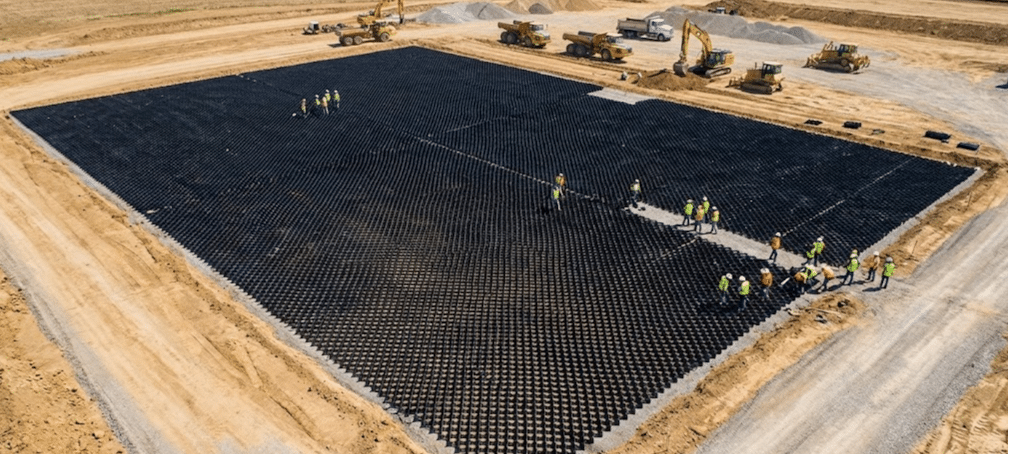
A gravel grid—also called a geocell system—is an interconnected honeycomb structure made from high-density polyethylene (HDPE) that confines gravel within individual cells. Think of it as creating thousands of tiny containers across your surface area, each one holding stones firmly in place.
According to BaseCore’s technical specifications, their geocell panels feature cell heights ranging from 2 inches up to 8 inches, with custom depths available for specialized applications. The HDPE material meets ASTM D5199 standards for sheet thickness and ASTM D6392 for seam peel strength, ensuring the welded honeycomb structure withstands heavy loads without separation.
The fundamental difference between a gravel grid and loose gravel is confinement. When you drive across loose stone, your tires push gravel outward and downward. The stones migrate toward edges, create ruts at turning points, and gradually sink into soft subgrade beneath. A gravel grid physically prevents this movement because each stone is locked within cell walls that resist lateral displacement.
BaseCore panels ship collapsed flat on pallets, then expand on-site to cover large areas quickly. Standard panel sizes include 10×12 feet, 10×20 feet, and 9×18 feet, though custom dimensions can be manufactured to minimize waste on specific projects.
How Gravel Grids Actually Work: The Engineering Behind the Performance
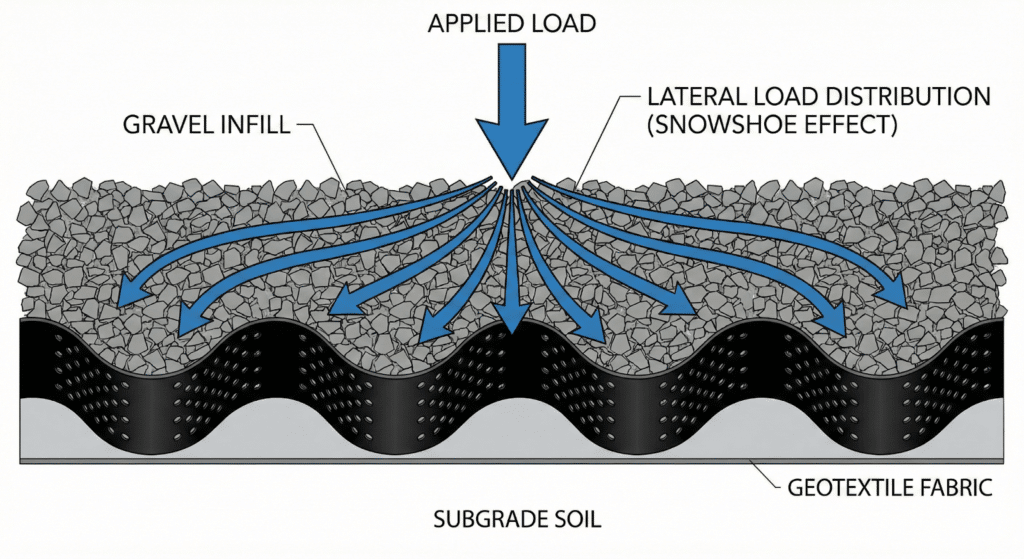
Understanding why gravel grids perform so much better than loose stone requires looking at three engineering principles that work together.
Load Distribution: The Snowshoe Effect
Traditional loose gravel concentrates all vehicle weight at small contact points beneath each tire. This focused pressure pushes stones down into softer soil underneath, creating depressions that become ruts.
BaseCore’s interconnected cellular structure transforms this dynamic completely. The grid spreads each tire’s weight across multiple square feet of subgrade rather than concentrating it at single points. Engineers call this the “snowshoe effect”—the same weight distributed so broadly that it doesn’t sink. According to BaseCore documentation, this load distribution allows gravel grid systems to support heavy equipment and loaded semi-trucks when properly specified with appropriate cell depths.
Physical Confinement: Stones Stay Where You Put Them
Each cell in the BaseCore grid has walls that hold stones in place. Gravel literally cannot migrate because it’s locked into individual compartments. The stones that started in a particular cell stay in that cell, maintaining uniform coverage indefinitely.
This confinement also prevents the “quicksand effect” that occurs when rounded stones shift under traffic. BaseCore recommends using angular crushed stone (#57 aggregate is typical) with 15-20% fines rather than rounded pea gravel, because angular materials interlock within cells for additional stability.
Maintained Permeability: Drainage That Actually Works
Here’s an often-overlooked irony: gravel should drain perfectly, yet traditional gravel lots often have terrible drainage. As vehicles drive over loose gravel, they compact it. Compacted gravel loses permeability. Poor grading creates low spots where water pools, softening the subgrade beneath and accelerating rutting.
BaseCore systems maintain 90-percent-plus permeability even under heavy traffic because the grid structure prevents compaction of the stone infill. Water passes through the surface layer, through the aggregate base, and into subgrade exactly as designed. This permeable nature often eliminates the need for detention basins or complex stormwater infrastructure that impervious surfaces like asphalt require—a significant cost savings we’ll discuss later.
Real Results: How a Distribution Center Eliminated Constant Maintenance

An Arizona distribution center provides a clear example of gravel grid economics in action. The facility spent $12,000 annually maintaining their traditional gravel yard where trucks staged and parked. Every quarter, they brought in equipment to regrade and add fresh gravel to replace what had migrated or been pushed into the subgrade.
Management initially hesitated at the BaseCore investment: $68,000 for 40,000 square feet including site preparation and heavy-duty specifications for loaded semi-trucks. Breaking down that cost, materials ran approximately $24,000, site prep and base course cost $28,000, and installation labor came to $16,000 (about 40 cents per square foot due to the large project scale and experienced installer).
The installation timeline worked around their operations. The contractor completed the project in sections over two weeks, keeping portions of the yard operational throughout. The actual BaseCore installation progressed at about 12,000 square feet per day with an experienced crew of five.
Five years post-installation, they haven’t regraded once. The lot looks nearly identical to installation day despite constant heavy truck traffic. At their previous annual maintenance rate of $12,000, the system paid for itself in less than six years—and they also eliminated the operational disruptions that happened every time maintenance crews needed to close portions of the yard.
When to Use a Gravel Grid System: Application Guide
Gravel grids solve specific problems for specific applications. Understanding where they excel helps determine whether this solution fits your project.
Commercial and Retail Parking
Office buildings, retail centers, and professional facilities need parking that looks presentable year after year. Design considerations include ADA-compliant accessible spaces, defined parking lines that create order and maximize capacity, and integration with surrounding landscaping.
BaseCore’s standard geocell system creates professional appearances while delivering long-term durability. Visitors often can’t distinguish between a well-designed gravel grid installation and traditional paving—until they notice superior drainage and complete absence of cracks.
Warehouse and Distribution Centers
Distribution facilities endure constant punishment from heavy trucks making tight turns, backing into loading docks, and parking for extended periods under load. Priorities shift toward heavy load capacity that prevents rutting, durability in high-stress zones, and wide drive aisles accommodating large vehicle turning radiuses.
Heavy-duty BaseCore configurations using 6-inch or 8-inch cell depths are engineered specifically for these demanding applications. The cellular structure distributes weight across broader areas than even thick asphalt, preventing the point-loading failures that plague traditional surfaces in truck-heavy environments.
Event Venues and Overflow Parking
Churches, sports complexes, fairgrounds, and entertainment venues face a different challenge: lots that sit mostly empty but must handle hundreds of vehicles during events without becoming muddy disasters.
A Georgia church installed BaseCore’s grass-reinforced system for their 15,000-square-foot overflow lot. The installation took five days total, with BaseCore panel installation completed in a single day by a local contractor working with the system for the first time. After their biggest event—Trunk or Treat with 500-plus vehicles—they had zero ruts and the grass remained healthy. Drainage proved so effective that the lot became fully usable within hours of heavy rain.
DIY Residential Projects
For property owners with smaller areas under 5,000 square feet and basic construction experience, DIY installation is achievable. You’ll need excavation and grading capability, compaction equipment (a plate compactor or roller can be rented), standard hand tools, and 2-4 workers depending on project size. BaseCore provides detailed installation guides with every order.
Practical Installation Overview
Installation follows a logical sequence that experienced site work contractors master quickly. The process differs meaningfully from paving but uses equipment most contractors already own.
Step 1: Site Preparation
Clear and level the site of vegetation and debris. Compact the subgrade to required density based on soil conditions and expected loads.
Step 2: Geotextile Fabric Placement
Install 6-12 ounce non-woven geotextile fabric over prepared subgrade. This separation layer prevents aggregate base from migrating into soil below while allowing water to drain freely.
Step 3: Aggregate Base Installation
Place and compact aggregate base layer. Depth varies by application—consult with your BaseCore representative for specific recommendations based on soil conditions and expected traffic.
Step 4: Edge Restraint Installation
Install edge treatments before or concurrent with geocell panels. Options include concrete curbs for high-traffic commercial areas, corten steel edging from BaseCore for durable industrial aesthetics, pressure-treated wood for budget-conscious or rustic applications, or flush excavation that blends seamlessly with surrounding surfaces.
Step 5: Panel Expansion and Connection
Expand BaseCore panels to full dimensions based on cell aperture specifications. Connect adjacent panels along width and length at joints. Stake panels using rebar or wooden stakes at regular intervals to maintain positioning during infill.
Step 6: Infill Placement
Fill cells with specified aggregate using a loader or conveyor. Keep bucket close to cells and limit drop height to no more than 2 feet to prevent panel displacement. Typical overfill is 2-3 inches above cell tops.
Step 7: Final Compaction
Compact using a vibratory roller (3-ton minimum, 9-ton typical for commercial applications) to seat infill material and achieve final surface grade.
An experienced crew of four can install approximately 10,000 square feet per day on prepared, graded surfaces, making BaseCore one of the fastest-installing ground stabilization systems available. Installation labor typically runs $0.50 to $1.00 per square foot depending on site complexity and regional rates.
Cost Comparison: Gravel Grid vs. Traditional Alternatives
Understanding total installed cost—not just material prices—reveals why gravel grids often provide better value than initially apparent.
Traditional loose gravel costs less initially but requires constant maintenance: regrading multiple times yearly, replenishing migrated material, repairing edges. Calculate these costs over five years and they frequently exceed what you’d spend on proper stabilization from the start.
Asphalt paving typically runs $5-7 per square foot installed, plus potential detention basin costs for stormwater management. Expect seal coating every few years with major resurfacing after 15-20 years.
Concrete paving costs $8-12 per square foot or more, representing the highest initial investment. Like asphalt, concrete triggers stormwater management requirements that gravel grids often avoid.
BaseCore geocell systems deliver complete installation at competitive rates while frequently eliminating detention basins entirely—savings that can represent thousands to tens of thousands of dollars on larger projects. The facility manager in Ohio discovered that the permeable geocell system eliminated an $18,000 detention basin his civil engineer had included in the asphalt plan, nearly paying for the entire geocell system with that single savings.
Getting Started with Your Project
Your first step is gathering basic information: approximate square footage, intended use, vehicle types expected, and any specific concerns about drainage or soil conditions. Site photos or video walkthroughs help project managers understand your unique situation.
BaseCore offers phone support and responds to quote requests typically within one business day with recommendations tailored to your specific application. Visit basecore.co to request a detailed quote, or call 888-511-1553 to speak directly with a project manager.
Most standard BaseCore products ship quickly from stock, though larger or special orders (custom sizes, non-black colors like beige or green) may require up to 6 weeks. Materials ship on pallets or full trucks via commercial freight.
BaseCore provides installation guides and technical data sheets with every order. They can also connect you with experienced contractors in many regions, quote installation directly on some projects, or provide technical support if you’re working with your own contractor.
FAQ: Common Questions About Gravel Grid Systems
What’s the difference between a gravel grid and a geocell?
They’re the same product with different terminology. “Geocell” is the technical/engineering term, while “gravel grid” describes the common application. BaseCore geocells function as gravel grids when filled with crushed stone.
How deep should my gravel grid be for parking lots?
Cell depth depends on expected loads. Light traffic (passenger vehicles) typically uses 3-4 inch cells. Standard commercial parking uses 4-6 inch depths. Heavy truck traffic requires 6-8 inch specifications. BaseCore project managers provide specific recommendations based on your application.
Can I install a gravel grid myself?
DIY installation is achievable for projects under 5,000 square feet if you have basic construction experience and access to compaction equipment. Larger projects or heavy-duty applications benefit from professional installation.
Do gravel grids work in cold climates?
Yes. BaseCore HDPE material operates in temperature ranges from -50°C to 80°C according to technical specifications. The permeable surface also allows freeze-thaw cycles without the cracking issues that damage asphalt and concrete.
What warranty covers BaseCore gravel grids?
BaseCore provides a 10-year warranty on product and seam strength. Contact the project management team for complete warranty details specific to your application.
Conclusion
The Ohio logistics company that opened this article represents thousands of property owners, contractors, and facility managers who’ve discovered that proper gravel stabilization eliminates the maintenance treadmill of traditional loose stone surfaces.
Whether you’re planning a new parking area, replacing failed gravel, or looking for cost-effective alternatives to asphalt, gravel grid systems offer proven solutions. The technology isn’t new—it’s simply becoming more accessible as terminology like “gravel grid” helps DIYers and property managers find what engineers have called “geocells” for decades.
Your next step is simple: visit basecore.co/quick-basecore-quote/ or call 888-511-1553 to discuss your specific project with a BaseCore representative. They’ll help you determine the right specifications, provide accurate quantity calculations, and connect you with installation resources.