
Pads That Don't Fail When the
Frac Fleet Shows Up
Stabilized well pads and completions yards engineered for rig
moves, frac operations, and the heaviest equipment in the oilfield.


Frac fleet traffic

Rig moves

Coiled tubing

Flowback operations

Workover rigs

What BESS Project Teams Are Saying
The Rig Pad Problem: Why Conventional Surfaces Fail
Drilling and completions put more stress on pad surfaces than any other oilfield application.

Frac fleets concentrate extreme loads.
Pump trucks, blenders, sand storage, hydration units—frac spreads put hundreds of thousands of pounds on pad surfaces. Conventional aggregate can't handle it. Neither can most alternatives.

Rig moves stress transition areas.
Moving a drilling rig onto and off a pad concentrates loads at entry points and travel paths. These high-stress zones fail first on conventional pads.

Completions traffic is relentless.
Frac operations mean constant heavy truck traffic—water, sand, chemicals, equipment. For days or weeks, the pad takes continuous punishment.

Wet weather doesn't wait for your schedule.
Rain during completions turns conventional pads into problems. Soft spots develop. Equipment gets stuck. Operations stop. Schedules slip.

Pad failures cascade into rig delays.
When the pad surface fails, everything stops. Rig moves get delayed. Completions schedules slip. Production gets deferred. The cost compounds fast.

Multi-well pads need surfaces that last.
A pad designed for 4, 8, or 12 wells needs to perform through multiple drilling and completions cycles—not just the first one.
Where BaseCore Fits on Transmission Projects
BaseCore HD geocells confine aggregate in a three-dimensional structure that handles the heaviest oilfield loads. The aggregate can't migrate. Wheel paths don't rut. Pad surfaces stay intact through drilling, completions, and beyond.
The engineering principle: Cellular confinement distributes point loads across a wider subgrade area. A 6-8" BaseCore HD section handles loads that would destroy conventional aggregate surfaces.
- Drilling pad surfaces — Work areas that support rig operations, pipe handling, and ancillary equipment
- Completions yards — Staging areas for frac fleets, pump trucks, sand storage, and support equipment
- Rig move routes — Travel paths for moving drilling rigs onto and off locations
- Flowback and testing areas — Surfaces for flowback equipment, tanks, and separation
- Coiled tubing and workover pads — Support for intervention operations
- Multi-well pad surfaces — Pads designed for multiple drilling and completions cycles
- Frac spread staging — Areas for pump trucks, blenders, hydration units
- Sand storage areas — Surfaces under sand boxes and conveying equipment
- Water storage and transfer — Pad areas for frac tanks and water handling
- Wireline and perforating — Work surfaces for completions services
- Equipment laydown — Staging for BOP, wellhead, and completion equipment
Engineering for Extreme Loads
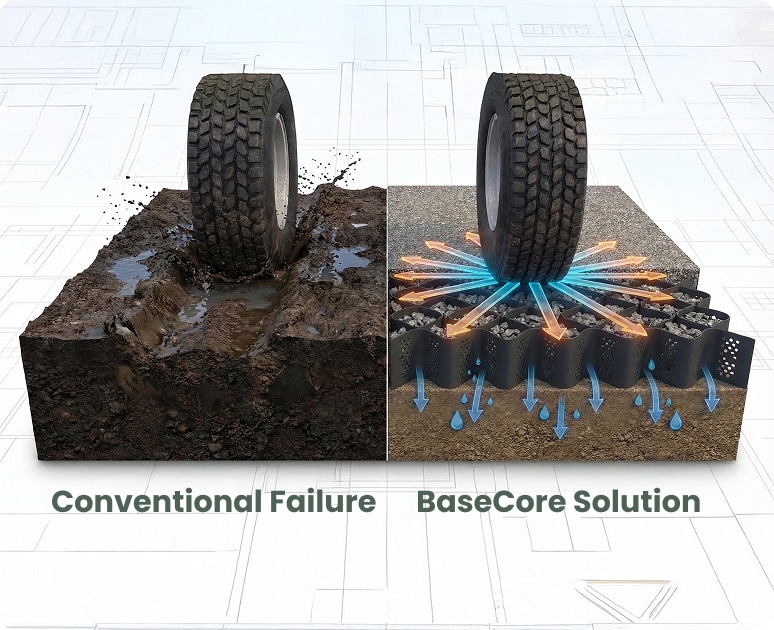
Load Distribution
Frac operations put concentrated loads on pad surfaces that exceed what conventional aggregate can handle. BaseCore HD's cellular confinement distributes these loads across a wider subgrade area—reducing point loading and preventing the surface failures that shut down operations.
6-8" cell depths handle the heaviest completions traffic: frac pumps, sand kings, blenders, loaded water trucks.
4-6" cell depths work for lighter support areas: personnel parking, light equipment staging, perimeter roads.
Subgrade Bridging
Well pads often encounter variable soil conditions. One soft spot under a frac pump becomes a failure point. BaseCore's geocell structure bridges localized weak areas rather than transmitting loads directly to subgrade—reducing sensitivity to the variability that causes conventional pad failures.
Wet Weather Performance
Rain during completions doesn't have to mean shutdowns. BaseCore's permeable surface drains rather than ponding. The confined aggregate stays stable even when wet. Operations continue while conventional pads turn to mud.
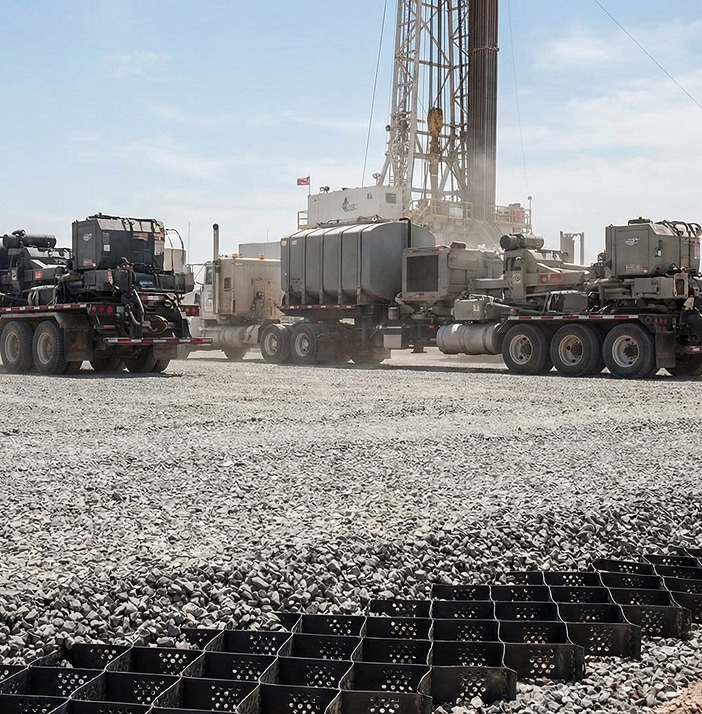


Before and After
Before:
- Pads that fail during frac ops
- Rig moves delayed waiting for pad repairs
- Rebuilding surfaces between wells on the same pad
- Completions schedules slipping due to surface conditions
- Soft spots that frac equipment finds and destroys
After:
- Frac fleet traffic without surface failures — Pump trucks, blenders, sand storage—pad holds up
- Rig moves on schedule — Surface performs from spud to plug
- Multi-well pads that last — Drill, complete, move, repeat—same pad surface
- Completions on schedule — Weather doesn't shut down operations
- Consistent performance across the pad — No more hunting for soft spots
Rig Mat Alternative?
BaseCore isn't a temporary mat—it's a permanent stabilized surface.
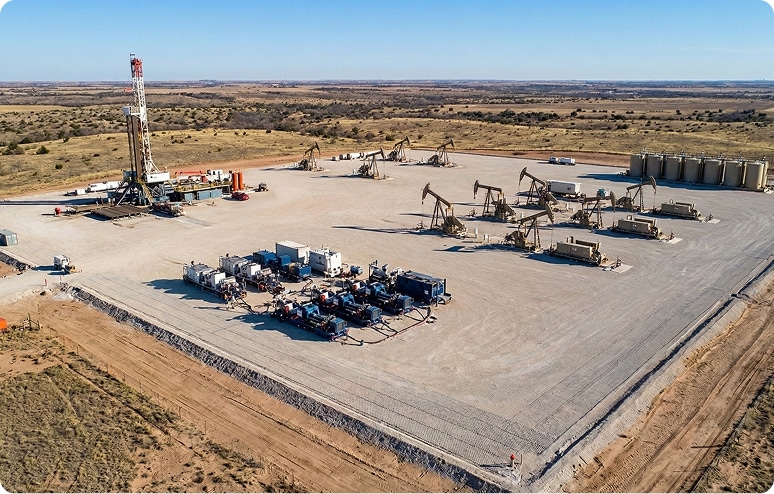
When BaseCore makes more sense than mats:
- Multi-well pads where you'll drill and complete multiple times
- Pads that convert to long-term production infrastructure
- Locations where mat rental and logistics cost more than permanent stabilization
- Sites where you don't want to manage mat inventory, transport, and laydown
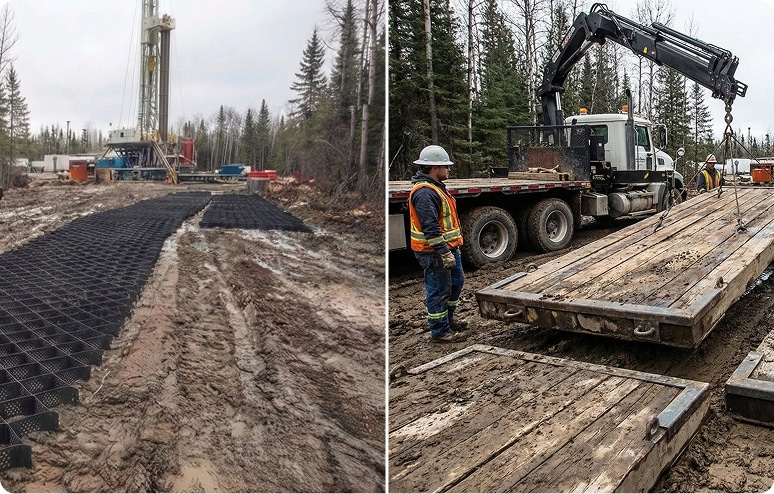
When mats may still make sense:
- True single-well, single-use access
- Locations where full restoration is required and nothing can remain
- Very short-term needs where permanent infrastructure isn't justified
For most multi-well development programs, BaseCore's install-once approach beats the
recurring cost and logistics of mat systems.
Products for Rig Pads & Completions
BaseCore HD
Best for: Frac staging, rig pads, completions yards, any area with extreme loads
- Smaller cell aperture (180mm x 218mm) for maximum confinement
- Double-welded seams for integrity under heavy, repeated loads
- Virgin HDPE—consistent material properties, no recycled content
- 6-8" cell depths for completions applications
BaseCore Geocell
Best for: Perimeter roads, light staging areas, slopes, drainage
- Larger cell aperture (287mm x 320mm)
- General reinforcement applications
- 3-4" cell depths for lighter traffic
Quick Selector
| Application | Typical Loads | Subgrade Risk | Recommended Product | Cell Depth |
|---|---|---|---|---|
| Frac spread staging | Extreme | High | BaseCore HD | 6-8" |
| Drilling pad surface | Heavy | Moderate-high | BaseCore HD | 6" |
| Rig move routes | Heavy, concentrated | High | BaseCore HD | 6-8" |
| Flowback/testing areas | Moderate-heavy | Moderate | BaseCore HD | 4-6" |
| Coiled tubing/workover | Heavy | Moderate | BaseCore HD | 6" |
| Support/parking areas | Light-moderate | Low-moderate | BaseCore HD or BC | 4" |
Get a Section + ROM for
Your Rig Pad
Tell us about your project. We'll send back a recommended section, quantities, and budgetary pricing within 1-2 business days.

Budgetary only. Final design confirmed by your Engineer of Record. We typically respond within 1-2 business days.
Or Reach Us Directly Call: 888-511-1553
Frequently Asked Questions
Yes. BaseCore HD with 6-8" cell depths handles the heaviest completions traffic—frac pumps, blenders, sand kings, loaded water trucks. The cellular confinement distributes loads and prevents the surface failures that shut down operations.
 888-511-1553