
Surfaces That Don’t Fail When
the Equipment Arrives
Engineered ground stabilization for energy sites, access roads, crane paths, and equipment yards—designed for heavy loads, wet cycles, and accelerated project schedules.

BESS yards

Wind farm access

Crane paths

Substations

Transmission ROW

What Energy Teams Are Saying
The Engineering Problem: Why
Conventional Surfaces Fail on Energy Sites
You already know the failure modes. The question is whether there's a
solution that actually works.

Delivery and equipment loads exceed design assumptions.
Battery containers, turbine components, transformers, and cranes apply loads that conventional aggregate sections weren’t designed to handle.

Subgrade conditions vary across sites.
One weak area becomes a failure point that traffic finds, exploits, and expands.

Wet cycles create shutdowns.
Access roads and laydown yards become impassable, delaying deliveries and idling crews.

Maintenance becomes a recurring cost.
Regrading, stone replacement, and temporary fixes add up over the life of the project.

Energy sites require long-term access.
Roads and yards built for construction often fail during operations and maintenance.

Environmental and permitting constraints limit options.
Stormwater management, disturbed area limits, and site footprints affect what you can build.


For Land & Environmental Teams
BaseCore addresses common land and environmental constraints:
- Reduced disturbed area footprint — Thinner sections mean less excavation and smaller site impact
- Permeable surface — Reduces stormwater infrastructure requirements
- Less aggregate import — Fewer truck trips, lower emissions, easier permitting conversations
- Phased or permanent installation — Install only what’s needed, expand as the site grows
- Consistent with site restoration plans — Compatible with long-term environmental strategies
Where BaseCore Fits in Energy Applications
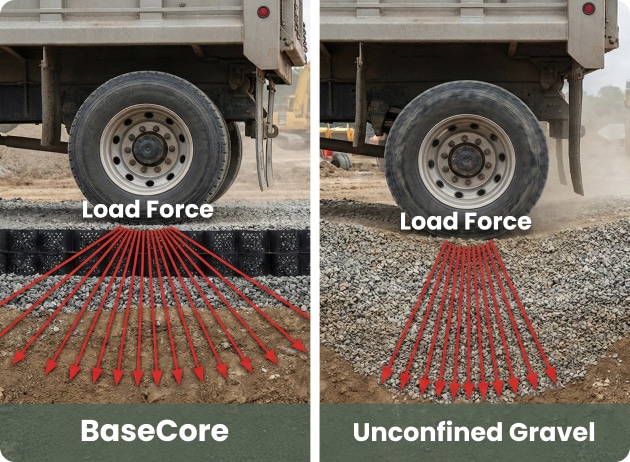
BaseCore geocells confine aggregate within a three-dimensional honeycomb structure—creating load-distributing, permeable surfaces that handle heavy traffic without the failure modes of conventional aggregate sections.
The engineering principle:
Lateral confinement prevents aggregate migration under load. Vertical loads are distributed across a wider subgrade area.
Result: Higher effective bearing capacity from the same aggregate section.
Battery Energy Storage Systems (BESS)
Container delivery routes, inverter yards, equipment pads, and maintenance access
Wind Energy Projects
Access roads for oversize components, crane pads rated for heavy lifts, long-term O&M routes
Solar Energy Facilities
Construction access, panel delivery routes, inverter pads, permanent circulation paths
Transmission & Distribution ROW
Stable, well-drained aggregate yards for maintenance and equipment replacement
Substations & Switchyards
Stable, well-drained aggregate yards for maintenance and equipment replacement
Engineering Considerations
Load Distribution
BaseCore’s cellular confinement increases the effective structural number of the aggregate layer. A BaseCore HD section with crushed stone infill provides load distribution equivalent to 2-3 times thicker conventional aggregate sections.
Practical implication: Required bearing capacity can often be achieved with less imported aggregate—reducing cost and environmental footprint.
Subgrade Independence
The geocell structure bridges localized soft spots rather than transmitting point loads directly to subgrade. This reduces sensitivity to variable soil conditions.


Permeability
Water drains through the aggregate surface rather than ponding or sheeting. This maintains trafficability during and after precipitation events while reducing erosion and sediment transport.
Before and After
Before
- Access roads that fail during heavy deliveries
- Repeated regrading of laydown yards
- Crane paths that rut or settle
- Soft spots that equipment finds and destroys
- Maintenance costs that grow over time
After
- Heavy equipment traffic without surface failure
- Laydown yards that don’t require regrading
- Crane paths that hold up during lifts
- Consistent performance across variable subgrades
- Maintenance budgets that stay intact
Why Procurement Teams Spec BaseCore

Reduced aggregate volume
Lower material cost, especially on remote or constrained sites

Near-zero maintenance
Predictable lifecycle cost

Faster install
10,000+ SF/day supports aggressive schedules

One product across applications
Simplifies procurement and specification

75+ year product life
Aligns with energy asset lifespan
Products for Energy Applications
BaseCore HD
Best for: Well pad access, frac fleet routes, facility yards, any application with heavy repeated loads
- Smaller cell aperture (180mm × 218mm)
- Double-welded seams for heavy loads
- Virgin HDPE—no recycled content variability
- 4–8" cell depths available
BaseCore Geocell
Best for: Lighter lease roads, pipeline ROW, slopes, erosion control, drainage channels
- Larger cell aperture (287mm x 320mm)
- General reinforcement applications
- 2-6" cell depths available
Quick Selector
| Application | Typical Loads | Subgrade Risk | Recommended Product | Cell Depth |
|---|---|---|---|---|
| BESS container access | Heavy equipment | High | BaseCore HD | 4–8" |
| Wind crane paths | Crane & lift loads | High | BaseCore HD | 4–8" |
| Substation yards | Equipment traffic | Moderate | BaseCore HD | 3–6" |
| Solar access roads | Construction vehicles | Moderate | BaseCore HD or BC | 3–6" |
| Transmission ROW access | Construction equipment | Variable | BaseCore HD | 3–6" |
Get a Section + ROM for Your Project
Tell us about your project. We'll send back a recommended section, quantities, and budgetary pricing within 1-2 business days.

Budgetary only. Final design confirmed by your Engineer of Record. We typically respond within 1-2 business days.
Reach Us Directly: 888-511-1553
Frequently Asked Questions
Yes. BaseCore HD with 3–8" cell depths supports loads required for cranes, transformers, and heavy energy equipment.