

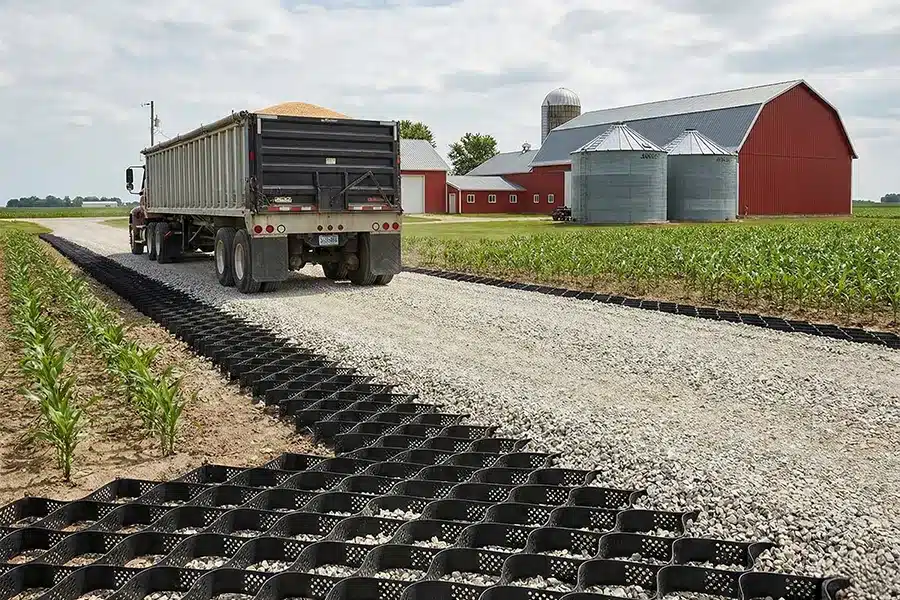
Your Farm Driveway Isn’t a Residential Driveway
If your farm driveway looks fine in July and turns into a disaster every spring, you don’t have a gravel problem. You have a stabilization problem.
Most advice about gravel driveways assumes residential conditions: a few passenger cars, maybe a delivery van, and relatively short distances. Farm driveways operate in a completely different universe. Yours probably handles pickup trucks, feed delivery semis, loaded grain haulers at 80,000 pounds, combines being trailered at 60,000-plus pounds, tanker trucks for fuel or milk, and the occasional concrete mixer or excavator. It runs 500 feet, or 1,000 feet, or a quarter mile from the county road to your buildings. It crosses low spots that hold water. It has a section that’s been soft since your grandfather farmed this place.

Standard residential driveway solutions fail on farms because they’re not designed for these loads, these distances, or these conditions. This guide covers farm driveway stabilization specifically — what works, what doesn’t, why your gravel keeps disappearing, and how to fix it permanently so you can stop fighting the same battle every year.
Why Farm Driveways Fail: The Three Forces Destroying Your Surface
Understanding why your driveway fails helps you understand why some fixes work and others waste your money. Three forces are working against you simultaneously, and any lasting solution has to address all three.

Force 1: Lateral Displacement (Your Gravel Is Walking Away)
When a tire presses down on loose gravel, the stones don’t just compress — they push sideways. Every loaded truck that rolls down your driveway shoves gravel outward from the tire tracks toward the edges. Over hundreds of passes, your wheel paths get lower (creating ruts) and your driveway edges get higher (creating berms of migrated stone).
This is why regrading works temporarily: you’re just pushing the displaced gravel back to where it started. But without anything to hold it there, the next truck shoves it sideways again. You’re in a loop.
The heavier the vehicle, the worse this gets. A pickup truck displaces some gravel. A loaded grain semi displaces a lot. A year of combined traffic displaces enough stone to fill several dump trucks — and you’re the one buying replacement gravel and paying for the blade work to redistribute it.
Force 2: Subgrade Intrusion (Your Gravel Is Sinking)
Below your gravel sits your subgrade — the native soil. On most farms, that’s clay, silt, loam, or some combination that turns soft when wet. When heavy loads compress gravel against a wet subgrade, the gravel punches down into the soil and the soil squeezes up between the stones. Road builders call this “pumping.”
The result: your 6-inch gravel layer slowly becomes a 3-inch gravel layer contaminated with mud. The contaminated gravel loses its load-bearing strength, your surface gets softer, and the ruts get deeper. You add more gravel, and it sinks into the subgrade too. As one experienced road builder described the problem, adding gravel to mud just creates more mud.
This is why simply adding more stone often doesn’t fix a failing farm driveway. Without a separation layer between the gravel and the subgrade, you’re feeding expensive aggregate into the ground.
Force 3: Water (The Amplifier)
Water doesn’t cause driveway failure by itself, but it amplifies everything else. Wet subgrade soil is weaker, so loads cause more displacement. Standing water in ruts softens the surface further, creating deeper ruts in subsequent passes. Freeze-thaw cycles in cold climates heave and crack gravel surfaces, breaking whatever compaction you achieved.
Kevin Abbey, director of the Penn State Center for Dirt and Gravel Road Studies, has identified drainage as the single most important factor in unpaved road performance. A well-drained gravel surface can handle surprisingly heavy loads. The same surface with poor drainage falls apart under a pickup truck.
On farm driveways, water problems are common because many driveways traverse low-lying areas between fields, cross natural drainage paths, or have flat grades that allow water to sit rather than shed.
What Doesn’t Work (And Why You’ve Probably Already Tried It)
If you’ve owned a farm for more than a few years, you’ve likely tried some or all of these approaches. Understanding why they fail on farm driveways helps explain why a different approach is necessary.
Adding More Gravel
The most common response to a failing driveway: call the quarry, get another load of gravel, spread it, and hope for the best. This works for a few weeks or months. Then the gravel migrates sideways, sinks into the subgrade, and you’re back to where you started — minus the cost of the stone and the labor to spread it.
Some farms report spending $2,000 to $5,000 per year on replacement gravel for driveways and access roads. Over a decade, that’s $20,000 to $50,000 spent on material that’s now mixed into your subgrade.
Regrading With a Box Blade or Tractor
Every farm owner with a tractor and a blade has dragged their driveway. It temporarily redistributes the stone and smooths the surface. But regrading doesn’t add material, doesn’t address the subgrade, and doesn’t prevent the gravel from displacing again. Most farm driveways need regrading 2 to 4 times per year. Each session burns fuel, consumes hours of your time, and wears your tractor and blade.
The fundamental problem: regrading treats the symptom (uneven surface) without addressing the cause (unconfined aggregate on a weak subgrade).
Calcium Chloride and Dust Suppressants
These products bind surface fines together, reducing dust and providing some surface hardening. They work reasonably well for dust control. They do almost nothing for the structural problems that cause ruts, gravel migration, and mud under heavy farm loads. They also require reapplication several times per season and may raise environmental concerns near waterways or livestock areas.
Asphalt or Concrete
The “nuclear option” for a failed farm driveway. While hard surfaces handle heavy loads, they come with major drawbacks on farms. Asphalt costs $4 to $8 per square foot installed. For a 12-foot-wide by 1,000-foot driveway (12,000 square feet), that’s $48,000 to $96,000. Concrete is even more — $6 to $12 per square foot, or $72,000 to $144,000 for the same driveway.
Beyond cost, hard surfaces crack under the settlement and heaving common in rural soils, require impervious surface stormwater management in many jurisdictions, can’t handle the concentrated point loads that tracked equipment like combines and large tractors impose, and need professional repair when they fail — you can’t fix a pothole in concrete with your tractor.
Most farm operations simply can’t justify these costs for a driveway, especially when the money competes with equipment, seed, and operating expenses.
What Actually Works: Geocell Farm Driveway Stabilization
Farm driveway stabilization with geocells addresses all three failure forces simultaneously — and that’s why it works where other approaches don’t.
How Geocell Stabilization Solves Each Problem
Lateral displacement: The cell walls physically prevent gravel from moving sideways. When a tire pushes down, the aggregate within each cell can compress vertically but can’t migrate laterally. The gravel stays where you put it. No rut formation. No berm buildup along the edges. No regrading.
Subgrade intrusion: A geotextile fabric layer installed beneath the geocell system creates a permanent separation barrier between your gravel and the native soil. The gravel can’t punch down into the subgrade. The subgrade can’t pump up into the gravel. Your aggregate layer maintains its full designed thickness for the life of the system.
Water management: The geocell system is fully permeable. Water infiltrates through the gravel surface, passes through the perforated cell walls and geotextile, and drains into the subgrade rather than pooling on the surface. No standing water in ruts (because there are no ruts). No saturated surface layer softening under traffic. The surface drains as fast as the subgrade allows — and remains trafficable within hours of heavy rain rather than days.
The Four-Layer System for Farm Driveways

A properly stabilized farm driveway is built in layers, each serving a specific structural function:
Layer 1 — Prepared subgrade. The native soil is graded to establish a slight crown (2% minimum slope from center to edges) for surface drainage. Low spots are filled and compacted. Organic material (topsoil, roots, vegetation) is removed. The subgrade is compacted to at least 95% Modified Proctor density using a vibratory roller.
Layer 2 — Geotextile separation fabric. A non-woven geotextile fabric (BaseCore recommends 6 to 12 oz weight depending on subgrade conditions) is laid over the compacted subgrade with 12-inch minimum overlaps at seams. This fabric prevents subgrade soil from migrating up into the aggregate and distributes loads more broadly across the subgrade surface.
Layer 3 — Geocell filled with crushed stone. BaseCore geocell panels are expanded over the geotextile, connected together, temporarily staked, and filled with #57 crushed stone with 15–20% fines. The angular stone interlocks within each cell, creating a rigid composite structure. This is the primary load-bearing layer.
Layer 4 — Aggregate overfill and compaction. An additional 2 to 3 inches of crushed stone is placed above the cell tops and the entire surface is compacted with a vibratory roller (minimum 3 tons for standard applications, 4–8 tons for heavy-duty). This creates a smooth, crowned driving surface and embeds the cell walls below the traffic surface, protecting them from tire contact and UV exposure.
Choosing the Right Specification for Your Farm Driveway
The most important decision in farm driveway stabilization is matching the geocell specification to your heaviest regular vehicle. Underspecifying saves money upfront but leads to premature failure. Overspecifying costs more than necessary.

Geocell Depth by Vehicle Load
BaseCore publishes a weight specification chart (available at basecore.co) that matches geocell depth to gross vehicle weight. Here’s how that translates to common farm vehicles:
| Your Heaviest Regular Vehicle | Typical Weight | Recommended BaseCore HD Depth | Recommended BaseCore Standard Depth |
| Pickup trucks, ATVs, farm UTVs | 3,000–8,000 lbs | 2″ or 3″ | 3″ or 4″ |
| Loaded pickup, horse trailer, small delivery truck | 8,000–16,000 lbs | 3″ or 4″ | 4″ |
| Feed truck, propane delivery, empty grain truck | 16,000–30,000 lbs | 4″ | 4″ or 6″ |
| Loaded grain semi, fuel tanker, loaded cattle trailer | 30,000–80,000 lbs | 4″ or 6″ | 6″ or 8″ |
| Combine on transport, heavy equipment, crane | 60,000–132,000 lbs | 6″ or 8″ | 8″ |
Sources: BaseCore Weight Specifications chart and GeoCell Selection Guide (BSC-1). BaseCore HD depths are typically one size shallower than standard due to tighter cell confinement (8.5″ x 7″ cells vs. 12.6″ x 11.3″).
The common mistake: Farm owners often specify for their daily-driver pickup truck and forget that their driveway also handles loaded semis during harvest, a concrete truck when they pour a new pad, or a lowboy trailer moving a combine. Always specify for your heaviest regular vehicle — not your most frequent one.
BaseCore Standard vs. BaseCore HD for Farm Driveways
BaseCore manufactures two product lines, and understanding the difference helps you choose wisely:
BaseCore standard has 12.6″ x 11.3″ cells — the same dimensions found in most geocell products on the market. It provides solid performance across a wide range of applications and represents the more economical option per square foot.
BaseCore HD has smaller cells at 8.5″ x 7″ — approximately 40% less area per cell. This tighter geometry confines aggregate more aggressively, which means better load distribution per cell. Practically, this allows you to use a shallower HD cell to match the performance of a deeper standard cell. A 4-inch BaseCore HD can often replace a 6-inch standard cell for the same application.
BaseCore HD also features double-welded seams (for redundancy at the highest-stress points), thicker cell walls (65–75 mil after texturing versus 60 mil for standard), seam peel strength of 88 lbf/in minimum per ASTM D6392, and environmental stress crack resistance of 7,000 hours per ASTM D1693.
For most farm driveways that handle loaded semis and heavy equipment, BaseCore HD in 4-inch depth represents the best balance of performance, material cost, and installation efficiency. The shallower depth means less excavation and less fill material compared to a 6-inch standard cell, which often offsets the per-panel price difference.
Infill Material: What to Put in the Cells
BaseCore recommends #57 crushed stone with 15–20% fines for load-bearing farm driveway applications. Here’s why this specific material matters:
Angular stone interlocks. Crushed, angular aggregate pieces wedge against each other within the cell, creating a rigid mass that resists compression. Rounded stone (like pea gravel or river rock) rolls under load instead of interlocking. This is critically important — using rounded gravel in geocells significantly reduces load capacity and can cause the “quicksand effect” that several geocell manufacturers warn about on their product pages.
The 15–20% fines component fills voids. Stone dust and small particles fill gaps between larger stones, creating a dense matrix that compacts firmly and sheds water from the surface. Without sufficient fines, the surface feels loose under foot and tire.
The #57 size (3/4″ to 1″ nominal) is optimal. Larger stone is difficult to compact within cells and creates an uncomfortable driving surface. Smaller stone may compact too tightly and restrict drainage.
Other infill options for specific situations: #4 or #57 angular rock for areas with flowing water (channels, drainage swales). Topsoil for grass-reinforced driveways where appearance matters more than heavy-load capacity. Concrete for extreme-duty applications like loading ramps.
Geotextile Fabric Weight
The separation fabric beneath the geocell system prevents subgrade contamination. BaseCore recommends:
- 6 oz non-woven for most farm driveway applications with stable subgrade.
- 8 oz non-woven for driveways on clay-heavy soils that are prone to pumping.
- 12 oz non-woven or BaseGrid high-strength woven for driveways on very poor subgrade (peat, organics, or saturated silts) or under the heaviest loads (semi-trailers, heavy equipment).
Your BaseCore project manager will recommend the appropriate weight based on your subgrade conditions.
Planning Your Farm Driveway Project
Step 1: Measure and Map
Start with the basics. You need total square footage, which is width times length. Most farm driveways are 12 to 16 feet wide (a single loaded semi-trailer is about 8.5 feet wide, so 12 feet is minimum for one-way traffic with margin; 20 to 24 feet for two-way traffic).
For a typical single-lane farm driveway at 12 feet wide:
| Driveway Length | Square Footage |
| 200 feet (short approach) | 2,400 sq ft |
| 500 feet (typical) | 6,000 sq ft |
| 1,000 feet (quarter mile) | 12,000 sq ft |
| 2,000 feet (half mile) | 24,000 sq ft |
Add 5–10% for cuts and waste. Google Maps satellite view with the measurement tool works well for estimating length if you can’t easily walk and measure.
Map any problem spots: low areas where water collects, locations where the subgrade is perpetually soft, steep grades where gravel washes during rain, and intersections where vehicles turn and scuff the surface. These areas may need additional specification attention (deeper cells, heavier geotextile, or supplementary drainage).
Step 2: Address Drainage First
No stabilization system overcomes catastrophic drainage failure. Before installing geocells, address any active drainage problems:
Culverts. If your driveway crosses a natural drainage path, install properly sized culverts. A plugged or undersized culvert will pond water against your driveway, saturating the subgrade and undermining the system from below.
Ditching. Side ditches along your driveway collect surface runoff and direct it away from the travel surface. On flat terrain, even a shallow ditch (6–12 inches) dramatically improves subgrade conditions.
Crown. Your finished driveway surface should be crowned — higher in the center than at the edges — so water sheds to the sides rather than pooling in the wheel paths. A 2% crown (about 1.5 inches of height difference across a 12-foot-wide driveway) is sufficient.
Grade breaks. On long driveways, install periodic grade breaks (shallow angled berms across the driveway, sometimes called water bars) to prevent water from building velocity and volume as it flows down the driveway length. This is especially important on driveways with sustained grades.
The good news: the geocell system itself is a significant drainage improvement over unstabilized gravel, because the permeable surface eliminates the ruts where water traditionally collects. Many farms find that addressing the major drainage items (culverts, ditching) combined with the geocell system’s inherent permeability resolves drainage issues that seemed intractable before.
Step 3: Plan Your Installation Timing
The best time to stabilize a farm driveway is when three conditions align: the ground is dry enough to compact the subgrade properly, farm activity is low enough that you can take the driveway offline for several days, and weather is stable enough for outdoor construction.
For most operations, this means late summer (after second cutting, before harvest), early fall (after harvest in warmer climates), or late spring (after ground has dried from thaw, before planting ramps up).
Avoid installation during spring thaw (subgrade is too saturated to compact), peak harvest (you need every hour of driveway access), and extended rain periods (subgrade preparation requires dry conditions).
Step 4: Talk to BaseCore
Once you have your square footage, your heaviest vehicle, a few photos of the current conditions, and a general timeline, you have everything needed for a productive conversation with a BaseCore project manager.
The consultation is free and typically takes 15 to 20 minutes. Your project manager will confirm the right product (standard vs. HD), recommend cell depth, specify geotextile weight, suggest infill material, and help you understand the material quantities and cost framework for your project.
Visit basecore.co/quick-basecore-quote/ to start the conversation, or call 888-511-1553. You can also email site photos to begin asynchronously.
What Installation Looks Like on a Farm Driveway

Can You Do It Yourself?
Many farm operations install BaseCore themselves using equipment they already own. The minimum equipment list is a tractor with a loader or skid steer (for site prep, aggregate placement, and filling cells), a box blade or grading attachment (for subgrade preparation and final grading), and a vibratory roller (for compaction; can be rented for 1–2 days at $200–$400/day from most equipment rental companies).
If you have these tools and are comfortable with basic grading work, you can install a geocell driveway. BaseCore provides detailed installation guides, and your project manager can walk you through the process by phone if questions come up.
For operations that prefer professional installation, BaseCore can connect you with experienced installers in your region. Labor costs for professional installation typically run $0.50 to $1.00 per square foot.
Installation Steps
Day 1–2: Site preparation. Strip existing surface material if necessary. Grade subgrade to design profile (2% crown). Compact subgrade with vibratory roller to 95% Modified Proctor density. If subgrade is soft, your project manager may recommend allowing it to dry before proceeding or adding a thicker aggregate base course.
Day 2–3: Fabric and panel installation. Roll out geotextile fabric with 12-inch overlaps. Expand BaseCore panels from their collapsed shipping form. Connect panels to each other. Temporarily stake panels with provided stakes to hold position during filling. An experienced crew can install approximately 10,000 square feet of panels per day.
Day 3–4: Fill and compact. Fill cells with #57 crushed stone using a loader, skid steer, or excavator. Drop material close to cells (no more than 2 feet above) to avoid damaging cell walls. Overfill 2–3 inches above cell tops. Compact with vibratory roller (minimum 3-ton for standard, 4–8-ton for heavy-duty applications). Remove temporary stakes after filling.
Day 4 (or same day): Drive on it. No curing time. The surface is ready for full-load traffic immediately after compaction. This is a major advantage over concrete (7-day minimum cure) and asphalt (24–48-hour cooling period).
Timeline Summary
| Driveway Size | Typical Installation Time |
| 2,500 sq ft (200 ft x 12 ft) | 2–3 days |
| 6,000 sq ft (500 ft x 12 ft) | 3–4 days |
| 12,000 sq ft (1,000 ft x 12 ft) | 4–6 days |
| 24,000 sq ft (2,000 ft x 12 ft) | 7–10 days |
For very long driveways (1,000+ feet), installations can be sequenced — stabilize in sections while maintaining traffic flow on unstabilized portions.
Long-Term Maintenance: What to Expect After Installation
One of the most significant benefits of geocell farm driveway stabilization is the near-elimination of ongoing maintenance. Here’s what your maintenance schedule looks like:
Year 1: Inspect after the first heavy rain and first freeze-thaw cycle. Check for any settling (unusual, but possible in localized soft spots). Add a thin layer of top stone if settling created a low spot. This is rarely needed.
Years 2–20+: Periodically (annually or as needed) add a thin top-dressing of crushed stone to replace the small amount of surface material that wears away from tire contact. This is typically 1/2 inch or less across the surface — a fraction of the gravel you’d add annually to an unstabilized driveway.
What you stop doing: Regrading (never again). Buying truckloads of replacement gravel (occasional light top-dressing only). Dragging the driveway after every rain. Avoiding your driveway during wet weather. Apologizing to truck drivers about your road conditions.
Edge Restraint Options for Farm Driveways
The edges of your stabilized driveway need containment to prevent the outermost cells from spreading under load. Four options work well on farms:
Flush excavation — the simplest approach. Excavate the driveway footprint so the geocell sits below the surrounding grade. The native soil along the edges acts as a natural restraint. Lowest cost, cleanest appearance, and works well where the driveway borders fields or lawn. This is the most common choice for farm driveways.
Pressure-treated wood — 4×6 or 6×6 timbers set along the driveway edges. Cost-effective, easy to install, and provides positive containment. Expected life is 15–20 years with treated lumber.
Concrete curbs — poured or precast. Most durable option. Appropriate for the driveway entrance or areas near buildings where you want a more finished appearance.
Corten steel edging — available from BaseCore. Develops a weathered patina over time and provides decades of maintenance-free edge containment. Attractive option for visible portions of the driveway near the farmstead.
Your Next Step
If you’ve been dealing with a farm driveway that fails every spring, eats gravel every year, and forces trucks to crawl through ruts during your busiest weeks, this is the fix.
The investment pays for itself by eliminating annual regrading, replacement gravel purchases, and the productivity losses that come with an unreliable surface. Most farm driveway stabilization projects see payback within 2 to 4 years, after which the savings accumulate year over year for the 20-plus-year service life of the system.
Start with a conversation. Bring your driveway length, your heaviest truck, and a few photos. BaseCore’s project managers have helped hundreds of farm operations build driveways that handle everything from daily pickups to harvest-season semi traffic without flinching.
Request a free consultation and quote:basecore.co/quick-basecore-quote/
Call: 888-511-1553
Or email site photos to start the conversation on your schedule.
Your driveway is the first and last road every vehicle uses on your operation. It’s time it worked as hard as you do.
Frequently Asked Questions
How long does a geocell-stabilized farm driveway last?
BaseCore geocell systems are designed for 20-plus years of service life. The HDPE material is UV stabilized and embedded below the surface, protected from direct sunlight and mechanical damage. Both BaseCore standard and HD carry 10-year product and seam strength warranties.
Will geocell work on a driveway with a steep grade?
Yes. BaseCore geocells perform well on sloped driveways because the cell walls prevent aggregate from washing downhill. For grades steeper than 10%, your project manager may recommend deeper cells and anchor stakes for additional security. The BaseCore Selection Guide provides specific recommendations by slope steepness.
Can I install geocell over my existing gravel driveway?
In some cases, yes. If your existing gravel layer is clean (not heavily contaminated with mud from the subgrade) and the subgrade beneath it is stable, you may be able to install geocell directly on top of the existing surface with a geotextile layer. More commonly, removing existing contaminated gravel and starting with a clean subgrade produces better long-term results. Your project manager can advise based on your conditions.
What happens in winter — does the geocell system handle freeze-thaw?
BaseCore HDPE is rated for extreme temperatures and maintains flexibility well below zero. The permeable surface actually reduces freeze-thaw damage compared to impervious surfaces because water drains through rather than sitting on the surface and forming ice lenses. Snow removal with a plow blade works normally — just set the blade to ride 1 inch above the surface to avoid scraping the cell tops.
How wide should a farm driveway be?
For single-lane traffic: 12 feet minimum (accommodates a standard semi-trailer at 8.5 feet wide with margin). For two-way traffic or areas where trucks pass: 20 to 24 feet. For turnout areas on long single-lane driveways: widen to 20 feet at intervals of 500 to 1,000 feet to allow vehicles to pass.
Helpful Resources
- Request a farm driveway consultation: basecore.co/quick-basecore-quote/
- BaseCore HD specifications: basecore.co/basecore-geocell-hd/
- BaseCore standard specifications: basecore.co/basecore-geocell/
- Geocell selection guide: basecore.co/geocell-selection-guide/
- Road construction applications: basecore.co/geocell-for-road-construction/
- Phone support: 888-511-1553
This article references publicly available data from the Penn State Center for Dirt and Gravel Road Studies (unpaved road drainage principles), the USDA Agricultural Marketing Service (agricultural transportation statistics), and BaseCore product specifications including the GeoCell Selection Guide (BSC-1), Weight Specifications chart, and published technical data including ASTM D5199, D6392, D1505, and D1693 testing standards. Cost estimates for driveway materials and maintenance are based on industry ranges and may vary by region, material availability, and site conditions. This guide provides general educational information about farm driveway stabilization. For project-specific recommendations and engineering guidance, consult a BaseCore project manager or qualified engineer.