
Build the Lease Road Once.
Access the Well for 30 Years.
Stabilized lease roads that handle water haulers, service traffic, and decades of production operations—without the regrading cycle.
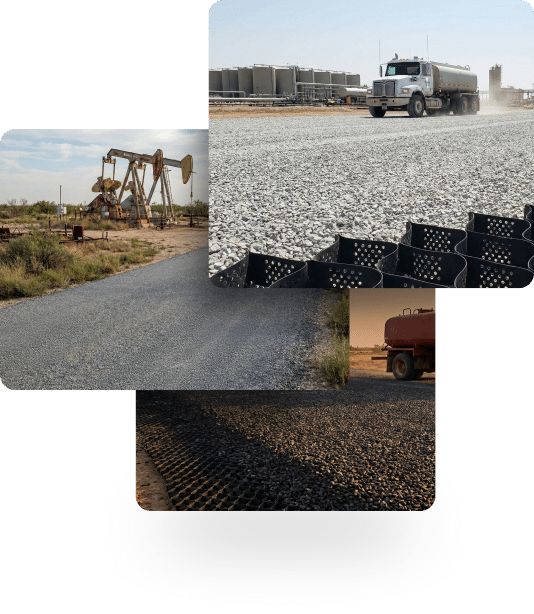

Water hauler traffic

Service vehicle access

20-30 year asset life

Remote locations

What Production Teams Are Saying
The Lease Road Problem: Why They Fail
Roads built for drilling rarely survive production.

Water haulers destroy conventional roads.
Loaded water trucks running the same route daily concentrate axle loads in wheel paths. Conventional aggregate migrates, ruts form, soft spots develop. Within months, the road needs work.

Production lasts 20-30 years. Roads don't.
A well producing for decades needs access for that entire period. But lease roads built with conventional aggregate rarely last more than a few years without major maintenance or rebuild.

Remote locations make every repair expensive.
Grader mobilization to a remote lease costs real money. Aggregate delivered 50 miles from the nearest pit costs more per ton. Maintenance that's routine closer to town becomes a budget problem in the field.

Regrading is a recurring cost with no end.
Every year, the same roads need the same work. The cost compounds over the asset life. A $10K annual maintenance line item becomes $200-300K over 20-30 years—often more than the original road cost.

Landowner relations suffer when roads fail.
Rutted roads, mud tracked onto county roads, dust complaints—surface owners notice. Failed lease roads make renewals harder and relationships worse.


Lease Road Applications

Primary lease road access
Main route from county road to well site, built for the life of the asset

Multi-well lease roads
Shared access serving multiple wells on the same lease

Water hauler routes
Roads that handle daily loaded truck traffic without rutting

Service vehicle access
All-weather routes for pumpers, technicians, and maintenance crews

Saltwater disposal routes
Access to SWD facilities handling constant truck traffic

Remote/challenging terrain
Roads across soft soils, wet areas, or variable subgrade conditions
Where BaseCore Fits on Transmission Projects
BaseCore addresses common landowner and surface owner concerns:

- Narrower road prism — Thinner section means less excavation, smaller disturbed footprint
- Less aggregate import — Fewer truck trips during construction, less surface disturbance
- No regrading equipment — Graders and maintenance crews don't return year after year
- Permeable surface — Water infiltrates rather than sheeting; reduced erosion and runoff
- Clean, stable surface — No mud, no ruts, no aggregate tracked onto county roads
When lease roads perform, landowner relationships improve. Renewals get easier. Complaints drop.
The Math: Lease Road Lifecycle Cost

Conventional aggregate lease road:
- Initial build: $X
- Annual maintenance: $10-15K (regrading, aggregate replenishment)
- Major rebuild: Every 5-7 years
- 25-year total cost: Often 3-5x initial build cost

BaseCore lease road:
- Initial build: Higher than conventional
- Annual maintenance: Near zero
- Major rebuild: None expected (75+ year product life)
- 25-year total cost: Typically 40-60% lower than conventional lifecycle cost
Breakeven: Often 18-24 months on remote locations where maintenance mobilization is expensive.
Actual costs vary by location, aggregate availability, and traffic intensity. Request a ROM for your specific project.
Before
- Lease roads that need regrading every season
- Water hauler wheel paths turning into trenches
- Soft spots that show up after every rain
- Annual maintenance budget that never goes away
- Landowner complaints about road conditions
After
- Roads that handle water haulers for decades — Daily loaded truck traffic, no rutting
- No seasonal maintenance cycle — Build it right, don't touch it again
- Consistent performance across variable subgrades — Soft spots don't become failure points
- Maintenance budget that goes to zero — Redirect dollars to production, not road repair
- Landowner relationships that improve — Clean roads, no recurring disturbance
Products for Lease Roads
BaseCore HD
Best for: Primary lease roads, water hauler routes, any road with heavy repeated traffic
- Smaller cell aperture (180mm x 218mm) for maximum confinement
- Double-welded seams for long-term seam integrity
- Virgin HDPE—consistent material properties over 75+ year life
- 4-6" cell depths for lease road applications
BaseCore Geocell
Best for: Lighter service roads, shoulders, drainage, erosion control
- Larger cell aperture (287mm x 320mm)
- General reinforcement applications
- 3-4" cell depths for lighter traffic
Quick Selector
| Application | Typical Loads | Subgrade Risk | Recommended Product | Cell Depth |
|---|---|---|---|---|
| Primary lease road (water haulers) | Heavy, daily | Variable | BaseCore HD | 4-6" |
| Multi-well shared access | Heavy, frequent | Moderate-high | BaseCore HD | 4-6" |
| Service vehicle routes | Light/medium | Low-moderate | BaseCore HD or BC | 3-4" |
| SWD facility access | Heavy, constant | High | BaseCore HD | 6" |
| Remote/soft subgrade areas | Variable | High | BaseCore HD | 6" |
Get a Section + ROM for
Your Lease Road
Tell us about your project. We'll send back a recommended section, quantities, and budgetary pricing within 1-2 business days.

Budgetary only. Final design confirmed by your Engineer of Record. We typically respond within 1-2 business days.
Or Reach Us Directly Call: 888-511-1553
Frequently Asked Questions
Yes. BaseCore HD with 4-6" cell depths handles loaded water trucks running the same route daily. The cellular confinement prevents the wheel path rutting that destroys conventional lease roads.
 888-511-1553